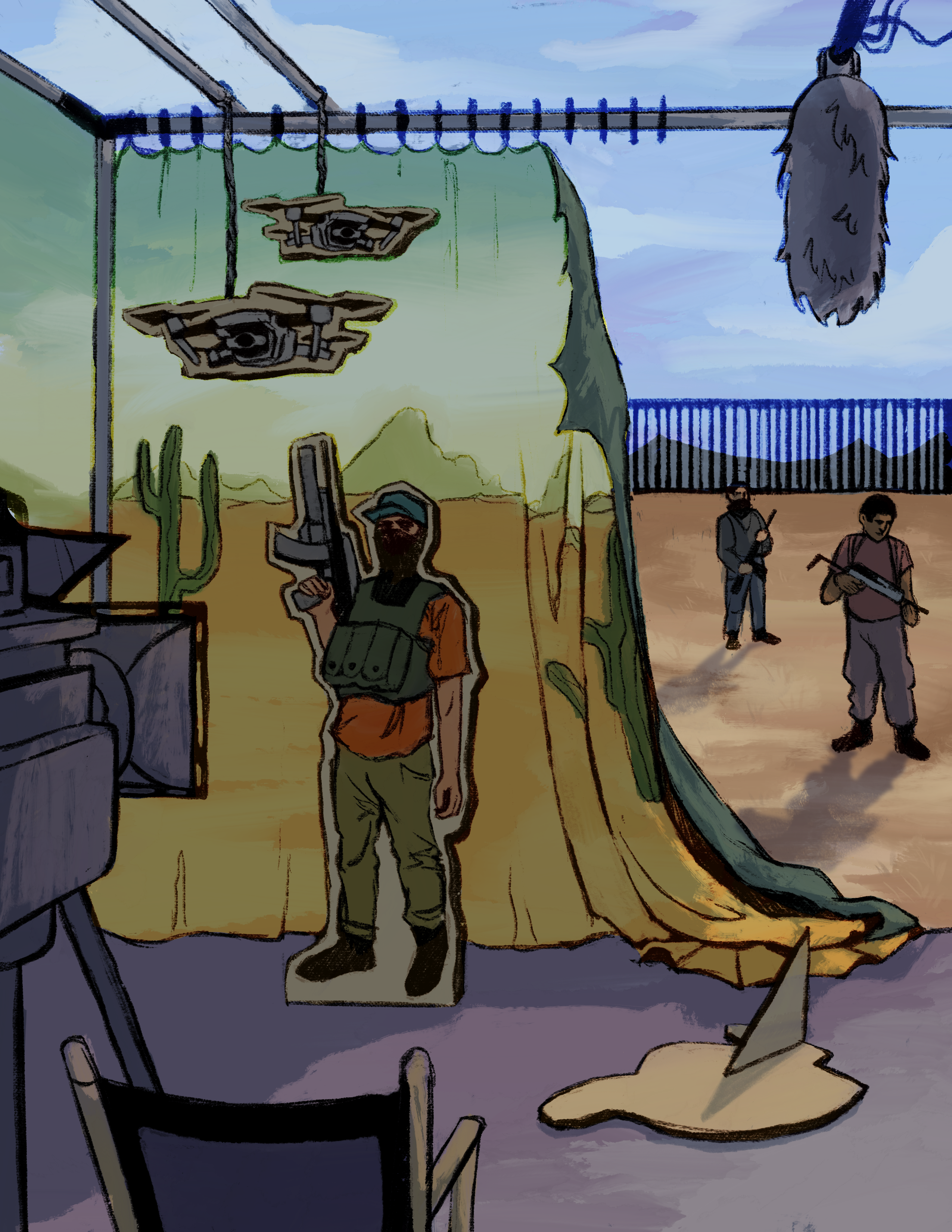
The 2015 film Sicario by French-Canadian director Denis Villeneuve features US strikes and troop deployments to combat Latin American “narco-terrorist” drug cartels across the Southern border. After FBI agents raid a cartel safe house and discover dozens of bodies murdered by the fictional “Sonora Cartel,” the American president designates a number of Mexican criminal cartels as foreign terrorist organizations (FTOs) and authorizes the US military to deploy lethal force against them. US troops enter Mexico, but their plan soon devolves into a vicious gunfight at a border crossing, and security cooperation between Mexico and the US breaks down. Though the US government prevents the events from reaching the press, it nearly becomes an international diplomatic catastrophe.
Although Sicario is fictional, it draws many parallels to President Donald Trump’s current regime change and anti-cartel ambitions. Because of these similarities, Sicario offers a compelling idea of how US intervention in Venezuela, Mexico, or another nation may not go as Trump hopes.
In our current reality, powerful criminal syndicates throughout Central and South America engage in drug trafficking. Drugs sent to the US cause tens of thousands of overdose deaths every year. Drug-trafficking groups like the Sinaloa Cartel and Jalisco New Generation Cartel (CJNG) are so powerful that they operate as a shadow state in many areas of Mexico, committing terrorist attacks and influencing politicians.
In February 2025, President Trump designated eight cartels as FTOs. Since then, he has unilaterally struck 22 alleged drug-smuggling vessels, killing at least 80 people. Claiming that Venezuelan President Nicolás Maduro is the leader of a “narco-terrorist” network, Trump announced a $50 million bounty for his arrest and authorized CIA agents to operate inside Venezuela. Additionally, he has stationed 10,000 American troops and 10 F-35 fighter jets in Puerto Rico, and sent the USS Gerald R. Ford, the most expensive warship ever built, on its way to Venezuela.
Trump and his advisors maintain that the recent US moves against Maduro are purely to curb alleged drug trafficking by the Cartel de los Soles—a criminal terrorist organization embedded, according to Trump, within the Venezuelan military and political brass. However, Trump’s true motive is broadly understood to be regime change in Caracas. When asked by a reporter if he is bent on regime change, Trump said that “Maduro’s days are numbered.”
Maduro is not backing down from confrontation. He has already mobilized the Venezuelan air force and Bolivarian militia, mass conscripting 4.5 million people. In a post-Maduro Venezuela, it would be challenging for the US to ensure stability and prevent a similar politician from filling the power vacuum. Perhaps the pro-American, persecuted opposition leader María Corina Machado would take power, but the mechanisms for installing her in Caracas remain unclear. Both Trump’s alleged mission of stopping drug trafficking and his likely goal of ousting Maduro are more easily said than done. Both Trump and Secretary of State Marco Rubio have also floated the idea of US drone strikes or troop deployments against Mexican cartels and the Revolutionary Armed Forces of Colombia (FARC), a socialist paramilitary group now primarily engaged in drug trafficking, despite Mexico’s objections.
If Mexico’s recent history is any indication, criminal cartels are not easily defeated through force. In 2006, after a series of cartel terror attacks in Michoacán, former President Felipe Calderón declared a war against drug trafficking in Mexico. Since then, almost 200,000 people have been killed across the country. This high cost has done little to curb drug trafficking. In fact, Mexican cartels are more profitable and powerful than ever, soliciting favors from the highest levels of government, boasting military-grade weapons, and bringing in $40 billion annually from their vast illicit trade networks that include fentanyl sourced from China. In a country whose most violent areas are also some of its poorest, decades of neglect and corruption have only made the problem worse—two factors that cannot be rooted out with rifles.
Apart from the fact that an armed intervention in Mexico is unlikely to eradicate drug trafficking, any military action would also bring suffering for the most vulnerable populations. In addition to the combatant lives lost, anti-narcotic operations against the FARC in Colombia, the cartels of Michoacán in Mexico, and President Nayib Bukele’s gang crackdown in El Salvador have all led to the collateral detainment and death of innocent civilians. Villeneuve illustrates this human cost of anti-narcotic operations viscerally on screen in Sicario, where action scenes in war-torn Ciudad Juárez are interspersed with scenes of children playing soccer and families going about their days mere yards from hailstorms of bullets.
While Trump believes that solving the US drug crisis means looking abroad, many state governments across the Union are also working to prevent drug overdose deaths in their jurisdictions, showing that domestic drug reform must also be part of the equation. Trump’s fight against the cartels may beat back some of their influence, but the truth is that Americans will continue to die from drug overdoses regardless of who their dealer is. This is perhaps Sicario’s most important message: A truly effective war on drugs is far more difficult than dropping bombs.