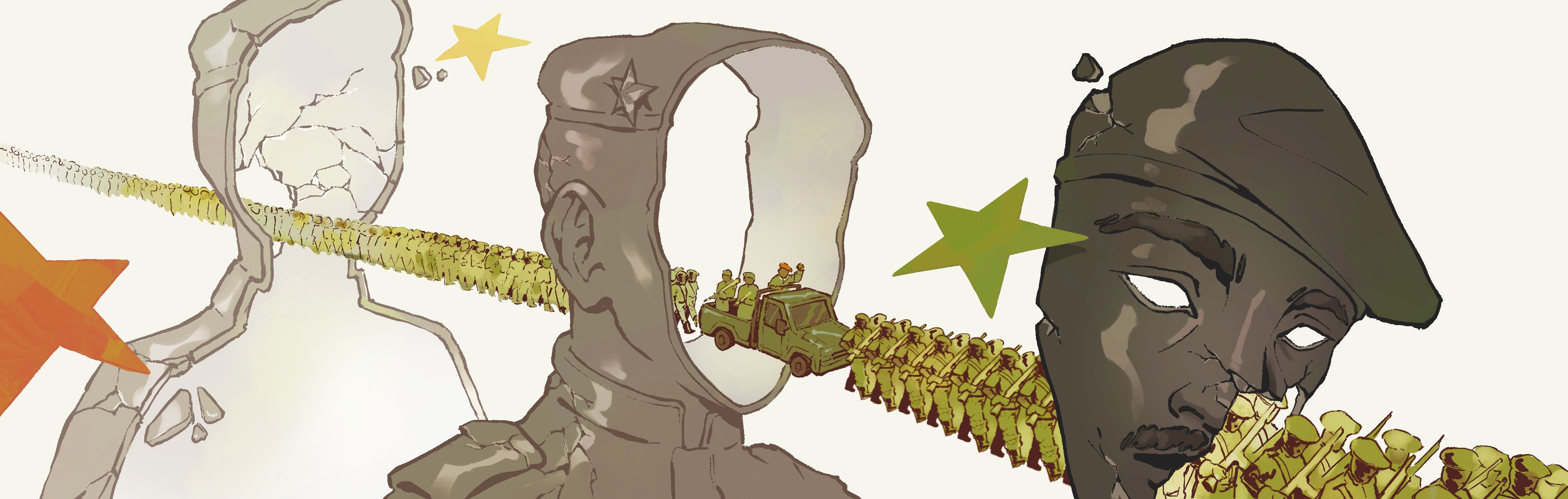
Accra, Ghana. Cheers erupt from the gathered crowd as a man’s name is announced. Clad in a red beret and a camouflage uniform, the national flag stitched onto his sleeve features a yellow star, not Ghana’s emblematic black one. Nevertheless, the spectators who have gathered for Ghanaian President John Mahama’s inauguration embraced this other man as if he was one of their own. This is Ibrahim Traoré, Burkina Faso’s interim president. As his more-than-warm welcome in Ghana would suggest, Traoré has successfully built a platform on the promise of a Pan-Africanist government, promising to free his citizens and African citizens writ large from political and economic exploitation by European powers like France. Despite his populist appeal, Traoré’s actions have been far from democratic — in fact, he is openly authoritarian. His backing by the Pan-African Vanguard thus reflects a contemporary rejection of Western liberal frameworks under a pretense that improvement of material conditions is incongruent with “bettering” ideological ones.
Traoré’s rise to power was undemocratic from the onset. A former army captain, he seized power in 2022 by leading a coup to oust the previous military leader, who had also entered power through a coup nine months earlier. He arrived with a mandate founded on “the restoration of security and integrity” in Burkina Faso, both of which were in flux. His political aims resonated with Burkinabés, who had grown disillusioned with the country’s French-dominated political-economic order. France’s six-year-long military campaign, Operation Barkhane, failed to defeat increasing threats of jihadist insurgencies across the Sahel, and Burkina Faso remained dependent on the CFA franc.
With his mission to “decolonize mentalities,” Traoré is often compared to Thomas Sankara, Burkina Faso’s revolutionary leader and a figurehead of Pan-Africanism. Sankara, who replaced the country’s colonial name of Upper Volta with Burkina Faso (“Land of Upright Man”), championed the same causes of self-reliance and anti-imperialism. Both Traoré and Sankara’s own brother claim the “Progressive and Popular Revolution” as a continuation of Sankara’s ironically-named “Democratic and Popular Revolution.” Sankara’s Pan-Africanist enthusiasm has continued under Traoré, similarly centered on the removal of structures of Western democratic governance. Traoré’s disdain for Western institutions that espouse democratic ideals is rooted in his rejection of Burkina Faso’s imperial past, one from which Sankara also passionately fought to escape. As such, Traoré’s model of governance suggests that authoritarianism can be politically legitimized so long as it is expressed as a reclamation of national sovereignty and economic might.
Traoré argues that democratic governments in Africa, such as Burkina Faso’s previous regime, fail to efficiently deliver policy change — but authoritarian governments can. His unilateral decision-making power allows him to skip the slow legislative processes that democracies require. Traoré describes his new regime as a “People’s Progressive Revolution,” calling democracy an end to rather than a means of development. In other words, to reach the end of “democracy” and enact structural change, the country must first embrace a revolutionary period.
Traoré’s conception of democracy thus aligns with Sankara’s: Democracy is unattainable unless citizens can be protected by the power-yielding groups and individuals who have traditionally held influence over democratic governments. By calling back to the iconic figure of Sankara to characterize democracy as an extension of Western imperialism, Traoré justifies his authoritarian approach and essentializes the need to maintain power as a security and sovereignty measure. Traoré, who once assured Burkinabés that he would incorporate democratic practices into his regime, has since delayed the re-integration of democracy until 2029.
Prior to Traoré, Burkina Faso’s democratic project had largely been a failure. There had been no attempts to transition to democracy until 2014, when Burkina Faso’s second president, Blaise Compaoré, was removed from office with hope of a democratic shift. National elections began in 2015, but by 2020, a failure to quash escalating jihadist insurgencies prevented nearly seven percent of the electorate from voting in national elections. For a nation that so zealously wished to express its political will and see it reflected in its leadership, this level of disenfranchisement pushed Burkinabés back towards military rule, which received an overwhelming level of support before Traoré’s arrival in office. Approval has only increased during his time in power: from 24 percent in 2012 to 66 percent in 2023.
Traoré does not need to disguise his authoritarian agenda. The mass support for his regime and military rule as a whole demonstrate that he has successfully framed authoritarianism as a tool for national unity.
Traoré’s economic policies further embody his belief that the country must consolidate power to achieve sovereignty. In the tradition of Sankarist resource nationalism, which has been followed by countries like Mali and Niger, Traoré has reshaped Burkina Faso’s economy. He has increased the government’s stake in major gold mining operations owned by Western companies to 15 percent. Considering Burkina Faso’s gold export comprises over 70 percent of the country’s export revenue, Traoré’s increasing nationalization of the gold industry provides his government with the ability to counter European unilateral economic decision-making and redistribute revenue to the country’s development at large. Unlike democratic systems, where the nationalization of gold mining operations would require legislative negotiation, Traoré’s government can act efficiently with minimal institutional resistance. The authoritarian governance structure he has embraced has thus allowed Traoré to implement radical economic policies to ensure the country’s sovereignty — even if their material efficacy is yet to be determined.
Still, Burkina Faso is reliant on foreign assistance for its development. Traoré has demonstrated a willingness to let sovereignty take a backseat when forging allyships with non-Western countries. Sometimes, this means partnering with extractionist nations. Traoré’s government has decisively abandoned its longstanding relationship with France for Russia, framing the new alliance as one that breaks from colonial influences and produces economic and military benefits. Traoré described Russia as a “family for Africa,” deeming Russia an ally in the mission for African sovereignty and necessary for knowledge exchange outside of a Western framework. After he removed French troops from the country, Traoré invited Russian troops into Burkina Faso to help its battle against jihadists and gave Russian mining company Nordgold an 85 percent stake in a project which could yield over two tons of gold a year. Russia’s relations with Burkina Faso assist Russian political and economic aims far more than they assist Burkinabé sovereignty, but Traoré has convincingly portrayed them as bilateral to further the perceived success of his crusade against French imperialism.
While Traoré has successfully harnessed nationalist sentiment, his crusade has blinded him to Burkina Faso’s most pressing issue: the jihadist insurgency, which has taken 60 percent of the country out of government control. Traoré alleges that the insurgency is supported by “foreign powers” seeking to keep Burkina Faso under “a state of permanent war.” He claims the attackers are not domestic terrorists, but rather forces funded by France to reduce citizen mobility, portraying Burkina Faso’s most urgent issue as another arm of the imperialism he vows to dismantle. While major think tanks like the International Crisis Group instead attribute the insurgency to a deep-rooted local unrest, Traoré refuses to address the issue through domestic means, instead preferring to continue cutting ties with the elusive alleged foreign backers.
The authoritarianism of Ibrahim Traoré’s regime is not unexpected. Centuries of economic exploitation by democratic Western powers and the failure of domestic democratic institutions have left Burkinabés disillusioned with the promise of democracy. Traoré has cemented himself as a national — and continental — hero with his promise to cut Western ties and better Burkina Faso’s material condition. His openly authoritarian stance has pushed him to the forefront of African politics, where, as his power consolidates, his popularity grows. To his millions of supporters, he is the “liberator of Africa” — even if this “liberation” means cracking down on their personal freedoms. If Traoré is the future of African politics, then autocracy via popular support may be as well.