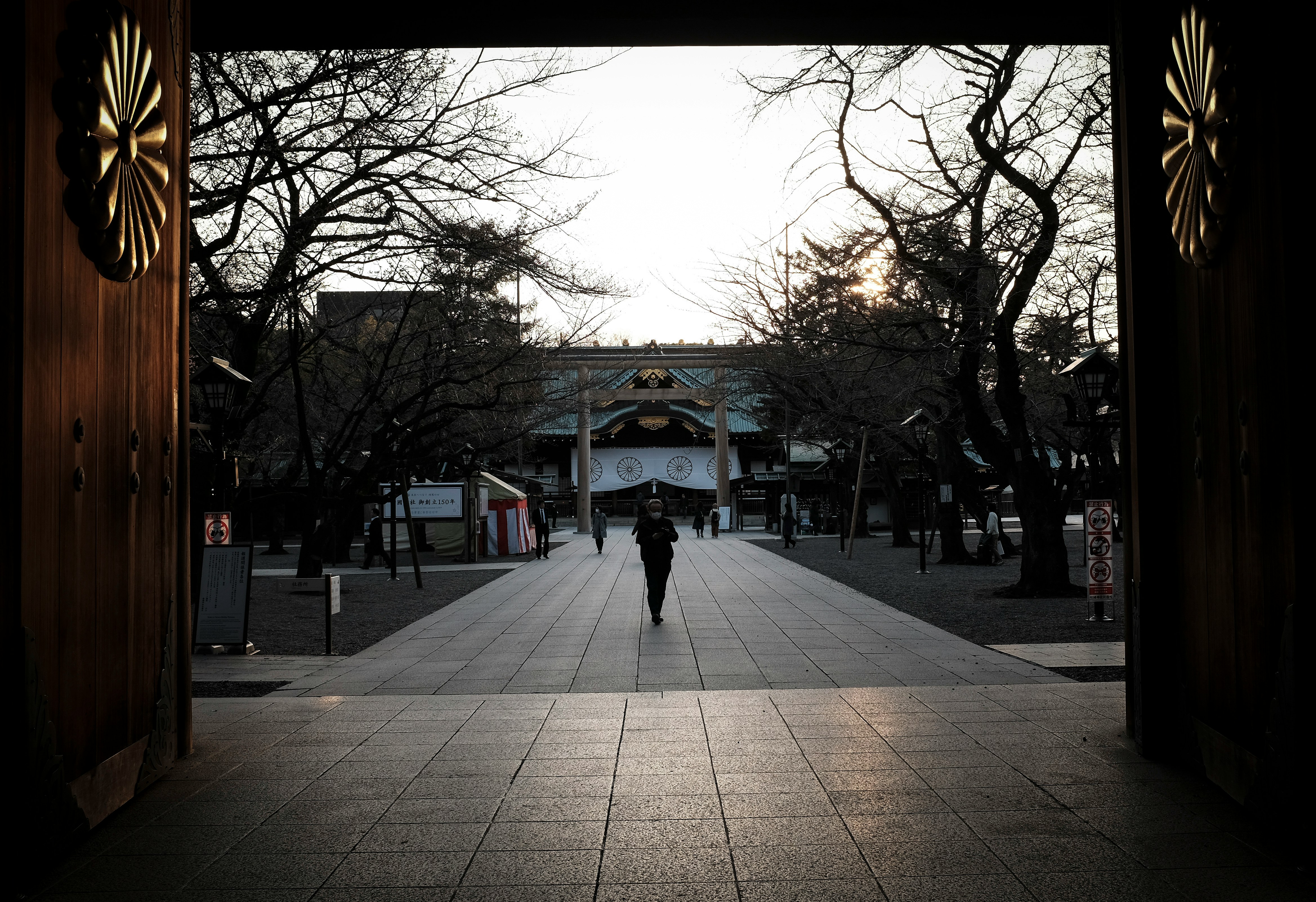
The 1946 Tokyo War Crimes Trials, carried out by the Allied powers during postwar occupation, marked one of the first attempts to reckon with the atrocities committed by the Japanese Army during the Second World War. 28 men, many of whom were architects of the war, were indicted on charges of “Class A” war crimes for directing aggression that led to crimes against humanity. The trials represented an initial but important effort to reconcile a violence-filled past waged across East Asia. However, the legacy of the trials became far more complicated 30 years later, when 14 Class A criminals were enshrined in the Yasukuni shrine—a monument in the heart of Tokyo meant to honor those who gave their lives in service to the Japanese military. Since then, the shrine has been the subject of heated debate and constant controversy. After all, the 14 men were responsible for millions of deaths. The shrine also honors 2.5 million others who gave their lives in service of Japan throughout history, many of whom never saw the battlefield. As such, visits have been justified as an important remembrance for all of those who gave their life for the nation, a remembrance that should not be diluted by the inclusion of a small percentage of war criminals. At first glance, the shrine seems to propose a straightforward moral tension: how should a nation honor sacrifice while acknowledging horrific wrongdoing in its past? But this framing is incomplete. Controversy around Yasukuni persists because it attempts to serve two legitimate but ultimately opposing purposes. As a Shinto landmark, it seeks to nonjudgementally honor the dead and provide the living with a means to fulfill religious obligations; as a political symbol, it appears to affirm a hypernationalist, negationist, and revisionist view of history that at best denies and at worst glorifies past atrocities. As long as the shrine is asked to serve this dual function, any conflict surrounding it will remain irresolvable.
Yasukuni—which translates to “to preserve peace for the entire nation”—is a Shinto shrine, placing it within a religious framework that does not and cannot make moral distinctions between the dead. Shinto is Japan’s indigenous religion, centered around the worship of divine spirits. The shrine was established in 1869 by Emperor Meiji in the wake of a civil war to honor those who died and gave their souls for the Emperor. In Shinto belief, the dead become Kami, a rough equivalent to the word “spirit” or “deity.” Crucially, Shinto followers see death as inherently tragic no matter what, and believe there is no evaluative judgment of the dead or delineation into heaven or hell. On the contrary, it is up to the living, through rituals and worship, to ensure a peaceful transition and a fruitful afterlife for all of the dead and to maintain harmony between the living and spiritual realms. Within this logic, the enshrinement of war criminals in Yasukuni is not necessarily a statement on morality, history, or national memory; it is simply the fulfillment of a religious obligation to the communal war dead, regardless of the actions of specific individuals within that group.
However, Yasukuni does not exist in a vacuum, and the shrine has unquestionably become a critical political symbol, particularly for neighboring countries China and South Korea, the victims of Japan’s harshest wartime atrocities. Following former Prime Minister Shinzo Abe’s 2013 visit to the shrine, the Chinese foreign ministry accused Abe and Japan of trying to “whitewash the history of aggression and colonialism by militarist Japan” and warned that Abe was taking Japan in a “very dangerous direction.” Similarly, the South Korean ministry called the move “anachronistic” and said it “fundamentally undermine[s] … not only [Korea]–Japan relations but also stability…in Northeast Asia [as a whole].” The Chinese and Korean ministries’ accusations of “whitewashing” and anachronism, which tie to warnings of geopolitical tensions, show that both countries view the shrine as a primarily political entity, not a religious one. For the leaders of Japan’s neighboring nations, the religious context of Yasukuni is irrelevant; rather, for a Japanese leader to visit it is for them to endorse and defend the war criminals enshrined and their horrific acts.
Abe seemed to conceptualize his visit differently: “There is criticism based on the misconception that this is an act to worship war criminals, but I visited Yasukuni Shrine to report to the souls of the war dead on the progress made this year.” Abe described his visit in a purely religious context, namely as the fulfillment of his duty to maintain a strong relationship with the Kami honored by the soul. The Japanese public, too, seems to support this notion. According to a 2015 poll, 70 percent of Japanese citizens supported the Prime Minister’s visits to the shrine overall, but only 33 percent supported visits in an official capacity, with the remaining 37 percent limiting their support to visits made in a private, personal capacity, demonstrating a meaningful distinction made by the public between the shrine’s religious function and its political symbolism. Abe’s statement and the overall opinion of the Japanese public seem to reflect emphasis on the religious ideology underpinning the shrine, showing support for its value as a means to pay respect to the dead independent of politics.
Abe’s handling of the shrine was an attempt to manage these two conflicting phenomena, seeking to toe the line between honoring the shrine’s status as a religious landmark and managing the very real-world political implications it carries. His single visit—completed right after a major political comeback following years out of office and in the first year of his term—signaled to his conservative base a strong and patriotic view of Japanese history. Abe was photographed at the shrine, standing directly next to one of the priests who oversees it, creating a strong and lasting symbol of his devotion to Japanese tradition and religion. Nonetheless, the last seven years of his premiership were defined by restraint with Yasukuni. Ministers or cabinet members would occasionally visit in his stead, but Abe himself would avoid the shrine until after he left office. Politically, this allowed for Abe to satisfy two needs at once: signaling a devotion to tradition to his conservative base without drawing the anger of China and Korea year after year. Despite arising as a response to ambiguity from the shrine’s dual functions, approaches like these serve to reinforce them, sending a message that even country leadership struggles to reconcile what Yasukuni is supposed to represent.
The disconnect between internal and external conceptions of Yasukuni is a consequence of its fulfillment of two very legitimate, often opposed, and always intertwined roles: religious institution and political symbol. As a religious landmark, it is nonjudgmental. Visits are not an endorsement of the war criminals enshrined; they are a nonevaluative ritual to respect the dead. As a political symbol, the shrine—and visits to it by leaders—are symbolic affirmations of a hypernationalist, negationist, and revisionist view of history that, at minimum, denies years of atrocities committed by the Japanese military. As long as the shrine serves these dual functions, conflict surrounding it will remain vicious and unresolved.
A sustainable, permanent solution—one that allows for the fulfillment of religious duty and reconciliation with China and Korea—would recognize this duality and create an explicit distinction between Yasukuni as a religious monument and Yasukuni as a marker of history. The shrine could remain as an important religious institution where leaders and private individuals could go to pay their respects to the dead as Kami, while Japan simultaneously invests in secular, historically focused institutions and monuments that grapple with Japan’s role in the war primarily through a lens of accountability. A memorial to the victims of the Nanjing Massacre, for example, would allow for a secular, critical, and honest memorial of Japan’s past, separating in an official capacity the two functions of religious mourning and historical judgment that Yasukuni currently performs simultaneously.