As I settled into life in Rhode Island as a freshman, I began searching for a healthcare provider in the Ocean State—but no matter where I looked, I couldn’t find a primary care provider, let alone any of the several specialists that I see back home in Florida. There were so few of them, and the ones that were practicing had months- or even years-long wait lists. This experience is a new normal for Rhode Islanders: In 2025 alone, almost 30,000 residents have lost access to primary care solely due to practice closures, and there is only one primary care provider per 1,600 people in the state. This shortage in primary care physicians and medical providers writ large threatens to jeopardize the health of hundreds of thousands of patients residing in Rhode Island and has become a hot topic among government officials. Efforts to address this crisis have mostly focused on plans for a new public medical school and the Attorney General cancelling an anti-trust investigation into Brown University Health in exchange for the institution taking on more patients. However, these policies fail to address the root cause of the shortage in Rhode Island: Insurance companies are leveraging their dominance to minimize reimbursements for providers and thus make practicing medicine in the state financially unfeasible.
If doctors decide to practice in Rhode Island, they are effectively subjecting themselves to some of the lowest salaries offered in the nation, which drives providers to seek employment in neighboring states and results in the shortage we see today. Furthermore, Rhode Island’s health insurance market is the second least competitive in the country, which enables large insurers like Blue Cross Blue Shield and United Healthcare to hike insurance premiums as they please. The core force keeping Rhode Islanders from accessing healthcare is not just the physician shortage but rather the corporate greed that has enabled the crisis in the first place. Solutions must therefore focus on democratizing the insurance market to benefit both providers and the patients they treat.
In order to visualize the extent to which Rhode Island’s health insurance landscape is riddled with monopolization and greed, we can look at the Herfindahl-Hirschman Index (HHI), a measurement that quantifies a market’s concentration and competitiveness in a specific region. The higher the HHI value, the less competitive that market is. When comparing HHI data for health insurance companies by state, it is clear that Rhode Island is facing a uniquely anti-competitive health insurance market compared to other New England states and the United States overall. The HHI for health insurance in Rhode Island was almost 7,000, compared to the national average of 4,987; that same year, the market share of the largest insurer of the state was 83 percent.
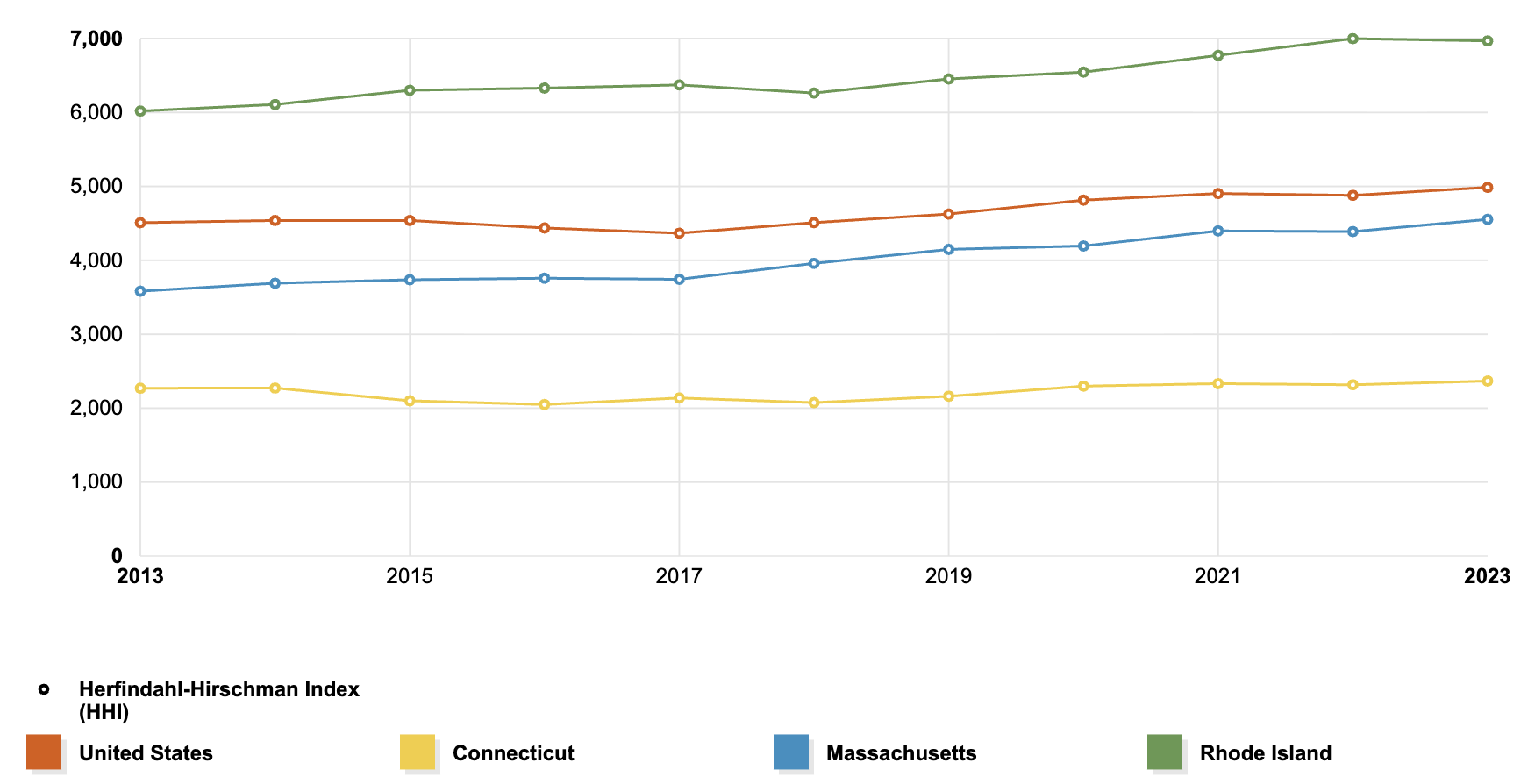
How did health insurance companies establish such supremacy in Rhode Island specifically? The answer lies in the state’s small size and the history of these corporations. Blue Cross Blue Shield (BCBS) established their presence in Rhode Island in 1939, and have gone on to dominate individual and large group (employer) markets for decades. Since the state has such a small population, BCBS can cover a larger proportion of the state without needing to provide more coverage than in other states. In Rhode Island specifically, the insurance market breakdown has consistently demonstrated BCBS dominance in the private insurance sphere: As of March 2021, BCBS held 70 percent of the overall market share, followed by Neighborhood Health (Rhode Island’s Medicaid plan) with 15 percent, and UnitedHealthcare with 10 percent. When companies like BCBS and UnitedHealthcare have such significant leverage in a market, their self-interest goes effectively unchecked, which has consequences for the very providers they depend on.
At the end of the day, the healthcare system in the United States incentivizes insurers to operate as a for-profit corporation, rather than with the interests of patients and physicians as their priority. When any given insurer holds a significant share of a regional market, they can increase their profit margins by decreasing physician reimbursement. Even if physicians try to resist lower pay, if they choose to no longer accept patients from a specific insurance plan, they will lose almost their entire patient population, since only two companies in the state cover almost all residents. Providers are stuck with inadequate compensation that they can do little to increase; insurers hold all the cards; ordinary citizens pay the price.
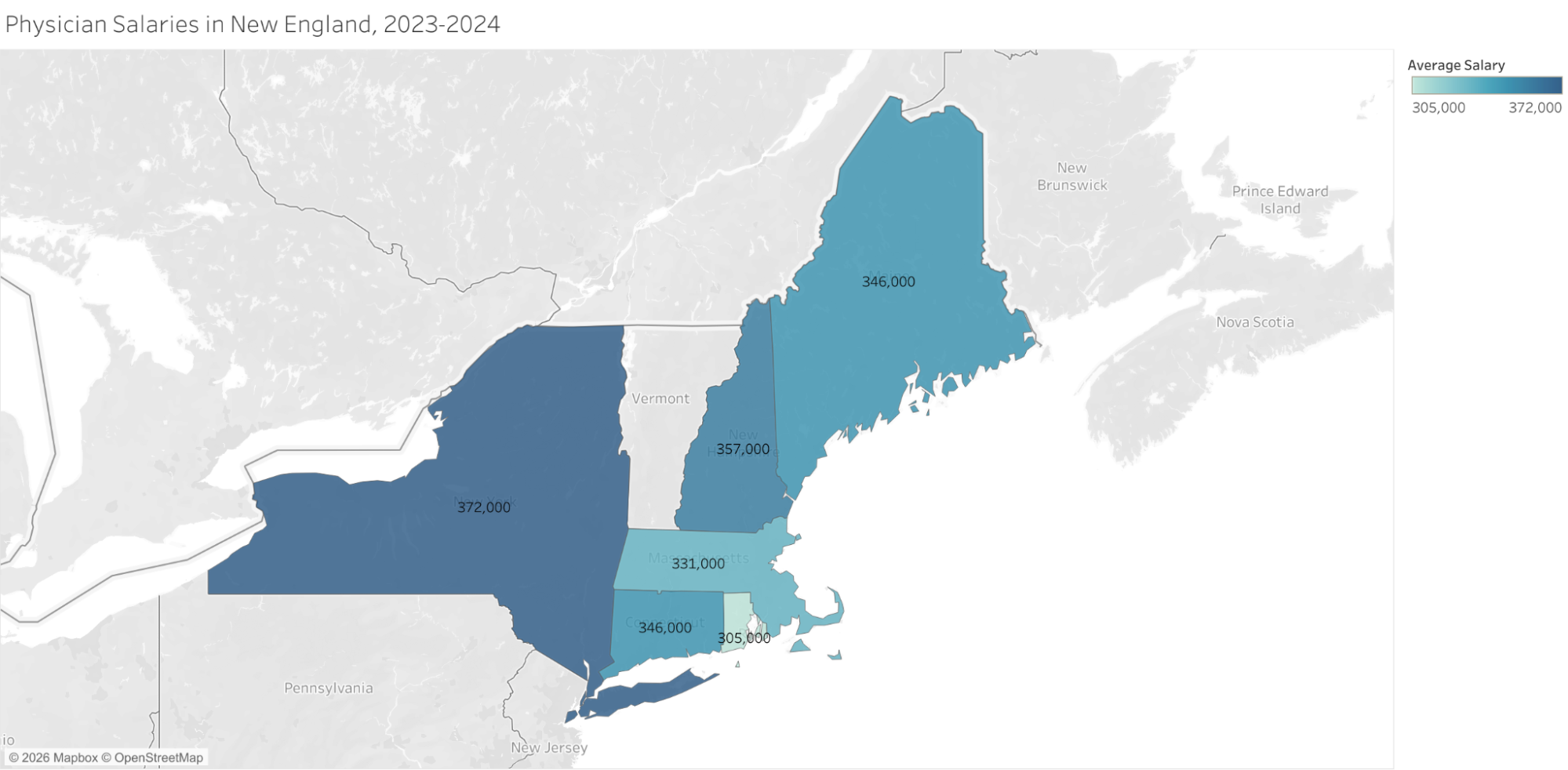
Average physician salary data from 2023 to 2024 clearly shows that Rhode Island offers the lowest pay in the New England region; in fact, during these years, Rhode Island’s average was the lowest in the entire country. A 2025 report from Doximity that adjusts salaries for cost of living found that Providence specifically had the seventh lowest physician compensation out of all American metropolitan areas. The shadowy, anti-competitive nature of insurance companies in Rhode Island are not just abstract policies but actively disincentivize healthcare providers from choosing to practice in the state. When Connecticut and Massachusetts are anywhere from 30 minutes to an hour away, what reason do clinicians have to refuse higher pay out of state but in the same geographic area?
Solutions like a new medical school and expanded primary health care from existing hospital networks are surface-level fixes that will never get to the crux of what deprives Rhode Islanders of the care they need and deserve. State and federal policymakers will make more efficient use of their time and taxpayer dollars by targeting the insurance monopolies that worsen quality of care, lower physician salaries, and increase patient costs to pad their own wallets. Strengthening the healthcare workforce in Rhode Island requires the state to be an attractive place to practice medicine. After hundreds of thousands of dollars and over a decade of training, physicians choosing their first jobs–and those looking for a new position–will keep overlooking us if we do not change.