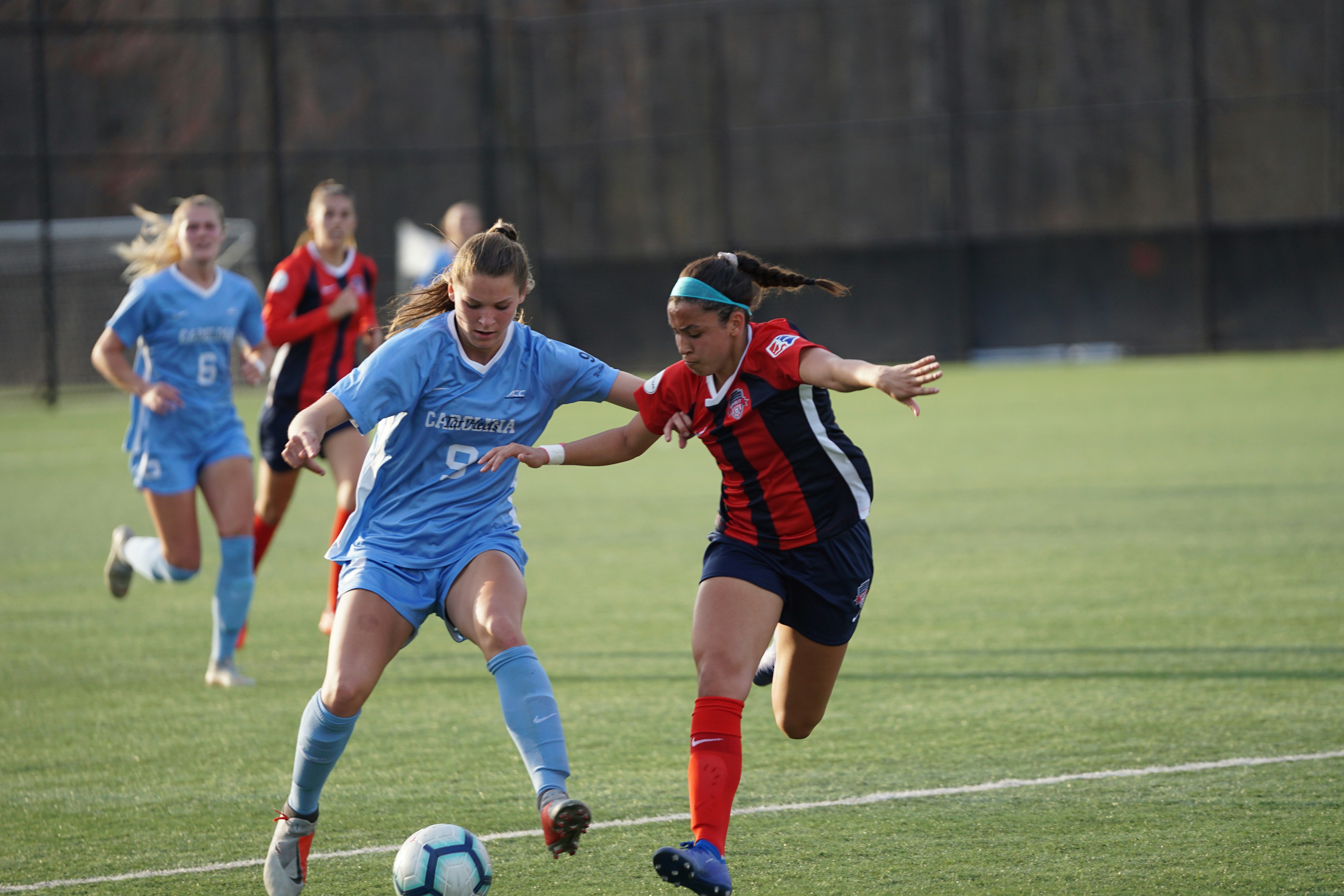
During the most-watched sporting event in the United States, Dove ran a commercial about young girls in sports. Last February, we saw preteen girls celebrating their love for athletics, while the text on the screen highlighted how one out of two girls who quit sports are criticized for their bodies. In this commercial, Dove attempted to address an issue that boils down to a cultural undermining of female athletes. Though their effort is commendable, considering that this is the third year in a row they have run a similar commercial, it is evident that perhaps more action is needed than just 30 seconds of screen time during an all-male sporting event.
While the trend of young girls quitting sports is of utmost concern, so is their safety when they don’t quit and instead go on to become female athletes. American society has disrespected women in professional sports by providing a stark lack of resources in comparison to their male counterparts, which in turn directly puts them in danger. The social and economic disregard for female athletics has increased the risk that women suffer health consequences such as Relative Energy Deficiency in Sports (REDs).
REDs is a syndrome where athletes do not take in enough fuel to support the energy demanded by their lives and training. While all athletes will enter a low-energy state after a difficult practice session, if an athlete continues to train without refueling properly, the energy deficit grows, leading to REDs. If this syndrome is left untreated, it can lead to various health complications. Specifically, the impacts of REDs on short- and long-term health include issues with reproduction, bone density, metabolism, and cardiovascular health. For affected women, REDs could put them on crutches due to a stress fracture, increase their risk of early onset osteoporosis, or cause hormonal imbalances leading to an increased risk of fertility problems such as miscarriage or premature labor.
The term REDs was developed by the International Olympic Committee in 2014 to replace the idea of the female athlete triad, which describes the connection between low energy availability, irregular menstruation, and bone density loss in women. This change from the female athlete triad to REDs was important in highlighting the impact of underfueling on male athletes as well. However, while all athletes can develop REDs, the cultural and societal factors uniquely impacting women illuminate why women are more likely to develop REDs and therefore are placed at a greater risk of the negative health implications that follow.
It is a fairly well-known fact that female athletes are not treated the same as their male counterparts, whether that be in compensation, viewership, or media representation. While many accomplished athletes have drawn attention to this issue and found success, such as the United States women’s national soccer team, there is still a lot of work to be done. Professional female athletes deserve the same respect and consideration given to their male counterparts, but this apathy towards women is not their burden alone. The dismissal of female athletics affects all female athletes, whether they are at the Olympics, or simply going on a run at home.
Women across the globe are put at a greater risk of REDs due to a lack of research on female physiology and performance. Historically, most performance research has been conducted on male athletes and simply applied to women, rather than centered around female athletes. In 2014, it was found that women only comprise about 37 percent of research subjects in athletic performance studies and are underrepresented across all related scientific journals. While the lack of sports medicine and physiological research on women is concerning, it is not surprising. Our culture has long undervalued women in sports, and this trend seeps into labs and the broader scientific community.
This gap in research is due to many complex factors. In some instances, it circles back to funding, as research is often sponsored by well-funded, male-dominated organizations such as the NFL, while female organizations simply do not have the same resource capacity. Other times, the lack of research can be attributed to sexism, with researchers being advised to avoid female participants in performance research because the menstrual cycle is seen as a “confounding variable.” This gross negligence of the scientific community should be inexcusable. Instead, it is the norm, as women in sports are deemed undeserving of the work needed to understand their anatomy and prevent serious health complications. While there might be some recent advances in this research, it still stands that most of the performance research and the resulting exercise and training guidelines are male-centric, not female. This trend fails to take into account the unique physiology of women and only serves to put female athletes at risk.
This research gap does not exist in a vacuum. Rather, it combines with other societal factors that collectively increase the chance that women develop REDs. While many may be reluctant to understand female bodies during performance sports, they are simultaneously quick to comment on female bodies overall. The societal hyperfixation with female body image has led to the internalization of a “thin ideal” body type for young women, which is a key contributing factor in the development of REDs. When female athletes exist in a society which is constantly telling them to be smaller, they are motivated to train more and eat less. This puts their body in a calorie deficit, which is especially dangerous to women when compared to men.
Women need an essential body fat percentage, or the minimum amount required to survive, of approximately 10 to 17 percent, while men need only two to eight percent. This discrepancy means that if a woman tries to bring her body fat percentage down to that of a man’s, her body will suffer potentially severe consequences. REDs results when any athlete, regardless of sex, has an issue balancing how they are training versus how they are fueling. For an athlete to close this gap, there must therefore be an understanding of both sides of the equation. On the fueling side, the societal hyperfixation on lowering body fat and dieting is only making this balance harder for women.
Similar to performance research, much of the popular diet advice and trends encouraged for both men and women are based solely on male physiology. One example of this is intermittent fasting, which has been shown to demonstrate success for men but increased risk of hormonal imbalances for women. Despite this potential negative impact on women, this diet trend has become incredibly popular as 38 million Americans tried it in 2023 alone. Another popular exercise trend is fasted training. For men, there are potential fat loss benefits, but for women, it can lead to issues with the hypothalamus and even weight gain. America has created an environment where women are told they need to be skinny and the diet advice given to them could result in underfueling and the beginning of a REDs diagnosis.
The other side of the REDs coin is training where the lack of performance research on women comes back into play. The phrase “women are not small men” was created by Dr. Stacy Simms to highlight the physiological differences between men and women and the problems that arise when research conducted on men is simply applied to women. When considering performance in sports, key physiological differences including different muscle composition, response to heat and hydration, and oxygen consumption between men and women can dramatically impact how they train and recover.
For example, the menstrual cycle can have an effect of heat dissipation during exercise via sweating and cutaneous vasodilation, or the widening of blood vessels. During the luteal phase, when estrogen and progesterone are high, the onset of sweating and cutaneous vasodilation occurs at up to a 0.6 degree Celsius higher core temperature. This means that women are more likely to become hyperthermic, or have a body temperature which exceeds safe levels. Beyond the specifics of the menstrual cycle, women have a lower sweating capacity than men. This forces them to compensate when exercising in the heat by increased peripheral vasodilation, or the widening of blood vessels away from the body’s core. This puts women at risk of orthostatic intolerance which is a condition where standing can cause dizziness and fainting. As it turns out, women aged 18 to 35 are five times more likely to have this condition than their male counterparts. Taken together, this indicates that women have a higher need for training protocols which focus on thermoregulation and heat acclimatization training. However, when endurance training is modeled after men, this need may not be met.
Lack of access to informed training not only impacts women seeking to run a marathon in a hot climate, but it also affects how all women are able to train. If you talk to any runner, they will probably tell you the importance of training in a moderate heart rate zone to help build endurance and prepare for a race. However, it has recently been found that this type of running is best for men, while women should focus more on interval training. This is just another case of training guidelines being written using male physiology and then subsequently applied to females.
Overall, it is evident that women train in an environment built for and around men. It is therefore no surprise that up to 80 percent of female athletes have at least one symptom of REDs.
Women are not given the resources to fuel and train safely, which directly contributes to both short- and long-term health effects. In order to protect female athletes, there must be an overall cultural shift in the way that women in sports are supported. Research dollars need to be attributed more equitably, women must be given resources on how to eat during training rather than how to diet like a man, and the unique physiology of women, including menstruation, must be understood instead of ignored.
In their Super Bowl ad, Dove shows young girls celebrating their love for sports against all odds. Preteen girls clapping to music make for an empowering commercial; women on crutches with stress fractures and missing periods do not. However, unless there is a cultural shift, this is the future too many of those excited girls may meet.