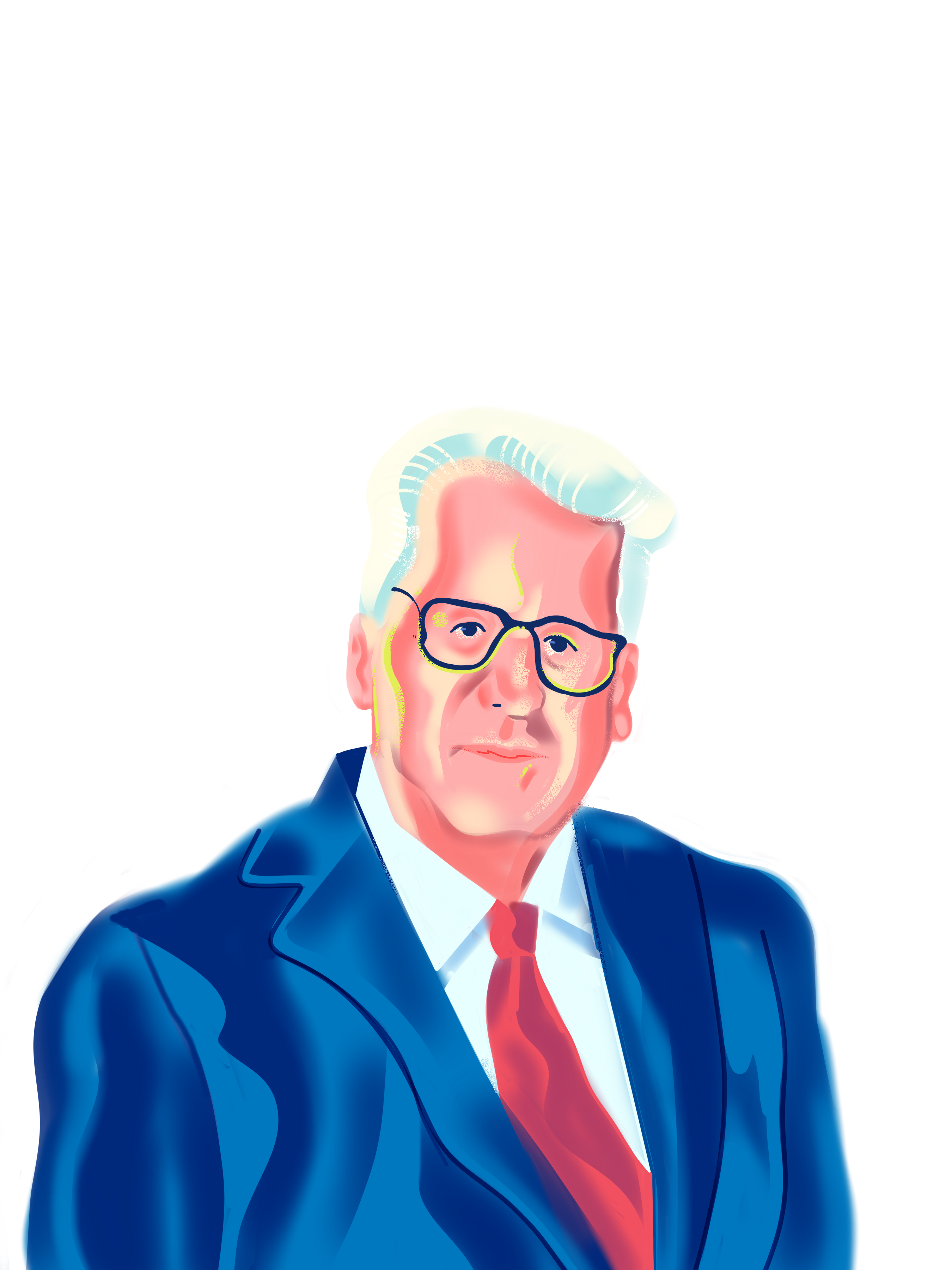
Joseph M. Sellers is a nationally recognized civil rights attorney who has been a trailblazer for victims of discrimination. He played a pivotal role in such seminal legislation as the Americans with Disabilities Act of 1990, the Civil Rights Act of 1991, and the Lily Ledbetter Fair Pay Restoration Act of 2009, and has litigated precedent-setting civil rights cases. Today, he is the founder and co-chair of the Civil Rights & Employment department of Cohen Milstein, a private law firm engaged in history-making class-action litigation. Joseph Sellers is currently litigating a landmark case—Thompson v. Trump, also known as Lee v. Trump—that seeks to hold President Trump personally liable for the January 6 insurrection and that affects the scope of presidential immunity. On March 31, 2026, US District Judge Amit Mehta ruled that President Trump’s speech that day is not protected under the banner of official-acts immunity, marking a major step forward in Sellers’ case.
Vanessa Tao: I would love to hear about the decision on the Thompson v. Trump case, if you could give an overview of the case and your role in it.
Joseph Sellers: On January 8, 2021, two days after the January 6 riot at the Capitol, I was approached by Congressman Bennie Thompson (D-MS), who was then the chair of the House Homeland Security Committee, and Derek Johnson, who’s the president of the National Association for the Advancement of Colored People (NAACP), about bringing a suit against Trump personally for his role in the riots.
I did some research and discovered a statute which was enacted in the 1860s.
It is rarely used, but it has total applicability here. It’s found in Title 42 of the US Code, Section 1985, Subsection 1. It forbids persons through the use of force, intimidation, or threat to conspire from interfering with the ability of federal officials to discharge their official duties.
Because Chairman Thompson was stranded in the House gallery on January 6 while the rioters broke into the Capitol and stopped all the proceedings, he had to be herded out because he was afraid of being harmed. The Capitol Police had to remove him and others, and they eventually returned at three in the morning to finish counting the Electoral College ballots.
This was a form of interference with federal officials’ ability to discharge their official duties by people who were using force, intimidation, and threats, and—we alleged—conspiring to do so.
We brought that suit on the first business day after President Trump was acquitted by the Senate in the second impeachment proceeding. There are currently 10 current or former members of Congress involved. We filed this suit and named President Trump personally, which is a rare thing.
You normally can’t sue the president personally because he has what’s called ‘constitutional immunity,’ which I’ll explain in a moment. We also sued the Oath Keepers and the Proud Boys, both organizations that we contended were conspiring with Trump to organize and eventually effectuate the insurrection on the Capitol.
In the legal proceedings, Trump and the others filed what’s called a ‘motion to dismiss.’
The scope of presidential immunity under the constitution was first established in Nixon v. Fitzgerald (1982). The Supreme Court said the duties and prerogatives of the president are so broad that they immunize the president from conduct that might otherwise be unlawful unless it’s outside the “outer perimeter of the presidency.”
That’s the term they used—the “outer perimeter of the presidency.” They never defined it.
Then came the Clinton v. Jones case (1997). There, Paula Jones claimed that Bill Clinton, before he was president, sexually harassed her, and she sued him.
By the time the suit proceeded, Clinton was president. He claimed that because he was president, the civil suit had to be suspended because he was too busy being president.
The Supreme Court unanimously ruled that, even when you’re president, if the suit is with respect to conduct that occurred before you were president, then the suit should proceed.
Trump moved to dismiss our case on the grounds of immunity. There were a host of other arguments they made to try to derail these claims.
The trial court rejected them all and found that Trump was not immune based on the allegation of the complaint. That’s the first time in American history that a court has found that a president is not immune from conduct occurring while he was president.
Trump took an appeal to the US Court of Appeals in DC. I argued this in the district courthouse and the circuit court. Nobody had ever figured out what the scope of the “outer perimeter of the presidency” meant.
There’s a case called Blassingame v. Trump (DC Cir. 2023). The Blassingame decision was the one that the Court of Appeals issued and affirmed, upholding the trial court decision finding that—on the allegations of the complaint—Trump was not entitled to immunity.
They gave factors that they thought would be relevant in sussing out whether or not Trump’s conduct was within or outside the scope of the presidency. The basic distinction was whether he was engaged in seeking to retain his position by campaigning.
If he was seeking reelection, then it’s private action. If he was speaking about and acting on matters of general public consequence that are consistent with the presidency, then it would be within the scope of the presidency, and therefore he would be immune.
VT: So the dividing line was, as they put it, was he an office seeker, office keeper, or office holder?
JS: I argued this in December of last year. Just last night at 8 PM, the court issued a decision.
What he was doing was dispatching people to the Capitol to try to stop the count of the electoral college. The statute prohibits people from conspiring for the use of force, intimidation, or threats to interfere with the ability of federal officials to discharge their official duties.
Trump will have to go to trial in federal court in front of a DC jury with respect to claims that he violated some federal civil rights laws with respect to his conduct on January 6.
VT: And that would completely shift the playing field for presidential immunity from now on as well, right?
JS: Well, we’ve already shifted it in the sense that we’ve shown the dividing line—office seeking versus office holding, so that’s guidance that nobody had before. The question would be: Could any reasonable jury find liability? If the answer is no, then it’s called a directed verdict. Then Trump would lose.
There are going to be three stages. We’ve gone through two of them now, in which the assessment of immunity is determined.
VT: So what stands between you, your team, and the final stage now? And what could Trump’s legal team do in response?
JS: What stands before us is the appeal to the Court of Appeals. We already won unanimously before the Court of Appeals before, but now there’s evidence and we’ll see what they do. If we win again before the Court of Appeals, Trump may seek review in the Supreme Court. That’s entirely discretionary whether the court grants review or not.
VT: I think on campus right now, there’s a feeling that institutions are breaking down the rule of law. What advice do you have for students feeling that?
JS: So the first thing—and the most important thing—is to vote. I know that sounds obvious, but people five or 10 years older than you have not voted very much because they’re disillusioned.
It’s like, why does my vote matter? The answer is, if you don’t vote, you end up having people like Trump elected, because other people will vote.
VT: How do you continue to wake up and do this every single day?
JS: You know, find what you are passionate about. Everybody’s going to have to decide what’s different, what works for them, and pursue it. There’s not a linear path, unless you’re extraordinarily lucky.
Ask yourself, does it challenge me enough in ways that I care about and draw upon the strengths of my personality or other characteristics that I value? If it does, then it’s probably right for you. And everybody’s going to have to find their own path.
*This interview has been edited for length and clarity.