For nearly a century, the FIFA World Cup has been promoted as a celebration of global unity—a rare stage where political borders blur and nations meet as equals through sport. Since its inaugural tournament in Uruguay in 1930, the World Cup has grown into the world’s most-watched sporting event. FIFA, the primary governing body for football and organizer of the World Cup, reports that the 2022 tournament attracted five billion viewers and generated more than $7.5 billion in revenue. In 2026, FIFA endeavors to take this one step further: the upcoming World Cup will feature an expansion from the historical 32 teams to 48 teams. On the surface, this shift aligns with FIFA’s stated mission to improve and promote the game worldwide. An additional 16 teams theoretically offers players from nations with limited football infrastructure or history the opportunity to compete, enhancing global representation and inclusion.
Football is often described as a “universal language” because it can connect people from different cultures, backgrounds, and nations, creating shared passion, national pride, and a sense of belonging that transcends political divisions. Yet history shows that politics has never truly been absent from the game. The 1934 tournament in Italy was used by Benito Mussolini as a propaganda tool designed to showcase the supposed strength and unity of his regime. Players were pressured to perform under threat, and Italy’s victory was framed as proof of fascist superiority. Similarly, the 1978 World Cup in Argentina served to legitimize a brutal military dictatorship, the junta, amid widespread human rights abuses. As political prisoners were tortured just miles away, the junta used football to project an image of national pride and stability to the international community. More recently, the 2018 and 2022 tournaments, in Russia and Qatar respectively, faced accusations of “sportswashing,” where nations sought to soften global criticism for human rights violations and corruption through the glamour of hosting the world’s most-watched sporting event. Qatar and Russia also faced scrutiny for the exploitation of migrant workers, unsafe labor conditions, and anti-LGBTQ stances. In each case, football became a stage for political performance as much as athletic competition.
It is not only host nations that wield the World Cup as a political instrument. FIFA itself has become a political actor and broker of global legitimacy with an influence that shapes international perception as much as any government. Through its selection of hosts, enforcement (or lack thereof) of human rights standards, and control over the global football economy, FIFA has repeatedly demonstrated that its decisions are guided as much by political and economic interests as by sport.
The upcoming 2026 World Cup, hosted jointly by the United States, Mexico, and Canada, is no exception. While FIFA President Gianni Infantino continues to tout football’s opportunity to unite the world amidst division, the policies, partnerships, and political realities surrounding this tournament expose FIFA’s hypocrisy and its role in perpetuating inequality and exclusion.
Look no further than the treatment of Iranian fans. Although Iran’s national team has successfully qualified for the tournament, the effects of President Trump’s travel ban continue to bar most Iranian citizens from entering the United States. The US State Department has reportedly declined visa requests for an official Iranian delegation, including Iran Football Federation President Mehdi Taj, coach Amir Ghalenoei, and other federation members who sought to attend the tournament draw scheduled for December 5th at the Kennedy Center in Washington, DC. While the policy exempts athletes and coaching staff for the actual games, it effectively prevents all Iranian supporters from attending matches hosted on US soil. The denial of the official delegation signals exclusion at the elite level, limiting the participation of those who represent Iran’s football authority, while the broader travel restrictions enforce exclusion at the popular level by preventing ordinary fans from experiencing the tournament firsthand. This multi-layered exclusion undermines the very spirit of the tournament, transforming what should be an open celebration of global participation into a display of geopolitical control under the guise of national security. The question of who gets access to the World Cup reveals how FIFA’s promise of universality is contingent on political privilege. Fans, not just athletes, are central to the World Cup’s unifying power, and their ability to come together across borders should be protected rather than politicized.
Additionally, the United States has yet to introduce a fast-track, temporary visa program like those used in the two previous World Cups, leaving many international fans uncertain about whether they will even be able to attend. In 2018, for example, Russia provided ticket-holders with FAN IDs that granted foreign visitors visa-free entry for the duration of the tournament. The US approach represents a significant departure from this precedent. Supporters may face a lengthy and unpredictable bureaucratic process. Immigration challenges, mass deportation raids, and rising travel costs have further dampened enthusiasm, while record-high ticket prices in the first phase of sales have left many fans questioning how accessible the 2026 World Cup will truly be. These barriers highlight how political and economic forces are shaping who gets to participate in the world’s game.
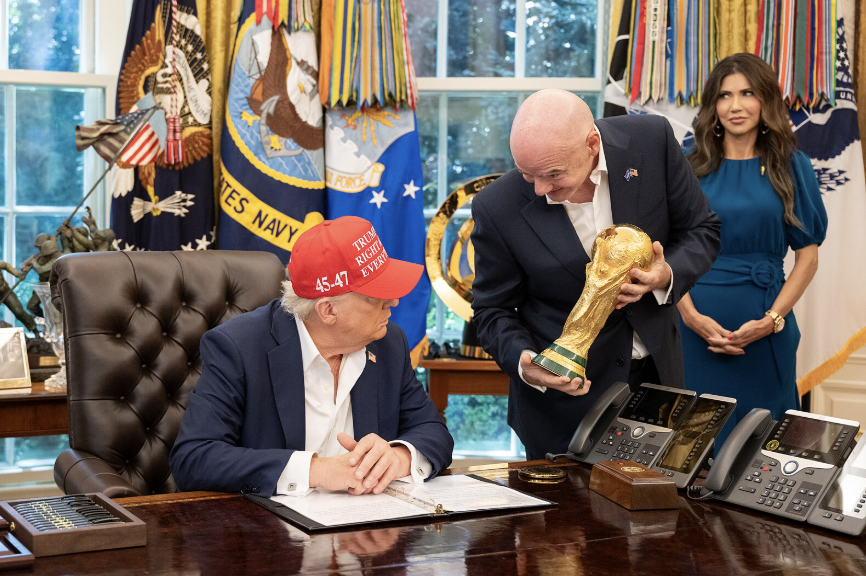
Rather than challenging these restrictions, FIFA appears increasingly aligned with US political interests. The organization frequently declares its commitment to fighting racism and discrimination, yet it has taken no action against Trump’s exclusionary travel policies or the broader inequities shaping access to the 2026 World Cup. This inaction reflects a pattern in which FIFA selectively applies its professed principles of unity depending on the political alliances at stake. Gianni Infantino, FIFA’s president and a close ally of Trump, has repeatedly blurred the line between diplomacy and sport. He attended Trump’s inauguration as 47th President of the United States, publicly endorsed Trump’s bid for a Nobel Peace Prize, and maintained a visible friendship with him throughout Trump’s presidency and campaign. Infantino also attended the peace summit in Egypt supporting the US-brokered ceasefire in the Israel-Hamas war, later praising Trump’s involvement and asserting that, “without President Trump, there would be no peace.”
The consequences of this political proximity emerge clearly in FIFA’s uneven approach to international crises. Prior to the ceasefire, there had been growing international calls to suspend Israel from the World Cup over its military actions in Gaza. Infantino dismissed the idea, stating, “No action will be taken against Israel; FIFA cannot resolve geopolitical issues.” This stance supported Trump, who had consistently defended Israel’s participation and opposed boycott efforts, underscoring the convergence of their political and institutional priorities. FIFA’s selective neutrality also reveals a significant hypocrisy. The organization swiftly banned Russia from competition after its invasion of Ukraine in 2022, aligning itself with global condemnation. In the case of the Israel-Gaza war, UN experts issued a formal statement calling for Israel’s suspension, but FIFA chose not to act. Infantino’s public alignment with Trump—praising his leadership, echoing his political framing, and dismissing international demands for accountability—demonstrates that football’s governing body is not above politics. FIFA is complicit in a form of soft diplomacy that reinforces the priorities of its most powerful hosts and revenue drivers. The 2026 World Cup, with the majority of games held in the United States, thus serves as a platform for the projection of American political influence, mediated through FIFA’ willingness to accommodate and legitimize US power and Trump’s ideals rather than challenge controversial ideas. To uphold its credibility, FIFA should assert its independence by applying its stated values impartially, holding all countries accountable for violations, and ensuring that the World Cup remains a platform for global solidarity, not political influence.
Trump’s involvement in the 2026 tournament extends beyond foreign policy. In recent months, he has publicly threatened to relocate World Cup matches scheduled in the Boston area, claiming that parts of the city have been “taken over” by unrest and attacking Boston’s Democratic mayor, Michelle Wu, as the “radical left.” He has issued similar remarks about other Democratic-led host cities including San Francisco, Seattle, and Los Angeles, claiming he could call Infantino and have the matches moved “very easily” if he wanted. This rhetoric transforms the tournament into a stage for domestic political performance, blurring the boundaries between sport and partisan politics. By refusing to challenge or distance itself from these threats, FIFA effectively allows its flagship event to be instrumentalized for partisan messaging, signaling that the organization is willing to tolerate political interference when it aligns with powerful actors. By invoking the World Cup as a tool for personal and ideological leverage, Trump extends his broader narrative of polarization, undermining the tournament’s mission of fostering unity through global sport.
The 2026 World Cup could have been an opportunity to reaffirm football’s role as a truly global connector, especially after years of controversy and mistrust. Instead, it reflects how ideals of unity and inclusion have been compromised by political expediency and self-interest. FIFA continues to present itself as “committed to using the power of football to unite people in a divided world,” yet as the tournament approaches, unity is increasingly defined—and constrained—by those in power. This dynamic exposes the inequalities, exclusions, and geopolitical alignments that shape access to the game. FIFA not only reflects politics but actively produces political legitimacy, offering moral cover to the governments whose interests it serves. Wherever the World Cup is held, it remains vulnerable to manipulation by actors who use it to divide, control, or elevate their own image on the global stage. The enduring challenge is to dismantle these hierarchies of access and influence and to reclaim football’s promise as a space of genuine solidarity where participation in the beautiful game is not determined by nationality, wealth, or political favor, but by a shared commitment to equality and human connection.