“Ok Boomer Time’s Up!” read a cardboard sign, clutched tightly in the hands of a Nepalese boy still in his school uniform. He stood among thousands of others on the streets in Kathmandu, Nepal. They called for an end to the government’s social media ban, enacted just four days earlier, as well as to broader corruption that has dominated headlines for years. This wave of uniforms embodied Nepal’s September 2025 uprising, a campaign operationalized by the notoriously fired-up ‘Gen Z.’
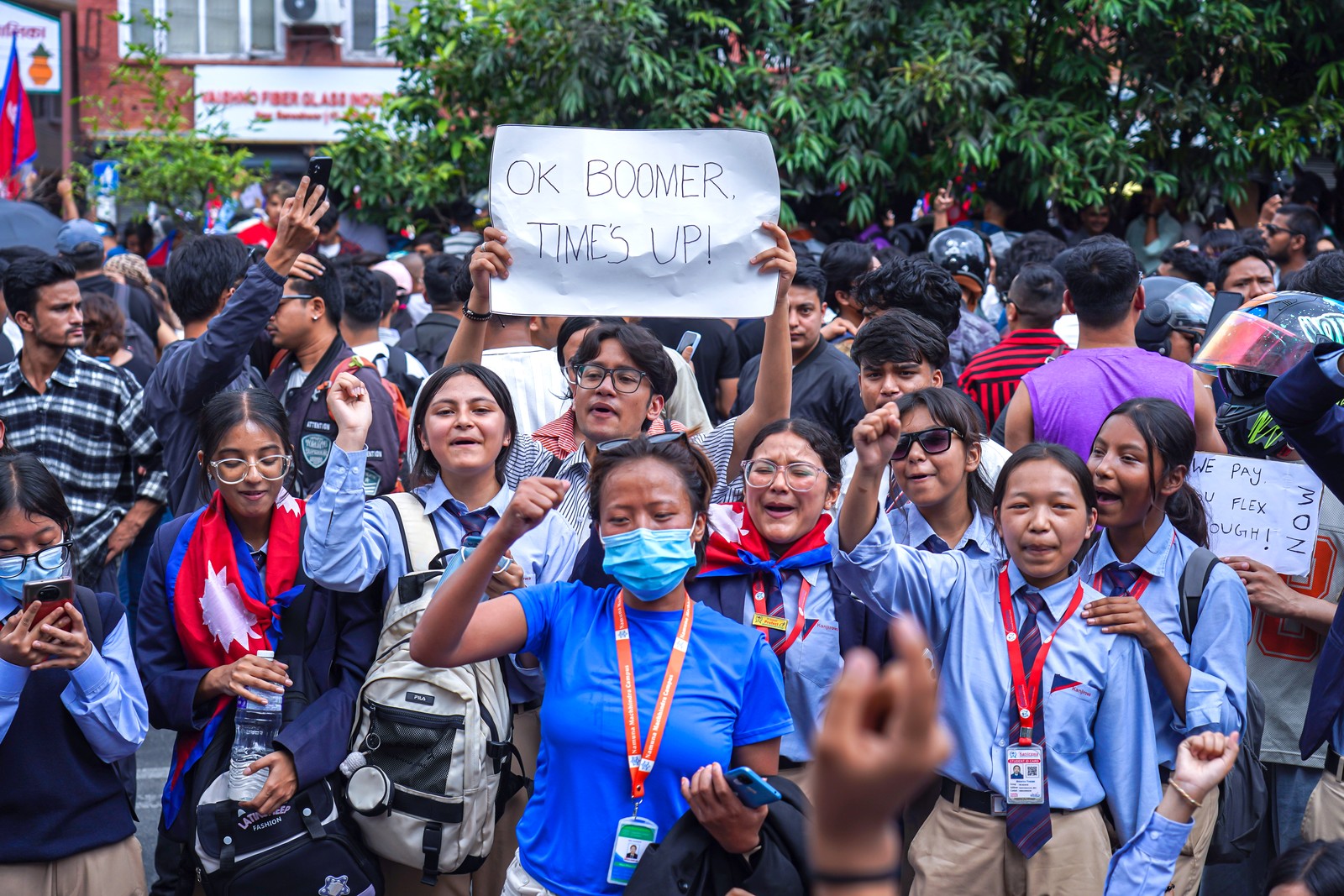
Seeing many young faces like mine in the picture, I was vividly transported to Colombo, Sri Lanka in 2022. The Aragalaya (Sinhala for “struggle”) movement tore across Sri Lanka demanding the president’s resignation due to hunger, power cuts, and empty gas stations. This movement, also largely driven by student organizers, kicked off what some political commentators are calling the “Asian Spring,” as Gen Z protests continue to sweep across southern Asia. For a moment, the faces of the young Sri Lankans and the Nepalese students blended in my mind. Calling for an end to economic inequality and political corruption was the essence of both movements. But will they both be able to achieve their goals?
Both movements, led by students and young people, successfully ousted the most powerful members of their governments. Sri Lanka’s President Gotabaya Rajapaksa resigned after furious crowds stormed his presidential palace in July 2022. Similarly, Nepal’s prime minister, Khadga Prasad Sharma Oli, resigned after renewed protests over the killing of 19 anticorruption protestors in clashes with the police. National and international media even criticized both movements for setting fire to important government buildings—the Sri Lankan prime minister’s residence and the Parliament of Nepal. Yet, despite these surface similarities, Sri Lanka’s movement appears better positioned to achieve an enduring transformation of its political system, primarily because established institutional actors have been incorporated into state reconstruction efforts.
Although political parties—such as the leftist National People’s Power (NPP) coalition formed in 2019 out of a mix of 21 political parties, civil society organizations, and trade unions—did not play an initial role in the organization of the Aragalaya due to concerns among protestors that the movement may appear to have been controlled by a political party and thus undermining its universal appeal of anti-corruption, other institutional actors did. Unions such as the Inter University Students Federation and the Socialist Student Union (affiliated with the NPP) played integral organizational roles. This demonstrates that Sri Lanka’s movement has been supported by institutional actors from the beginning. The involvement of established unions gave the movement leadership and legitimacy, helping to sustain it in its early days.
Once the initial fiery phases of the movement had passed and an interim president was in place, the NPP emerged from the Aragalaya as representatives of the struggle. The NPP was able to convert collective rage into electoral power. They carried the spirit of the protests into the 2024 elections, where the NPP’s anticorruption campaign triumphed. The NPP won a two-thirds majority in parliament, and shortly after, the presidential candidate Anura Kumara Dissanayake polled 42 percent of the vote and became the new president of Sri Lanka. This was, unbelievably, a party that had only three seats in the previous election. By channeling the movement’s ethos into electoral results, the NPP made the movement sustainable. With this unprecedented turnaround, Sri Lanka demonstrated that mass mobilization paired with institutional involvement—civil society and political parties—can lead to favorable, stable change.
Nepal, on the other hand, charted a different course. Instead of empowering a trusted opposition coalition to take control, the horizontal, leaderless movement that emerged from social media appears unable to establish a stable, legitimate new government. Nepal’s revolution was digitally driven, sparked by children of prominent leaders flaunting their wealth online in one of Asia’s poorest countries. Enraged, the relatively unknown Nepalese non-profit, Hami Nepal (“We Are Nepal”), used Discord and Instagram to cultivate dissent and invite people to the streets. Thousands of people turned out to these massive demonstrations, causing the prime minister’s resignation. The digital facet of this revolution also influenced the appointment of Sushila Karki as the interim Prime Minister through an election hosted on Discord. A Supreme Court justice who became infamous in Nepal for jailing an active minister for corruption, Karki is the first woman ever to hold the position and will head the government until elections in March.
The movement definitely achieved some of its aims, but it is questionable whether this will lead to electoral change as it did in Sri Lanka. The protests lacked infrastructure in traditional channels, with minimal participation from unions or established political groups. Although Karki is now the prime minister, she was hastily appointed by a few thousand protesters who participated in an online vote and has no significant prior political experience. Karki is not even affiliated with an established party, so it is unlikely she will remain in a major political role after the elections. Karki’s lack of affiliation with partisan politics is part of her appeal, but it also means she has no organizational scaffolding—a party that genuinely represents the people’s will—to support any long-term ambitions for change. Channeling rage into legislation is a long game and requires strategic organizational efforts, not a one-woman show. Social media is not designed for long-term change: It moves quickly, from topic to topic, depending on algorithms and hashtags rather than organizational capacity. Many recent digitally-driven protests, including ones in Africa and Hong Kong, have failed. Without institutional backing, the young Nepalese students may not see the change they desperately seek.
Once the fires died down, some felt little hope for the future. Nepal remains poor and plagued by rising unemployment and government corruption that persists despite the resignation of its former prime minister. With renewed urgency, these students continue to look for ways to leave their country.
Despite this, there is hope for Nepal’s transformation. The protests are representative of the broader political culture of the country, which is ambitious, fed up with the status quo, and determined to change the Nepalese state. This will was strong enough to topple a corrupt Prime Minister and christen a new leader. Sushila Karki—a fresher, cleaner figure not part of the old political establishment—could yet be an effective changemaker in a system weighed down by clientelism and corruption. It has only been some short months since the protests, which means Nepal could surprise us in time.
Institutional involvement might be necessary for protest movements to achieve sustainable change, but is it alone sufficient? The newly empowered NPP in Sri Lanka may not actually deliver on its promises when strangled by International Monetary Fund programs, crushed by debt to India and China, and operating with an economy in ruin. Dissanayake’s government can only boast small victories after one year in power, such as trimming wasteful subsidies and expanding some targeted welfare programs. Big election promises remain unfulfilled. While there is obvious uncertainty surrounding the ability for a Discord server to facilitate genuine reform, there is still a question of whether institutional actors can even translate protest energy into meaningful reform. Overthrowing governments is the easy part. Rebuilding them under the weight of geopolitical and economic constraints is the real test.