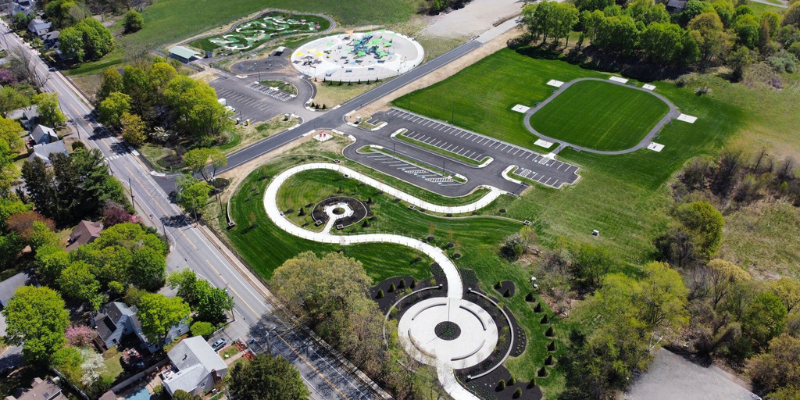
Earlier this year, hundreds of families flocked to a newly opened playground and park in Waltham, Massachusetts. Children soared on the swings, flew down the slides, and competed in mini-golf – unaware of the land’s shamefully buried history. As recently as 2014, the site was home to the Fernald Developmental Center, a state-run school for children with developmental disabilities that was rife with controversy. The school conducted experiments on students, institutionalized children who did not require treatment, and widely supported eugenics. Yet, a remembrance of these horrors was nowhere to be found.
Memorials are a form of storytelling: By choosing which names, events, and symbols to display, memorial sites shape how future generations will remember the past. As with the Waltham park, memorials too often fictionalize disability-related injustices to prioritize comfort and evade accountability. They wash over the experiences of individuals with disabilities by covering up the injustices they suffered or downplaying the challenges they overcame. In doing so, these fictionalized memorials undermine the possibility of remembrance and prevent us from realizing the principle of “never forget, never again.”
The Fernald Center was a site of unfathomable horrors. Students—perhaps more accurately described as residents or inmates—were subject to human rights violations, sexual abuse, eugenics-based practices, malnourishment, and poor education. Many did not have developmental disabilities but had tested below average on IQ tests or were orphans in state care. At times, they were treated like lab rats: In the mid-1900s, 73 students were subjected to an experiment without consent in which they were fed food laced with radioactive iron and calcium. As a leading educational facility for children with disabilities, the school also helped introduce forced segregation and mass institutionalization of individuals with disabilities into the mainstream. After Waltham transformed the property into a recreational site following the Fernald Center’s closure in 2014, the city had the opportunity to remember the land’s dark history and ensure that such injustices are never repeated.
But Waltham’s attempt to memorialize the students distorts the truth of the past. Although the site features a memorial area and a mini-golf course with holes dedicated to various aspects of the school, these components present a rendering of the past that overlooks the suffering of the school’s former residents. The signs along the park’s memorial path set the misleading tone: The foremost sign describes the Fernald Center as a place where “people with developmental disabilities (along with many staff) lived, worked, learned, and played in a variety of ways.” The other signs describe generic activities that students may have participated in, such as “wellness,” “athletics,” “arts,” “nature,” and “events.” These descriptions lie by omission: While some students may have participated in the described activities, the signs significantly misrepresent their full experiences.
The mini-golf course also fails to properly honor those who suffered. Only the fourth hole mentions the students; its dedication reads, “Fernald Residents and Guardians.” Meanwhile, a different hole is dedicated to Dr. Edward Jarvis, the school’s second superintendent, who advocated for an asylum for students who lacked social skills. The same hole also honors Dr. Walter Fernald, the school’s third superintendent and eponym, and a board member of the Eugenics Society. Fernald promoted eugenics practices, believed in IQ testing and the sterilization of those with developmental disabilities, and oversaw food deprivation and forced manual labor. Although Dr. Fernald later became an advocate against mass institutionalization, his impact on the students at the Fernald Center was overwhelmingly negative.
The distortion in the Waltham park reflects a broader trend in American society of fictionalizing disability-related injustices from public memory. In the late 1800s, proposals to construct monuments to injured railroad workers were rejected by those who, in part, did not want a reminder of the risks associated with the railroad industry. In the 1990s, historians raised concerns about a memorial for Franklin D. Roosevelt that did not display his wheelchair, crutches, braces, or cane that he relied on. It took until 2001 for a statue of the former president in a wheelchair to be added. Another example lies in the remains of the stone wall surrounding Brown University’s athletic fields: The wall was the former boundary of the Dexter Asylum, which treated the “indigent, elderly, and chronically unemployed” essentially as “inmates” for over 100 years. Yet, there is no recognition of the suffering of those confined at Dexter along its former perimeter. These examples demonstrate America’s frequent failure to accurately represent individuals with disabilities, offering a retelling of history that ignores or downplays their stories. While proper recognition of such individuals may require a difficult reckoning with the actions of one’s community, confronting these truths is a necessary step to honor their experiences and humanity.
To prevent historical injustices from recurring, such as those from the Fernald Developmental Center, we must remember how those injustices occurred and the consequences that resulted. This idea, often associated with the Holocaust, underpins the importance of having accurate memorials of historical injustices. Such memorials may evoke discomfort: A family wishing to visit a playground may not want to view disturbing images of students with disabilities, and Brown students cheering on their team may not want to be reminded of the people who were confined in that space years ago. Yet, we must do better at acknowledging the past. If we do not, we risk dishonoring those who struggled, suffered, and overcame. Worse, we create the conditions for injustices to repeat by failing to teach ourselves the signs and inherent wrongs of such injustices.
To accomplish this, planners must incorporate two principles. First, memorials to those with disabilities must involve input from people with direct connections to those that the memorial seeks to honor. This includes the individuals being memorialized, people who knew them, or others with similar disabilities. These perspectives are essential for creating an accurate and respectful representation of their stories. This is a source of frequent shortcomings. For instance, a report on disability-related displays found that despite 52 percent of surveyed museums and galleries having displays that include people with disabilities, only 21 percent worked directly with people with disabilities. Waltham is no exception: Several members of the nearby community felt that the city had not adequately sought input from residents. Such exclusion is unacceptable, and future memorials must strive to better incorporate meaningful input from these individuals. Second, memorial planners must not be afraid to make viewers uncomfortable. The truth may be ugly, but uglier yet is the silence or distortion that erases it. Remembrance must not lead to avoidance, but to accountability, honor, and the vigilance required to prevent injustices from happening again.
Waltham has the opportunity to take accountability for its misdoings, but it must do so with intention and care. The city must seek the input of those impacted by the Fernald Center. Given that the school closed just over a decade ago, many individuals alive today were affected by its operations. In addition, the city must not shy away from frightening families by revealing the land’s dark history. Instead, it must hope that proper recognition will offer parents and guardians the opportunity to engage their children in dialogue about the issues of discrimination, the empathy that individuals with disabilities deserve, and the importance of remembering the past to avoid repeating its mistakes. To remember truthfully is the first step toward long-deserved justice; until then, Waltham Park’s memorial tells a story of fiction.