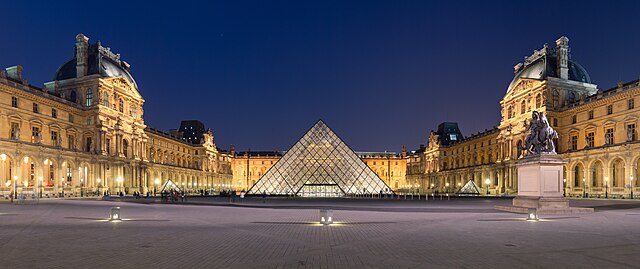
What can you achieve in 8 minutes? You can hard-boil an egg. You can listen to 80 percent of Taylor Swift’s “All Too Well” (10-minute version). Or, you can walk from the SciLi to Andrews Hall. In Paris, a team of three masked thieves heisted the Louvre—stealing 88 million euros worth of royal jewels. The team snuck into the first floor of the museum and managed to rob earrings, necklaces, tiaras, and brooches from empresses under the French crown. This heist is not just monumental, it is ironic: the colonizer’s museum is now being looted.
The same institution that displays relics stolen through European imperialism now finds itself plundered. When investigating this irony, one can draw connections between art being used as a tool of domination and the unraveling of Western cultural supremacy.
The Louvre is not neutral. It is a monument to colonial rule disguised as cultural appreciation. Many of the museum’s most prized and famous art pieces reflect French colonial expansion. In Plunder, a book on the history of Napoleon’s art thefts, Cynthia Saltzman writes, “Napoleon understood that the French kings had used art and architecture to aggrandise themselves and to build the image of political power, and he did the same thing.” Relocating plundered art to France was part of Napoleon’s grand scheme to assert the imperial dominance and destiny of the French empire. Saltzman highlights how the Louvre “would be Napoleon’s collaborator, ‘distracting eyes from the bloodshed and casualty counts, disguising his ruthlessness with the brilliance of its collections and transmuting that ruthlessness into glory.’” Essentially, the 18th and 19th century Louvre became a showcase of Napoleon’s imperial plunder. Napoleon’s conquest of Italy in the late 18th century and his display of stolen Italian treasures in the Louvre set a standard for later French colonialism in Africa.
The Rosetta Stone, found during Napoleon’s occupation of Egypt in the late 18th century, is now displayed in the British Museum. Napoleon’s army accidentally discovered the stone while digging up the foundations of a fort. The head officer, Pierre-François Bouchard, immediately detected the importance of his army’s discovery, noting that the stone could be a key to decipher hieroglyphic writing. French scholar Jean-François Champollion put the two pieces together: the Rosetta Stone holding hieroglyphics could record the sound of the Egyptian language, a facet essential to the study of Egyptology. When the French surrendered to the British in 1801, the stone was passed down and eventually showcased in the British Museum. Although not exhibited in the Louvre, French art taken during its colonial expansion still proved to transcend its own borders. Ruth Scurr, a lecturer at the University of Cambridge, observes that Napoleon envisioned “a universal museum in Paris and viewing himself as a ‘collector and a discoverer.’”
The era following the end of the Napoleonic empire involved the emergence of soft power, as opposed to military conquest, to expand France’s colonial interests. The theory of the “Velvet Empire,” coined by King’s College London Senior Lecturer David Todd, highlights how the exchange of luxury commodities such as champagne and silk textiles were a strategic form of imperial expansion to “seduce” client states. The silk industry, notably, experienced high export growth until the late 19th century, as France used it as a form of coercion for prestige and power. Silk—a symbol of affluence—granted France the ability to dictate the trade market and influence its trading partners. As the silk industry proliferated in France, so did its status as a regional power. Despite the shift from imperial plundering to coercive soft power in French monarchies, colonial legacies still stand strong.
The looted Louvre items and art exhibited in Napoleon’s “universal museum” have a deep past rooted in monarchical power imbalances. The stolen Louvre jewels, products of systematic colonial extraction and exploitation, have longstanding socio-cultural, historic, and economic value. Notably, the tiara belonging to Napoleon III’s wife, composed of 3,007 diamonds and 212 pearls, was fueled by slavery, as French colonial outposts funneled these goods into royal courts and elite collections. Royalty status symbols with embedded colonial pasts have now been taken away—a social comment against European imperialism and exploitation.
The Louvre epitomizes luxury and prestige, showcasing relics understood as sacrosanct. The heist, in turn, marks a shift in the perception of what is deemed “untouchable,” begging the question: How can Western museums respond to social comments about legitimately protecting global heritage? Modern reparation movements to reclaim what empires stole have occurred in museums in Greece, Nigeria, and Egypt. Even in France, President Emmanuel Macron, alongside a team of art and history scholars, established a commission to assess the country’s museum collections, which culminated in the 2018 report, “The Restitution of African Cultural Heritage. Toward a New Relational Ethics.” The investigation found that over 90 percent of the significant art and artifacts from sub-Saharan Africa were held by museums off the continent. Since 2018, France has been able to return roughly three dozen pieces. Despite initiating a global debate about reparations, many critics have argued that the country has taken minimal action regarding the decolonization of museums.
The act of museums increasing their effort towards returning work that is looted or symbolic of imperialism does send a broader signal that Europe is conceding and self-condemning its colonial history. In reality, former colonial powers are beginning to use their imperial relics showcased in museums like the Louvre to make symbolic amends for transgressions long past. Returning plundered art has now been perceived as a “moral obligation” since it represents an era of exploitation and injustice.
The image of the shattered jewelry display circulating online represents the vulnerability of Western cultural supremacy—something one deemed sacrosanct. The heist means that global powers must reconsider who owns culture and whose beauty they try to protect.