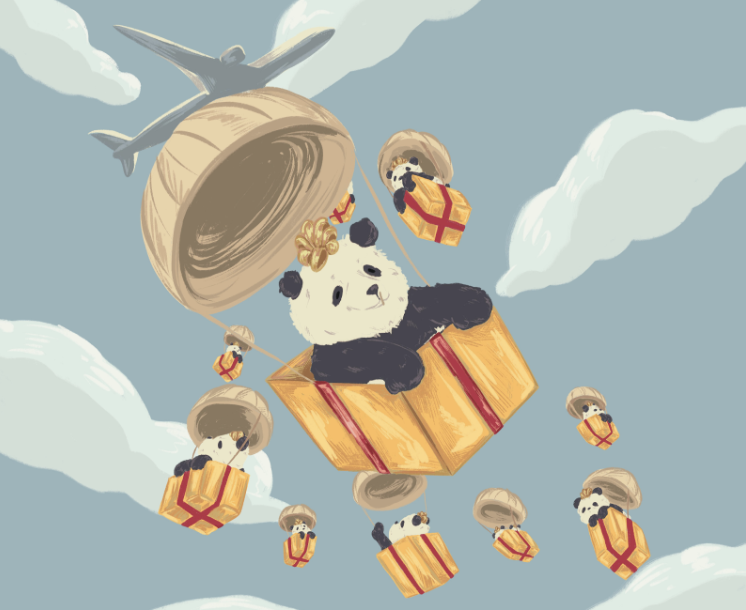
With Russia’s invasion of Ukraine—the largest European armed conflict since the Cold War—we have seemingly reentered an age deeming direct, great power combat as acceptable, and even more so, realistic. Whether a result of a growing national tendency towards isolationism, or due in part to increasingly nationalistic sentiments, we need one thing more than any: more Panda Express.
Not as in the fast-food Chinese restaurant, but the designated FedEx Boeing 777F planes adorned with Giant Panda graphics that transport the bears. Since 2000, these Panda Expresses have served as vehicles for the politics of “Panda Diplomacy” and a potential gateway for the Asian revitalization of soft power politics—something increasingly necessary amid a more disjointed international system, and one so historically interposed and currently dominated by hard power politics.
“Panda Diplomacy” is a form of soft power referring to the practice in which China loans or gifts Giant Pandas to other states to reinforce diplomatic ties or symbolize goodwill between nations. It dates back to the Tang Dynasty in the 7th Century, initially as a practice of gifting pandas, but today it revolves around leasing them out at the hefty sum of $1 million per year; the proceeds fund Chinese panda conservation and habitat development. However, leasing these pandas out is effective for more than conservation: it is inherently political in a way that does not require the mobilization of armies or the buildup of weapons.
‘Soft power’ politics is a more recently coined concept. For much of world history, international power had commonly been defined by military might, often quantified in the number of soldiers or the advancement of weapons. Historically, the Cold War was pivotal, serving as the apotheosis of hard power, before its brief decline thereafter, as the world subsequently saw a positive uptrend in soft power politics growing out of a more connected and globalized world. However, with the contemporary American diplomatic retreat and Russia’s brandishing use of military firepower, a continued world of sustained soft power politics seems to be in jeopardy.
Panda Diplomacy is one of many political efforts within a broader Asian movement advocating for the sustained vitality of soft power politics. It works by forging an international association between the symbol of the loaned-out Giant Pandas and China’s national image. Such diplomacy can bolster China’s global reputation, from which a happy public can garner indirect diplomatic power. For Chinese President Xi Jinping, these pandas can be political: possible “envoys of friendship between the Chinese and American people.” At a time of American paranoia surrounding the vitality of US hegemony, these political pandas are ideal for sustaining positive American-Chinese relations, without the need to flex military or technological muscle.
Yet, Panda Diplomacy is only one of many Asian attempts to reinvigorate, or at least utilize, soft power politics. China has recently made other attempts to sculpt a national image by incentivizing tourism by easing its visa processes and upgrading many of its museums. This is in addition to China’s most prominent attempt at garnering further soft power influence in surrounding countries through its Belt and Road Initiative, which seeks to improve rail and road infrastructure across Eurasia.
Other Asian nations exemplify their interests through the very structure of their governments. Thailand, with the creation of its National Soft Power Strategy Committee, fixates on shaping its leadership role in the broader global arena, approving guidelines meant to increase soft power via channels like the 5Fs—food, fight, film, fashion, and festival. Other countries also commonly utilize food to promote culture within the broader international system in an effort to increase global soft power, just as Taiwan does with bubble tea in its so-called “Boba diplomacy.” Countries like China, Thailand, and Taiwan gaze into the mirror of national potential, envisioning improvement—not through physical size and muscularity, but rather via decoration and international perception.
But with many East Asian countries mobilizing soft power, where do worries of their systemic precarity stem?
The first of many worries lies within the diminishing superintendential role of the United States, which many perceive as receding from its historical position of soft power stewardship. During his second term, President Donald Trump has begun dismantling traditional American avenues of soft power, whether through the deoperization of the US Agency for International Development (USAID) or the imposition of high global trade tariffs. It seems the United States has taken more of a back seat in national perception and international relations. This, in addition to initial worries of the US announcement of nuclear retesting, seems symbolic of a changing, harder time. The United States, as the historic weaver of global interconnectedness (especially after the Cold War), is just as capable of tearing apart its international tapestry as it is of reinforcing each bilateral, relational string, and in doing so, sustaining a more robust international system.
In addition to the United States’s relegated interests concerning soft power, there is the eruption of warfare between Russia and Ukraine. Such a threat of warfare between global powers has not existed to this extent since the Cold War. Conflicts like this may restandardize the use of physical armies in cultivating international relationships over constructivist identities, putting at risk many more millions in our now nuclear times. With the devolution back into the Cold War emphasis on physical and military strength, we put ourselves into the whims of political leaders and the risk of complete destruction.
After such a “long peace” following the Cold War, we are once again seeing the possibility for a more militant world, through the deconstruction, or at least de-emphasization, of relational diplomacy and soft power. With the changing atmosphere in international relations, many Asian countries now stand among the most prominent champions of such remaining soft power. The United States, with its diminishing interest in soft power, risks an upheaval of something it had once dominated—its best interests stand in its reinvestment. For all countries, how the world perceives you matters. Sometimes, what we need most is an appeal to human sentiment rather than fear; forging an appealing national identity rather than military presence. In the end, what better motivator is there than good food and cute animals?