The BPR High School Program invites student writers to research, draft, and edit a college-level opinion article over the course of a semester. Aayush Gandhi is a senior at Dublin High School in California.
Over the past decade, Russia has quietly expanded its military presence across the Arctic region by reopening and modernizing Soviet-era bases, deploying reconnaissance submarines, and limiting foreign access to the Northern Sea Route—a vital shipping passage along Russia’s northern coast. At the same time, China has also attempted to spread its influence in the region by collaborating with Russia militarily, developing the Polar Silk Road (an expansion of Beijing’s Belt and Road Initiative), and becoming a permanent observer in the Arctic Council, the region’s governing body.
While these two countries gained influence, the United States was absent from Arctic affairs and instead focused on conflicts in the Middle East and Europe. However, the United States has recently shifted its focus to the Arctic, worried by the threat of Russian and Chinese naval probing, accidental miscalculations, and other forms of conflict. This renewed attention facilitated the 2022 National Strategy for the Arctic Region, which made commitments to infrastructure, icebreakers, and international cooperation.
While this foreign policy strategy is a good starting point for the United States, it is insufficient to deter rising Russian and Chinese aggression; instead, the United States should create a grid of small, dispersed, and concealed bases across the Aleutian Islands and Northern Alaska.
For any deterrence strategy to be successful, it must sufficiently insert uncertainty in the other country’s decision calculus. For example, if Country A does not know Country B’s military capabilities, Country A might be less likely to attack Country B out of fear of an extensive retaliation or massive losses, regardless of Country B’s actual military capabilities.
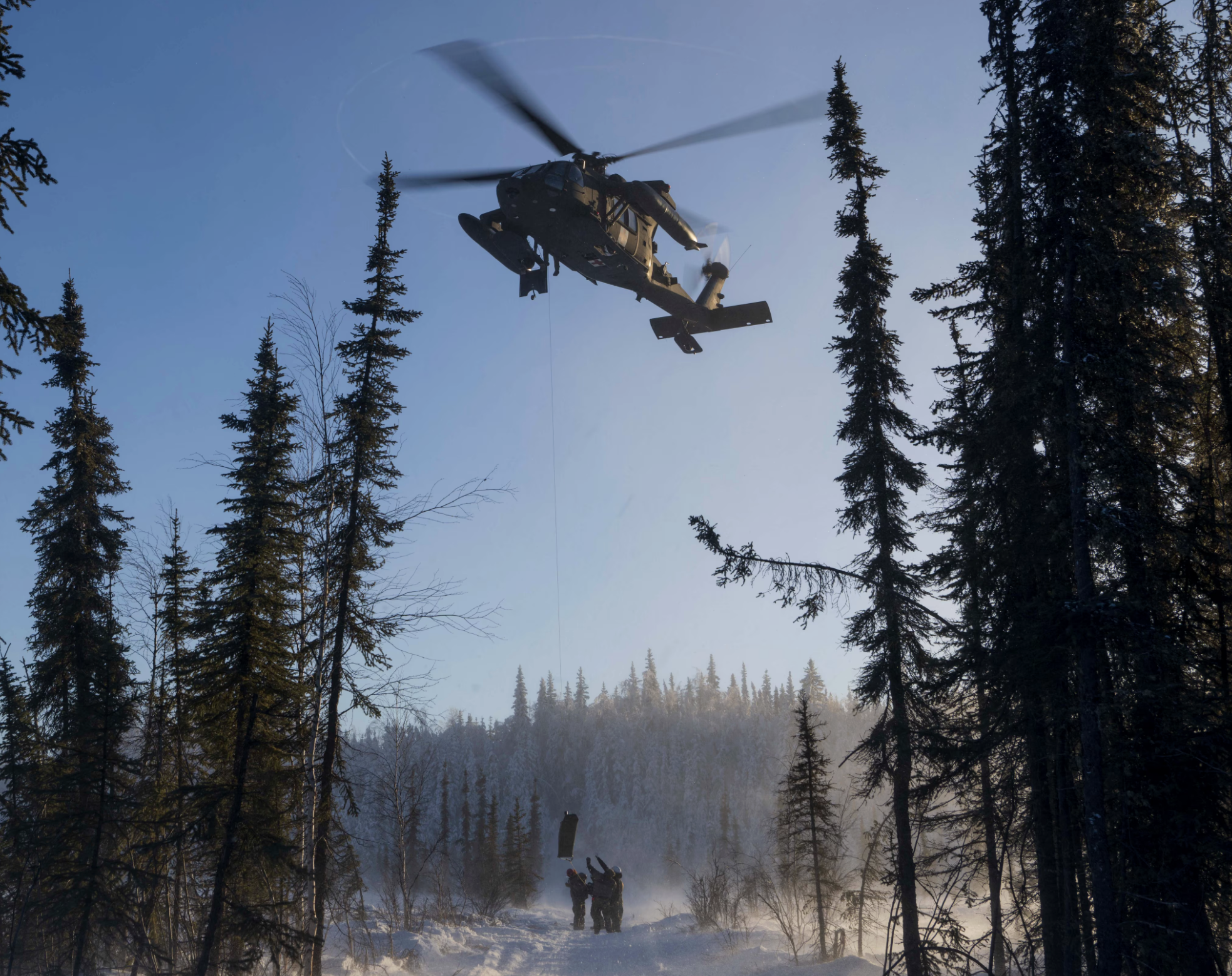
The dispersed basing strategy aligns well with this theory for the Arctic. Dispersed basing entails spreading military capabilities (e.g. missile defense systems and aircraft) across multiple facilities, rather than concentrating them in one large base (think Fort Bragg). In addition, the proposed strategy would focus on concealing bases by moving them underground or adopting extensive camouflage. Concealing bases creates an extra degree of uncertainty for foreign actors and further deters offensive action in the Arctic.
Dispersed basing can counter Russian and Chinese aggression in several ways. One of the biggest threats to the United States is China’s large missile arsenal and new flagship warheads that can swarm existing US defense systems in both the Indo-Pacific and the Arctic. However, if the United States creates multiple dispersed bases rather than a single large one, the cost of a missile attack for China would be high and unpredictable. Beijing would have to use considerably more missiles across a wider theater of war and detect all of the United States’ military facilities, which would be extremely hard since smaller bases are easier to conceal.
Another threat comes from Russia: the Kremlin is quietly conducting overflights and military maneuvers near Alaska and the Air Defense Identification Zones of NATO countries, likely cutting undersea internet cables, and expanding other offensive operations. More bases and investment would equip the United States with new capabilities (e.g. reconnaissance) that would help it monitor the region, raising the cost associated with an attack. At the same time, it will also signal US strength in the area.
This strategy would also have broad bipartisan and military support. The Arctic (and the urgency to act) is a concern on both sides of the aisle, and this strategy is already being used in the South China Sea. Furthermore, numerous military generals, including Admiral Samuel Paparo, commander of the United States Indo-Pacific Command, support the reopening of Adak (a decommissioned Arctic military base) and pursuing a flexible military strategy in order to improve US capabilities.
There are two main counter-arguments. The first focuses on the deterrence theory, while the other focuses on the dispersed based strategy itself.
Some argue that US military presence will exacerbate existing tensions in the Arctic and increase the risk of conflict. While there might be a possibility of a Cold War-style “military-race,” these critics ignore that China and Russia are already escalating tensions by increasing their militaries and violating US territorial sovereignty, so there’s only a possibility that a new strategy is better. Furthermore, a strong Arctic presence can strengthen the United States’ soft power, allowing Washington to pursue deescalation and other negotiations with China and Russia. Absent the threat of military force, China and Russia won’t listen.
Others might argue that increased Arctic military presence would unduly impact Alaskan Native communities. To alleviate this, any basing strategy should involve consultations with local indigenous communities to ensure their concerns are heard.
However, the biggest concern is financial: Alaska has one of the highest cost-of-living indexes in the United States, and building multiple small bases in remote areas would be expensive. This said, military presence in Alaska would actually stimulate further economic growth through the development of the Northwest Passage (a major modern shipping route) and an influx of investment (creating jobs, businesses, and houses). While these benefits might not “recover” the entire cost of the project, it is still worth pursuing because the risks to US security are far greater.
The United States is in the midst of developing its Arctic strategy after years of negligence. America must strengthen deterrence and Arctic capabilities to counter rising Chinese and Russian aggression—dispersed basing is the best way to do so.