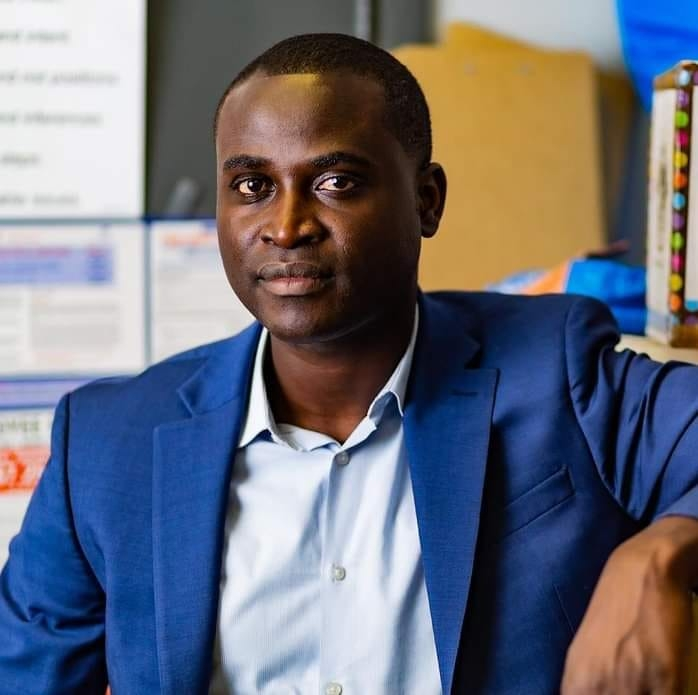
Dr. Omar Bah is the founder and former executive director of the Refugee Dream Center. Under his leadership, the Refugee Dream Center has grown into an incredibly comprehensive resource for refugees across Rhode Island, offering services spanning education, employment, youth development, and food and hygiene distribution. With degrees in political science and psychology, a trauma treatment certification at Harvard Medical School, and an adjunct professorship at William James College, Dr. Bah brings both lived experience and deep expertise to his work supporting the Rhode Island refugee community.
Riyana Srihari: Tell me about what drew you to founding the Refugee Dream Center (RDC), and what led you to this work.
Dr. Omar Bah: I grew up in rural Gambia, where I lived amongst three generations in a compound settlement, surrounded by aunts, uncles, and lots of family members. My father had three wives, but my mother was his first and was married very young, at 15. I believe that she should have been in school. She should have had a future for herself and been empowered and protected as a child, rather than forced to do domestic work and take care of children and families. I feel that that is where my sense of advocacy was born.
I’m the second child of eight children. My older brother had epilepsy, and, in my culture, many people believe that epilepsy is some sort of demonic attack. Because of this, and because he was often in the hospital or undergoing treatment, I became like the first son and took on a lot of responsibility. I would babysit while my mother took our laundry to the stream, and I would listen to her sing with her beautiful voice as she washed laundry for at least 15 people. Because she was the only wife in the compound, she would wash for everybody, carry heavy buckets of water on her head for everyone to drink and shower, cook for everybody, and sweep for everybody. It was extreme slave labor. I don’t think she slept more than four hours in a day. And if there was ever a shortage of food or water, someone—either my father or my father’s younger brothers—would beat her up.
I hated that I was powerless and could not protect my mother as a child. So I said, “When I grow up, I will fight for young girls to go to school and protect them against domestic violence and slave labor if they are already married.”
RS: I’m so sorry that you grew up feeling powerless, and it’s so powerful to think about what you’ve done in your mother’s memory. How did you begin pursuing this dream of fighting to protect women like her?
OB: I wanted to be a lawyer, but the only thing that my country offered was a two-year pre-law course. I would have had to travel to neighboring countries like Sierra Leone, Ghana, or even the United Kingdom in order to get my degree. But I did not have the money. My family was poor, from rural Gambia. I think I may still owe my community college some fees!
I felt I had hit a dead end in becoming a lawyer. Instead, I became a journalist. But during that time, there was a dictatorial regime, and I got into a lot of trouble for the things I was writing. I was tortured and imprisoned, and I went into exile in Senegal, then Ghana, and eventually fled to the United States. When I came to the US in 2007, I began working at a bank and volunteering within the refugee community, advocating for fair housing and access to services for refugees. It became my world. I asked myself, “What is my new form of journalism, my new form of lawyering, my new form of activism?” And the answer was setting up the Refugee Dream Center.
RS: Thank you so much for sharing your incredible journey to the RDC. I’d love to hear more about those early days: What was the political climate around immigration and refugeehood like then, and how has this climate and the makeup of the refugee community shifted over your time at the RDC?
OB: You know, when I came here, I was the only refugee from The Gambia. There were waves of people from different populations at that time: a lot of people from Bhutan, Liberia, Nepal, survivors of the Rwandan genocide, and eventually Iraqis in 2003. At that time, the environment was not so polarized, and immigrants were not blamed for all the problems that people encountered with the government or society. People felt supported and welcomed. But, eventually, that changed with the current system and administration.
Now, I see the administration failing to put in proper immigration policy to resolve the crisis. But the people are not supporting the situation. They are standing with refugees and immigrants, supporting them, volunteering, interning, speaking out, and donating so people see their humanity.
RS: That’s a great segue into my next question, which is actually more specific to the Trump Administration. How did his first term impact the RDC, how did you prepare for the second term, and how have recent federal policies impacted your capacity and the greater refugee community in Providence?
OB: This one is certainly worse than the last time. It’s hard to say, but it is. Last time, he specifically focused on Syrian refugees, and it was horrifying. Now, it’s become a broad, wide-ranging, calculated effort.
In the first Trump Administration, the RDC was a strong advocate for the Syrian community. When he instituted the Muslim ban, there was a major crisis; people were stopped at airports, and we really had to show up for our community.
Then comes the second Trump Administration, where everything has been amplified at every level. Even green card holders are being attacked, and the entire Somali population was deemed “garbage.” We feel that it’s extremely racist and an insult to refugees and immigrants. Somali populations have been coming to this country for a long time, meaning a lot of them are naturalized citizens. Trump does not even know what refugees or immigrants are: To him, any non-white person is potentially not “American” enough.
Because of that, our funding has been frozen. We’ve lost at least $500,000, and there has been a pause in the number of refugees that are being let in. We have so many Afghani refugees whose families cannot join them because of the immigration freeze. And now, there is a major asylum freeze. People are here, and their asylum cases are not being processed.
In addition to that, ICE is literally terrorizing our communities. This morning, when we finished our press conference, I got a report that an Afghani community member who was coming to the office had been arrested by ICE. We don’t know what happened, and we’re fighting to figure it out. But that marks the fourth person within the last month and a half arrested by ICE. It’s a situation where people live in fear, uncertainty, and helplessness.
RS: I know ICE has long been a source of fear and terror for immigrant communities across America, and the federal government’s endorsement of this escalation is so horrific. I want to also zoom in a bit more on Rhode Island: How effectively do you think our local government coordinates refugee services, and what are the biggest gaps in US resettlement policy today?
OB: Both the local government and the state government are welcoming in declaring their support for immigrants and refugees. They say that they will maintain our status as a sanctuary city and proactively ensure funding for essential services. The state government is pretty involved in resettlement because they hire the state refugee coordinator who partners with us and approves which refugees can come here from Washington. We also get some money from the Department of Human Services to help with resettlement, and they’re always ready to coordinate with us, which we certainly appreciate. There is always further to go, but we are lucky.
RS: I know that you have also been personally engaged in local politics, through your grassroots campaign for the Second District Congressional Seat. Your platform was rooted in better healthcare, education, and a raised minimum wage. I would love to hear about that experience and what inspired your decision to move into politics.
OB: Yes, absolutely. A recurring theme in my life is my love for the American Dream and the notion that we can build a free society with opportunities and success for all. It’s where the Refugee Dream Center’s name comes from. I hoped that my campaign could promote a sense of inspiration for others and show refugees and immigrants that they do not have to sit on the sidelines. So, my theme was “Defend the Dream.” There was a dream that we were promised, a dream that should include affordable healthcare, housing, employment, and all the opportunities. I wanted to fight for that. It was tough, and we needed a lot of money, but I’m proud of my campaign and the people that fought with me.
RS: What do you think electoral politics can offer us right now, with regards to protecting the rights of the refugee communities you serve at RDC? What do you see as the limits of electoral politics?
OB: Well, I think they’re important. Sometimes, one vote in Congress can promote a sense of moral companionship and amplify important issues. I always talk to refugees and immigrants about how, when they become citizens, they can participate and support the continuous prosperity of this country. Electoral politics are a place where people can hear you, hear your issues, make changes, and address those issues from a policy perspective. But if some people at the table do not understand or care about your issues, it cannot happen.
RS: If you were able to advise the next federal government on refugee policy, what would your top three priorities be?
OB: I think I would begin by working to stop conflict in the world. America has the power for that: the power to end the majority of the problems that contribute to displacement of individuals across the world. We have the power to say “no more wars” and “no more conflict.” I would also increase our resettlement. We need to give people a real second chance and return to our promised American ideals: extending humanity and standing with the most vulnerable.
Finally, I would work to truly address the immigration crisis. People are sometimes here for decades without documentation, and many of them even have children that were born here. I spoke to one man, who was struggling to pay for immigration and filing fees for his family. His wife walks from house to house, cleaning eight to ten houses per day in order to make money. It is barely enough to feed their children and to afford the costly citizenship process. Imagine how much better her life would be, and imagine how much happier her children would be, if we had more comprehensive and supportive immigration policies that did not drain families’ savings.
RS: Building off of that family’s story, I know that prior to the creation of the RDC, refugees were only supported for up to 90 days after resettlement. What do you see as the largest challenge that families face after resettlement, and how has the RDC been able to help alleviate these challenges?
OB: I think the first challenge is culture shock and culture clash, and the second challenge is language and economics.
Refugees undergo extreme levels of violence and trauma in their home countries, and it’s important to remember that there is a baseline of suffering that they have experienced before arriving in the US. Sometimes, they do not even know the name of the city they are traveling to until the day before they leave the refugee camp, as was the case for me. Refugees are not given information about the culture they are joining and are simply dropped into an apartment. They have to relearn everything, and even little things like exchanging money are so difficult. That alone is psychologically damaging.
As they begin to settle in, they have to adjust to job interviews, and this new structured work schedule, and how to walk quickly and keep up with the pace of the city. Eye contact is a huge thing, as well: In American culture, you have to look people in the eyes for them to feel like you are present and learn how to engage in an energetic handshake, and all of these things feel so foreign. Many of our clients lose jobs over basic things like this—their employers may say they seem too robotic, or they don’t know how to interact in the workplace, or even imply that the food they are eating in work areas is too smelly. Racism and cultural clashes are major issues that our community has to grapple with.
Language is also a big problem. Many refugees cannot even read and write in their own languages, and those who speak English often struggle to keep up with the idioms here or speak in a flat affect that may concern their doctors or their bosses. This is why it takes some people months or even years to feel like they have a grasp on functional English—something that you need to be able to fully adjust to this society.
Finally, economic issues are a major problem. The refugee community is underemployed, and employers often take advantage of them. It’s something we advocate against, and we try to equip our clients with the resources they need to resist this. But it is certainly a massive problem that we continue to work on.
RS: Thank you for this robust description and for the work you’re doing to make that transition a little bit smoother. I’d love to hear about the community you’ve built at the Center and what your biggest source of hope is throughout this process. Where have you seen the community leaning on each other throughout the tumult of the current administration?
OB: You know, I think that there is always hope. I find hope in seeing Americans become welcoming communities, donate their money and materials, stand with refugees and immigrants, and show up as interns and mentors to support our people. That is the real America, because the country that we were before Trump was one with extremely high levels of resettlement and a lot more support for refugee communities. When everything gets polarized and difficult, I think about the people that I see every day: the older generations of immigrants and refugees and their children.
The beauty of the RDC is that we do not only work with one ethnic community. We have some incredible organizations in this country that focus on specific ethnic populations, and we need those. But it is also amazing to be part of an organization that can bring refugees from different origins together. When the Afghani community is struggling, or the Venezuelan community, or the Haitian community, we see their Congolese and Somali and Iraqi neighbors standing with them.
*This interview has been edited for length and clarity.