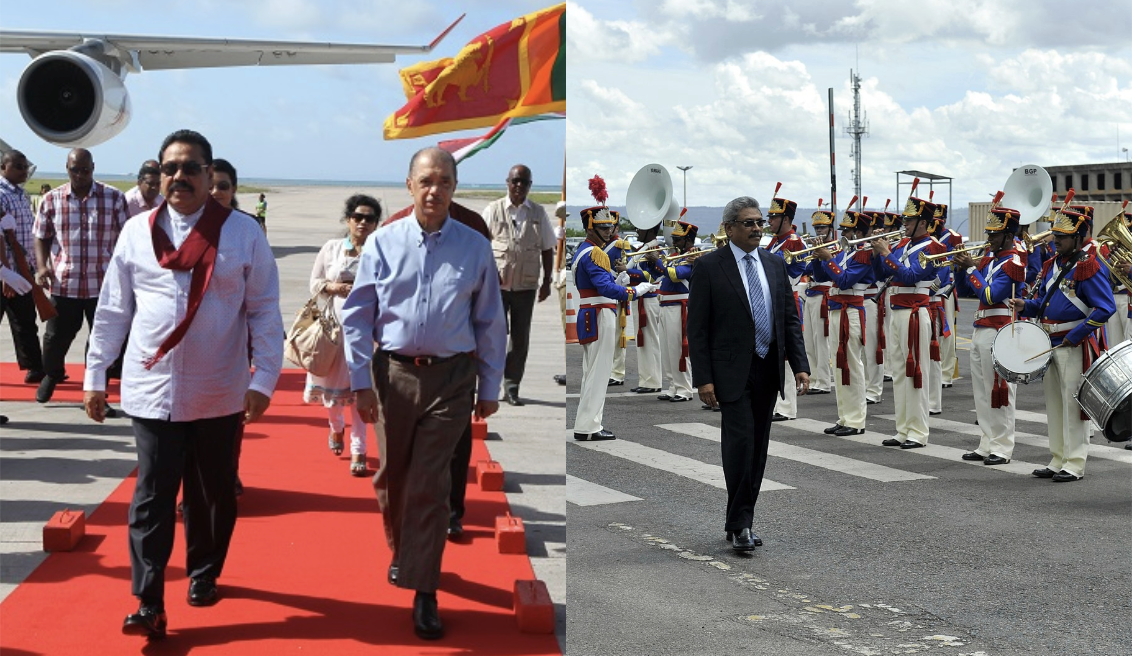
In July 2022, thousands of Sri Lankans stormed the presidential palace in Colombo. They swam in the president’s pool, sat in his chair, and used his personal gym. These actions were not borne out of rage at just one leader. It signaled the end of two decades under the Rajapaksa family, a regime that had treated the country like their personal empire.
The rise and fall of Sri Lanka’s Rajapaksa dynasty is a vivid illustration of how weak political parties, closed political networks, and high campaign costs enable political families to dominate a country’s political landscape. There needs to be systemic change in the Sri Lankan electoral system to ensure that these dynastic politics do not make a disruptive comeback. Both Mahinda and Gotabhaya Rajapaksa reigned through self-interest in their respective terms as executive presidents of Sri Lanka. They ensured that their family would rule the country, not serve it.
Weak, easily controllable political parties create the perfect breeding ground for political dynasties to centralize power. The Sri Lanka Podujana Peramuna (SLPP, loosely translated to the Sri Lanka Freedom Alliance) was founded by Basil Rajapaksa. The party functioned as little more than a vehicle for the Rajapaksa’s political ambitions, becoming known as the “party of the Rajapaksas.” The party has nominated Rajapaksas as its past two presidential candidates.
Weak political parties such as the SLPP do not just enable dynasties—they allow the buildup of patronage networks that push out minorities and, in some cases, actively harm them. Their patronage network largely consisted of Sri Lanka’s ethnic and religious majority, Sinhala Buddhists. The SLPP relied on its Sinhala electoral base to propel the Rajapaksa family to the top, with policies catered towards Sinhala pride. Mahinda won the presidential election in 2005 on a promise that he would end the country’s 30-year civil war with a Tamil militant organization, the Liberation Tigers of Tamil Eelam. He gained support through signing electoral pacts with Sinhala nationalist parties. Rather than addressing the underlying ethnoreligious tensions between the minority Tamil and the majority Sinhala which caused the war, Mahinda ended it after committing a series of war crimes against the Tamils. In other words, he played on the prejudices of Sinhala Buddhists by waging a campaign of terror against the country’s minorities, securing a surefire electoral base for when he or the next Rajapaksa ran for president. Subsequently, Mahinda’s older brother Gotabhaya won the 2019 presidential election by exploiting ethnic majoritarianism. He capitalized on Sinhala bigotry after a series of suicide bomb attacks in April 2019 were revealed to have been perpetrated by an Islamic terrorist group. When parties are built on ethnic patronage rather than broad coalitions or institutional strength, they give dynasties an easy path to power while abandoning minorities entirely.
To cement such a powerful dynasty, you must close ranks. Closed political networks were part of the reason that the Rajapaksas were able to enjoy two decades of power. When Mahinda became president, he appointed Gotabhaya as Defense Secretary, allowing his brother to take partial credit for ending the Civil War—a factor that would contribute to his presidential win in 2019. Mahinda’s other brothers, Chamal and Basil, also served as ministers of various departments during his term. At one point, it was reported that the brothers controlled 70 percent of the national budget. During Gotabhaya’s presidential term, Mahinda’s son Namal became a member of Parliament, and Mahinda was appointed prime minister. The Sri Lankan executive and legislative branches had effectively become the Rajapaksas’ family business—one that they used to tank the Sri Lankan economy. Mahinda began taking loans from China, an act that would spark Sri Lanka’s debt trap. It was clear that the amount of control the Rajapaksas had over the economy was disadvantageous to the country. Instead of expert-led decision-making, one family dominated the Parliament and the executive branch. The appointments of other Rajapaksas to positions of power also prevented more deserving politicians from taking these roles. This crowding out is the crux of the issue: The dominance of political dynasties reduces the ability of grassroots actors, or anyone new to politics, to enter the governmental sphere.
The need for connections is not the only red tape in entering politics. When campaigning for an office as prestigious as the presidency, a candidate incurs significant costs. To receive an established party’s nomination, a candidate must prove their worth to senior party leaders, which is often directly proportional to their financial capabilities. To stand a chance in a competitive election, a candidate must advertise, host rallies, and gain favor with potential electoral bases. These activities require not just organization but copious amounts of cash. The Rajapaksas were able to make use not only of a family name but also of family wealth. In 2021, the Pandora Papers, a global investigation of offshore finance, revealed the Rajapaksas’ hidden assets. Nirupama Rajapaksa—a cousin of the Rajapaksa brothers—and her husband owned luxury homes and expensive artwork, all hidden offshore. Nirupama herself was a Minister of Parliament while her cousin Mahinda was the president. The family’s ability to attain these high offices was supported by their massive wealth. Meanwhile, Sri Lankans suffered from the economic crisis caused by the Rajapaksas’ poor economic decision-making and exacerbated by the global recession brought on by the Covid-19 pandemic. To a normal Sri Lankan, their leaders’ massive wealth—most of which they hid—was unseemly in the face of lingering poverty in many parts of the country. The Rajapaksas embodied antimeritocratic elitism. And as is typical of elite institutions where only a select few participate, money equals success. If you happen to be short of it, your political path is considerably more difficult.
Dynasties fall, but history has seen them rise again. The Rajapaksas met their ugly political end in 2022, once Gotabhaya resigned amid mass protests sparked by a fuel, electricity, and foodstuff crisis. He fled the country in shame after his residence was stormed. Despite their unseemly exit from presidential politics, the Rajapaksas have still tried their hand at regaining power. Namal Rajapaksa contested in last year’s presidential election, but Sri Lankans kept their defenses up, and he came fourth. The consequences of dynastic rule have played out, and Sri Lankans appear to have learned from their mistakes.
Despite a breath of relief at a Rajapaksa-free era, it may be short-lived. To ensure that Sri Lanka is not led to ruin by a dynasty again, there must be action against the institutional problems that allow them to come into power. It needs to level the playing field for grassroots candidates and give them more funding through grants or matching programs that multiply small donations. Campaign finances should also be more transparent, with hard limits on how much any one person or corporation can contribute. This would encourage small donations from minority groups, so they can make their voices heard. The system must also reward politicians who build broad, diverse coalitions instead of courting the same wealthy donors and special interests. After a candidate comes to power, they should be forbidden from directly appointing family members to plum positions. Their preferred candidates must meet the qualifications for that position. The system must be fixed now, or the government will again become a playground for the wealthy and well-connected. Otherwise, we may see the Rajapaksas, or another aspirational dynasty, in power once more.