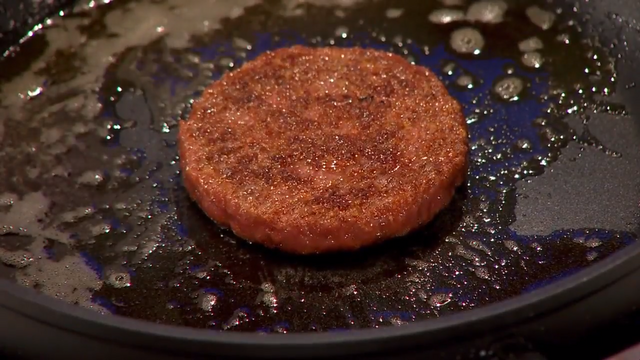
“They grow like a tumor, then you bathe them in chemicals,” says one girl at a science fair in an ad by the Center for Environment and Welfare (CEW). The CEW has recently launched a public education campaign to cast doubt on a food product that recently entered the market: cultivated meat. Produced by growing animal cells in controlled environments, cultivated meat eliminates the need to raise entire animals for food. This food technology has immense potential to tackle some of the world’s most urgent challenges, from reducing food insecurity and curbing emissions to safeguarding against future pandemics. However, the recent backlash against cultivated meat is preventing us from exploring—let alone realizing—this potential.
Alternative proteins refer to any food products designed to replicate the taste, texture, and nutritional value of conventional meat. This category includes plant-based meat, which use only plant-derived ingredients to emulate meat characteristics (for example, veggie burgers), and cultivated meats (also referred to as “cultured” or “lab-grown” meat), which are produced by cultivating animal cells directly to form meat tissue.
In recent years, efforts to discredit these alternative proteins have intensified, and their effects on public support of these foods are materializing. In the United States, sales in plant-based meat products fell by 12 percent in 2023, and similar declines are reflected in other countries as well. Critics have attacked plant-based burgers for being “ultraprocessed” and unhealthy while cultivated meat faces skepticism from consumers wary of eating “lab-grown” food. Cultivated meat has often been labeled “Frankenstein meat” by its opponents, a term that is spreading unfounded fears and misconceptions among consumers. Some are concerned that the potential health effects of cultivated meat remain understudied, despite the Food and Drug Administration approving it safe for human consumption in 2022.
The critique that cultivated meat and its effects are understudied has culminated in a series of legislations that, counterintuitively, make it increasingly difficult for companies that produce cultivated meat to research, grow, and innovate. In fact, in September of 2025, it officially became illegal to sell cultivated meat in the state of Texas. Sid Miller, Texas’s Agriculture Commissionary, supported the most recent ban, declaring that “Texans have a God-given right to know what’s on their plate, and for millions of Texans, it better come from a pasture, not a lab.” Such statements reflect a broader public distrust of a novel food item, and Texas is not alone in regulating its production, nor is it uniquely a domestic trend. Earlier this year, Florida, Nebraska, and Alabama enacted a similar ban on cultivated meat, and at least nine other states have imposed new restrictions on how cultivated meat products are labeled. Outside of the United States, Italy has already banned cultivated meat since 2023 in an effort to protect Italian farmers, and France has considered doing the same.
This growing trend of state regulations proposes new questions about the jurisdiction of state governments in the food industry. Should states be allowed to decide what ends up on their constituents’ dinner tables? Or should consumers have the freedom to choose what they eat? After all, basic economics tells us that if consumers do not like the product, it will not sell. However, states like Texas are intervening in these free market principles by regulating cultivated meat, despite consistently championing free-market values and the importance of consumer freedom in other industries. The Texas ban was proposed in order to protect cattle ranchers, but some farmers—particularly in Nebraska and South Dakota—have opposed similar bans and emphasized that market forces should determine the success of cultivated meat, rather than more rules and regulations. As Dan Morgan, a Nebraskan cattle rancher, says, “The customer ultimately makes the decision whether they like your product or not.”
Furthermore, the idea that food can come from a lab may not even be as foreign as it is made out to be. Take Cheetos, for example. It was ranked the most popular snack in Texas in 2024. But Cheetos, like countless other processed foods, contain synthetic flavors and dyes—many of which are developed in laboratories. The truth is, a majority of our food system is already far from “natural.” The United States has one of the largest consumer markets for artificial sweeteners, which are present in many energy drinks. More than 90 percent of US corn, cotton, and soybean crops are now produced from genetically modified seeds.
In his statement on Texas’s ban, Sid Miller adds that, “It’s plain cowboy logic that we must safeguard our real, authentic meat industry from synthetic alternatives.” This type of rhetoric, which argues that real meat is authentic and therefore must be protected, is pervasive, and yet it is also extremely misguided. In many cases, the meat and dairy industry is also incredibly industrial. Few would find the process of artificially inseminating a cow to produce milk natural, but it is a practice used by 80 percent of dairy producers in North America.
Considering that we have accepted many so-called “unnatural” methods of production for foods that are now staples in our diets, it is paradoxical that we refuse the development of a lab-grown product that currently only sells in a single restaurant in Texas. Much of this resistance stems from the messages consumers receive. Like the CEW advertisement that likens cultivated meat to a tumor, many organizations are producing material to evoke unsettling imagery around cultivated meat, framing it as artificial or unsafe. At the same time, we are surrounded by idealized depictions of farming that romanticize rural life. These images often euphemize many aspects of modern farming that more closely resemble factory-line production than pastoral life. In fact, today, over 70 percent of the world’s meat is produced in factory farms, which describes the large-scale mass production line type of farm. In the US, this figure reaches 99 percent. Most farms operate like factories out of necessity, since Americans now consume over 30 kilograms more meat than they did in 1961. Combined with population growth, this has driven a near threefold increase in meat production, even as the number of farms has steadily fallen.
As the global demand for meat continues to rise—projected to double by 2050—we need to rethink how we currently produce food. Almost half of the available land in the United States is used for the production of meat. Traditional livestock farming is reaching its environmental and logistical limits, even as global hunger persists. Cultivated meat offers the possibility of producing protein with far fewer resources, potentially easing pressure on our food systems already strained by climate change, soil degradation, and dwindling arable land.
It is time for states like Texas, as well as the United States as a whole, to uphold their values of free markets and consumer choice. The alternative protein industry offers vast potential for innovation and economic growth, yet these new restrictions stifle competition and limit the very consumer freedom Americans claim to defend. By stifling innovation in the cultivated meat sector, we are not protecting our food system, we are holding it back from the progress and adaptation it needs.