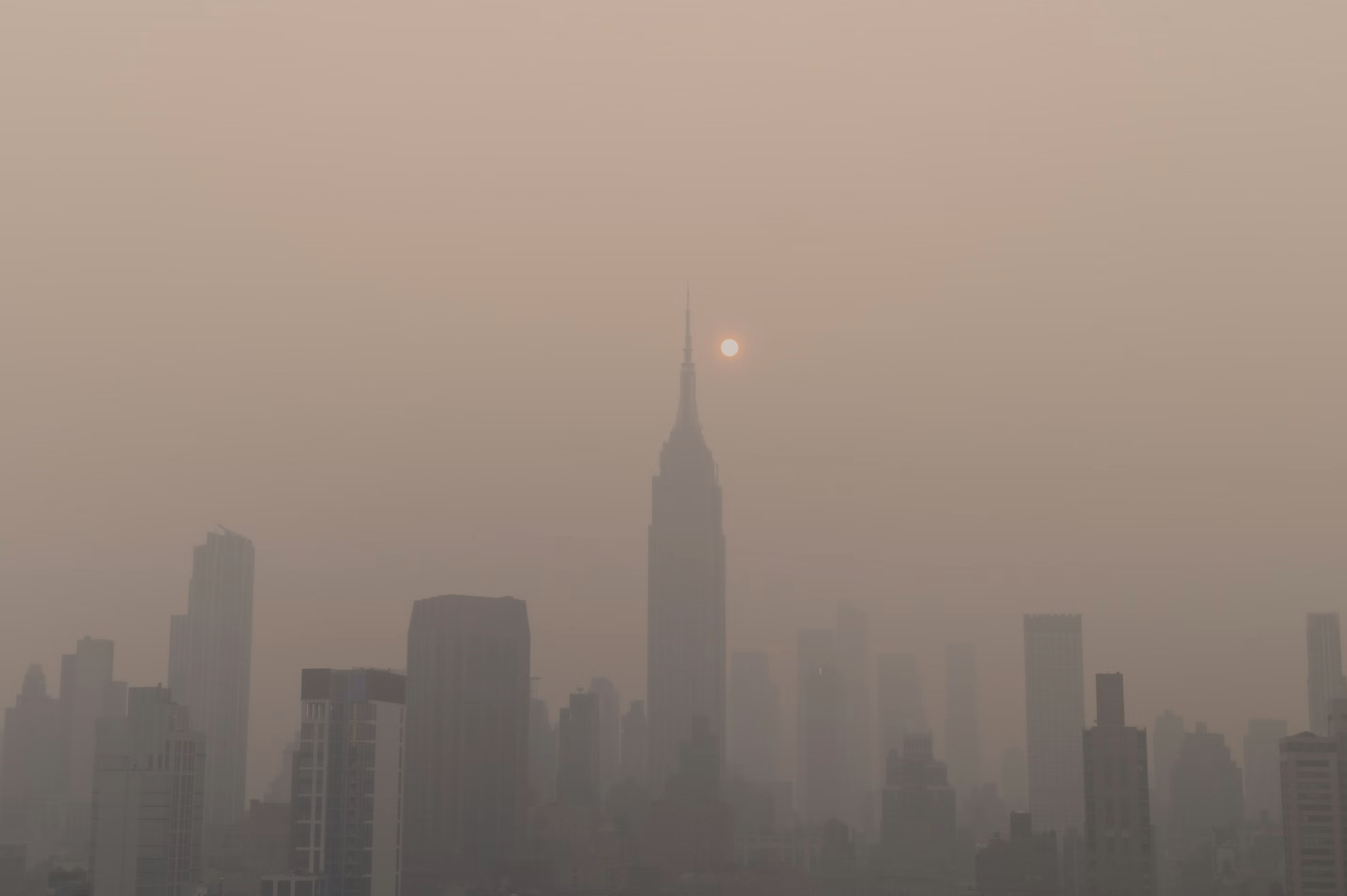
It’s easy to assume that air pollution is a relic of America’s industrial past: a phenomenon that belonged to the age of steel mills and smog-choked skylines. But drive through the petrochemical corridor of Louisiana, or the refinery-lined neighborhoods of Houston, or the fenced-off industrial pockets of South Los Angeles, and the illusion disappears. The distance between a clean breeze and a dangerous one often comes down to nothing more than a ZIP code. In the United States, who breathes safe air is not an accident of nature. Rather, it is a political decision.
Despite the sweeping victories of the 1970 Clean Air Act–including nationwide limits on key pollutants, the creation of National Ambient Air Quality Standards, and the establishment of the EPA to enforce compliance–environmental injustice remains deeply entrenched within our society. Black and Hispanic communities are still 1.5 times more likely to be exposed to toxic fine-particle pollution (PM2.5) than white communities. While the Clean Air Act dramatically improved overall air quality, it did not change where pollution is placed or whose lungs absorb its consequences. Industrial plants, refineries, and landfills have remained overwhelmingly concentrated in low-income neighborhoods across states like Louisiana, Texas, and California. Climate change only sharpens this divide: hotter days trap more smog, wildfires spread particulate matter across urban centers, and already vulnerable communities are hit first and hardest. Policymakers often cite modern climate legislation as evidence that the government is taking climate equity seriously. For example, the Inflation Reduction Act (IRA), the largest federal climate law in U.S. history, includes investments to reduce emissions and support clean energy. However, these policies typically focus on cleaning up after harm has already occurred, rather than preventing environmental inequality in the first place. They treat pollution as an unfortunate side effect of progress, not as an injustice concentrated through decades of zoning laws, corporate lobbying, and deliberate political neglect. In reality, the government’s efforts fall short because they chase mitigation, not prevention. True environmental equity requires redistributing environmental risk itself through stronger zoning protections, community-led planning, and constraints on industries that have historically benefited from exploiting vulnerable neighborhoods.
The evidence is striking. Joint research from the EPA and Harvard reveals that Black Americans experience 54 percent more pollution exposure than they generate through their own consumption. White Americans, meanwhile, experience 17 percent less than they produce. These imbalances did not emerge from consumer choices or natural geography; they are the predictable outcome of where governments have permitted pollution to exist. Louisiana’s “Cancer Alley” is the clearest example. Stretching roughly 85 miles along the Mississippi River, this corridor contains over 150 petrochemical facilities. Despite repeated public health warnings and residents’ pushback, state officials continue to approve expansions. It is often framed as a necessity for economic growth. The political power imbalance is unmistakable.
It is within this power imbalance that resistance becomes weakest. Minority and low-income communities often have less political leverage to push back because they have fewer elected representatives, lower voter turnout due to decades of disenfranchisement, and limited access to legal resources. Meanwhile, multinational petrochemical companies lobby aggressively with millions of dollars, high-profile attorneys, and political connections that dwarf the power of residents fighting simply for breathable air. This unequal power dynamic shapes zoning boards, state environmental agencies, and permitting decisions, making it easier for harmful industries to settle in communities least able to resist them.
Even well-intentioned federal initiatives like Justice40, which aims to direct 40 percent of climate investments toward disadvantaged communities, are hamstrung by vague metrics and inconsistent implementation. Without enforceable standards or structural changes, the program risks becoming symbolic, more gestural than remedial. Supporters of the current system argue that relocating industries would harm state economies or eliminate essential jobs. Others point to recent laws such as the Inflation Reduction Act, which includes historic investments in clean energy and community-level climate programs, and claim that they already adequately prioritize marginalized communities. Many provisions of the Inflation Reduction Act focus on remediation and incentives, including tax credits and grants for clean projects rather than explicit, enforceable mechanisms to stop the pollution in vulnerable neighborhoods. However, these counterarguments overlook how the system actually operates. Industrial zoning decisions nearly always place the most significant environmental risks where political resistance is weakest. Regulators routinely side with corporations, citing economic benefits while downplaying the long-term health costs. And the notion that economic growth requires polluting vulnerable communities rests on a false choice that benefits industries, not residents.
The result is a cycle of pollution that harms marginalized communities. Those communities have less political leverage to push back, and industries capitalize on that imbalance to expand further. Money can be poured into cleanup and health programs, but without changing who bears the risk, the inequality persists. Environmental injustice is not a technical problem but a structural one. It is etched into zoning maps, reinforced by state regulators, and preserved by a political system that treats some communities as acceptable buffers for economic development. Breaking that pattern requires more than federal grants or new standards. It requires transforming the underlying power dynamics, which means shifting who controls land-use and permitting decisions from industry and pro-development zoning boards toward community-led planning and legally enforceable municipal protections so that marginalized neighborhoods are no longer treated as acceptable sites for hazardous facilities. Unlike one-off grants or new regulatory standards, this approach centers redistribution of decision-making power, for example, community veto rights over new permits, changes to zoning that prevent hazardous siting near residential areas, and funding for community-led monitoring so that prevention becomes the norm. Until environmental risks are distributed fairly, air quality in America will remain a measure not of geography but of inequality.