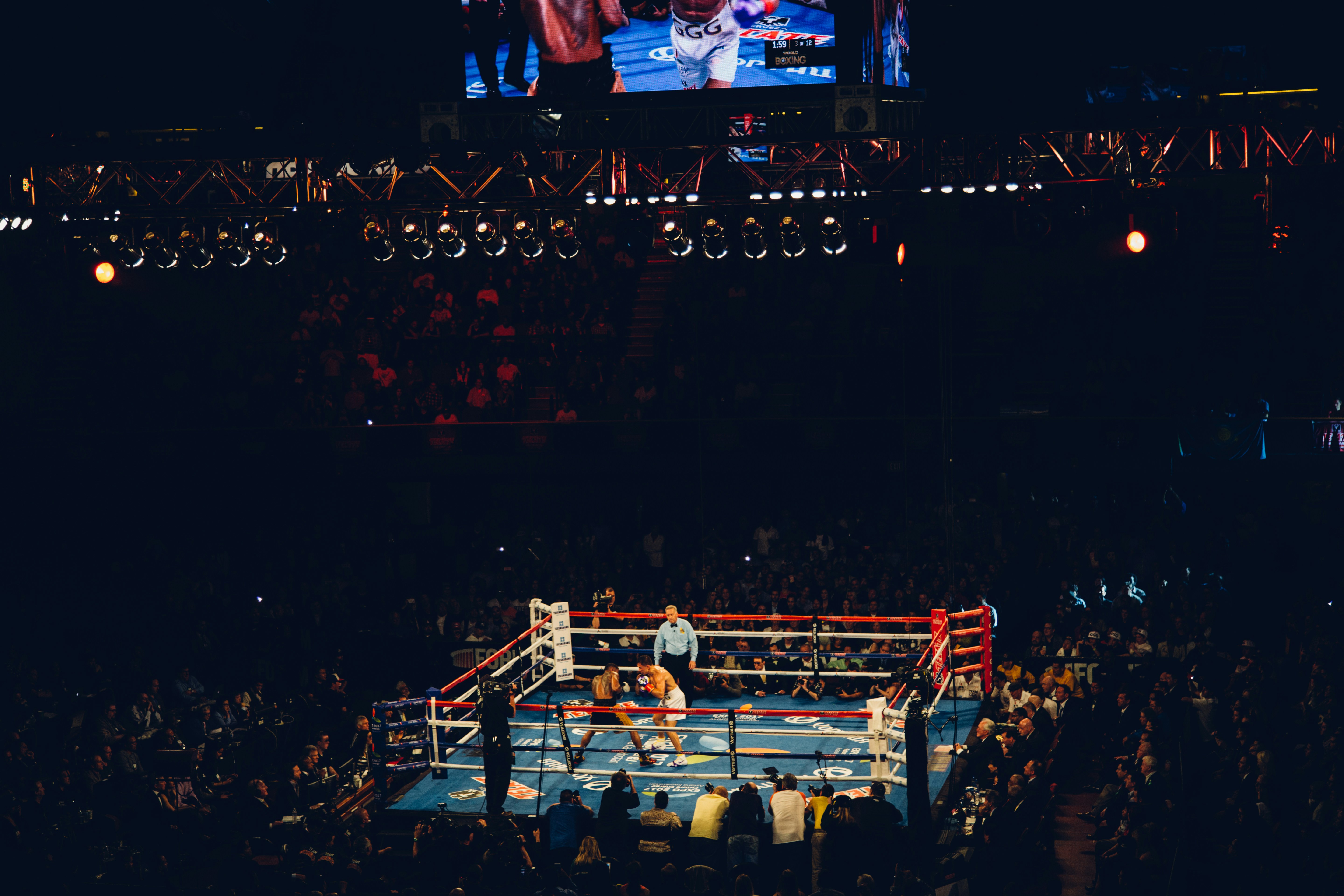
Last June, the United States Army held a military demonstration whose scale and extravagance were unparalleled for a country at peacetime. Columns of tanks, armored vehicles, artillery, attack helicopters, and around 6,000 uniformed service members moved through Washington DC roads. But among the long-range surface-to-surface missiles and fighter jets flying over Constitution Avenue, perhaps the most eccentric sight was the promotional banner of the Ultimate Fighting Championship (UFC), the world’s leading mixed martial arts (MMA) organization.
While Dana White, the CEO of the UFC, was grinning while seated next to senior army officials at the parade, Republican lawmakers like former Senator John McCain (R-AZ) had campaigned to make “no holds barred” fighting illegal across the nation just a few decades ago. MMA, a sport once banned in 36 states, has transformed into something loudly advertised at President Donald Trump’s 30 million dollar military parade. UFC fights are scheduled to be hosted on the White House lawn. The UFC’s dramatic sea change reflects how combat sports like MMA have exploded in popularity under the favor of right-wing authoritarian movements around the globe. Combat sports are a core soft power tool, co-opted by a political coalition hoping to embody a popular ideal of young, muscular, dominance-based masculinity.
In an appeal to young men, global right-wing politics has dragged MMA deep into their cultural realm. By inserting politics into combat sports, authoritarian nationalists can associate themselves with an aspirational form of masculinity—a form that feels “traditional” or “based” and attractive to a cohort of young men who feel scolded by increasingly progressive gender norms.
Just two years before Trump made promises of hosting UFC fights on the White House lawn, Chechen strongman leader Ramzan Kadyrov invited several top UFC fighters to fire off rocket launchers at a military base in Grozny. Authoritarian leaning figures like Kadyrov, Trump, Russian President Vladimir Putin and Saudi government official Turki Al-Sheikh openly sponsoring MMA marks a dramatic shift within the sport’s phenomenon of becoming co-opted as an explicitly political soft power tool.
The UFC exploded into mainstream visibility just as Trump has: riding the rise of media appealing to conservative, straight, young men within the United States. Mixed martial arts under the UFC has served as a toxic palliative for the fears of this cohort of men. MMA fighters are packaged as a twisted, cartoonish ideal to appeal to masculine coded insecurities about self-sufficiency, physicality and capacity for violence, and relationships to women.
Whether it be former lightweight champion Khabib Nurmagomedov appearing on a right wing podcast to say: “I’m from big mountains and we have only two genders,” or former UFC fighter Mike Perry eating underwear in an Instagram post, the personas of some fighters have become mascots for rudimentary and violent conceptions of manhood. Such rhetoric makes the world of MMA a rich environment for right-wing movements looking to capture boys and young men who may otherwise feel ignored by progressive shifts.
The efforts to capitalize on men and boys who gravitate toward violent masculinity are always obvious. Putin’s Russia uses combat sports as a way to recruit and promote its war effort against Ukraine. American conservative manosphere influencers promoting Trump flock to UFC fighters to collaborate on content.
In the United States, the manosphere content ecosystem—a hodgepodge of young male conservative creators—has had a particularly cozy relationship with MMA fighters. Awkward flattery of Trump in a podcast studio, livestreaming sparring with fighters, and clippable misogynistic soundbites amplify one another within a single media ecosystem.
Right-wing authoritarianism and combat sports have cross-contaminated by appealing to that same reactionary impulse of young men who feel left behind, explosively aligning the two. Today, the intersection between combat sports and state power, even outside of the UFC’s relationship with the White House, has become synonymous with a type of slick, extravagantly produced spectacle that resonates with the frustrated and insecure. While such a relationship between sports and the state is sometimes called out as sportswashing, MMA often serves to bring notoriety and legitimacy to oppressive regimes.
In Chechnya, MMA has been used to reinforce a brutal regime. Ramzan Kadyrov, head of the Chechen Republic, often sits proudly cageside and financially supports some of the best MMA fighters in the world (who in turn shout Kadyrov’s slogan “Akhmat power” while fighting). This primal, constrained ideal of manhood associated with both MMA and authoritarianism is best summed up in Kadyrov’s interview with HBO: “My father told me when I was a little boy, ‘If you’re coming home because you got scared, don’t come home. I have no need for you. You’re not a girl, you’re a man.’ … Our [Akhmat MMA] motto is: Death is better than second place.” In Chechnya and beyond, combat sports have been used to create a gendered legitimacy to state violence.
If men and boys choose to aspire to Kadyrov’s version of manhood and the manhood idealized in the fighting cage, they are also being rapidly herded into reactionary conservatism. Authoritarian figures who financially sponsor or simply are public fans of combat sports like Kadyrov or Trump make no effort to “wash” the violence or oppression their state commits, but rather make it a spectacle. It becomes hard not to see the parallels between UFC CEO Dana White at a military parade and Kadyrov hosting fighters at a military base in the midst of Russia’s invasion of Ukraine.
Combat sports have always profited from advertising themselves as the site of the most primal, grandstanded, confrontations of identity politics relating to gender, sexuality, class, and race. The ring or fight cage’s slippage as a political stage made it especially malleable to serve as a soft power device farming cultural relevance for reactionary right wing movements.