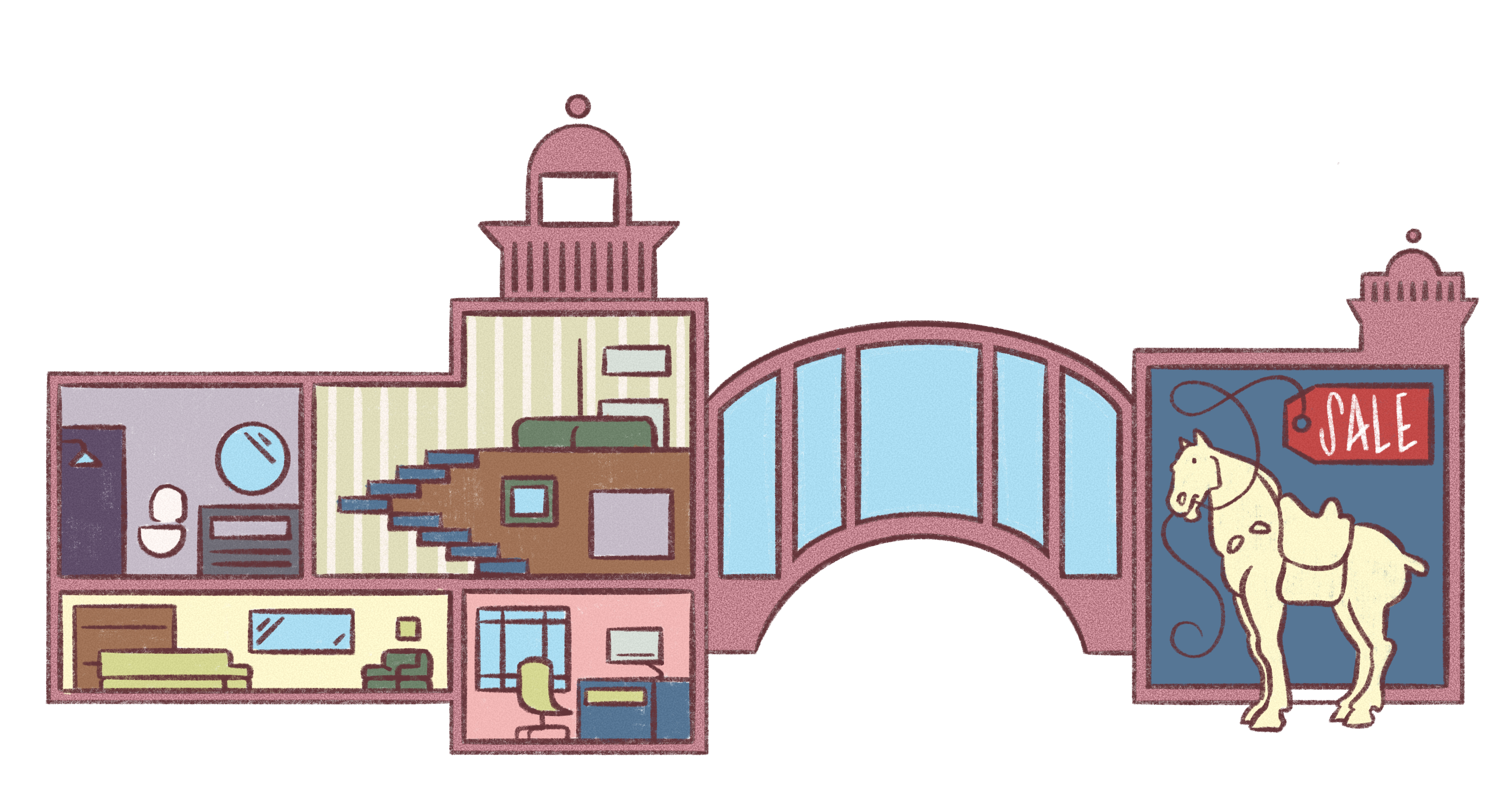
In the early 2000s, a group of eight young artists secretly lived inside Providence Place Mall. They built a hidden apartment in unutilized storage space to protest the displacement of artists from Fort Thunder and other historic homes to artist communities in Rhode Island. Two decades later, their story resurfaced in the 2024 documentary Secret Mall Apartment, which features real footage from the four years they lived undetected inside the mall. As a critique of commercialization, the project challenged the mall’s role as a site of pure consumption and reimagined it as a home and space for community. Today, what once seemed like a stunt feels more like a blueprint for transforming increasingly sidelined retail centers into housing.
Malls are no longer the economic and cultural anchors they once were. After World War II, the enclosed mall became a defining institution of mass suburbanization. Developers consolidated department stores, specialty shops, and restaurants into climate-controlled environments that promised convenience and leisure in a single destination. By the 1980s, more than 2,500 malls operated nationwide. Serving as gathering places for teens after school, families, and seniors seeking exercise, malls functioned as vital ‘third places,’ fostering informal connection beyond home and work. In the latter half of the 20th century, they structured everyday social life and symbolized a shared middle-class stability.
The enclosed mall retail model began to unravel in the early 2000s. It depended heavily on large department stores, like Sears and JCPenney, to draw consistent foot traffic. As those anchors declined, surrounding retailers suffered. The rapid rise of e-commerce further shifted consumer habits away from physical storefronts. The 2008 financial crisis weakened an already fragile system: development stalled, retail sales plummeted, and many malls shut down entirely, leaving behind “empty shells.” Between 2007 and 2010, median household net worth fell by nearly 40 percent. Even as financial markets recovered, many working- and middle-class households never fully regained their lost wealth, which reshaped consumption patterns and weakened the spending base on which malls relied. The Covid-19 pandemic further intensified these shifts, as remote work and online purchasing significantly altered consumer behavior.
The consequences are stark. Since the 1980s, more than 1,600 enclosed malls have permanently closed, and the last new mega-mall in the United States was built in 2006. In 2024, mall vacancy rates were reported to be 248 percent higher than the overall retail vacancy rate, underscoring the sector’s disproportionate decline. Projections suggest that by 2028, fewer than 900 malls will remain in operation. The United States, which built more retail space per capita than any other country, now faces a pressing question: What should be done with the millions of vacant square feet left behind by a retail era that no longer defines consumer life?
Providence Place exemplifies this crossroad. The 1.4-million-square-foot mall opened in 1999 and has since seen years of declining foot traffic and mounting financial instability. In 2024, it entered receivership, a court-supervised process in which an independent party manages a financially distressed property’s assets and operations. In February 2026, it was added to the Providence Preservation Society’s Most Endangered Places list, reflecting concerns that the massive structure could be wastefully demolished. However, unlike many struggling suburban malls, Providence Place sits in the heart of downtown; it is within walking distance of the State House, the train station, and dense residential neighborhoods.
Across the country, similar properties are being reimagined to better suit the needs of their communities. Obsolete malls are being converted into distribution centers, housing developments, schools, and mixed-use communities. Since the pandemic, nearly 200 malls nationwide have announced plans to incorporate residential units, reflecting a broader shift toward walkable “live-work-play” environments, rather than single-purpose retail destinations. Living at the mall, formerly a countercultural act of rebellion, is now becoming a viable development strategy.
Providence has already demonstrated the promise of adaptive reuse. Just minutes from Providence Place stands the Westminster Arcade, America’s oldest indoor shopping mall. After closing in 2008 during the Great Recession, it reopened in 2014 as the Arcade Providence, combining ground-floor retail with 48 micro-loft apartments. The units leased within weeks and thousands of potential tenants expressed interest, revealing how underutilized downtown space can be preserved and adapted for contemporary housing needs.
Providence Place presents an even larger opportunity. The massive property remains in extreme debt with an uncertain future; at the same time, Providence faces a severe housing crisis. Nearly half of the city’s renters and more than one-third of homeowners are cost-burdened — spending over 30 percent of their income on housing. Rents have risen sharply in recent years, at times faster than anywhere else in the country, while wages have not kept pace. Since 2020, the city has recorded more than 24,000 eviction filings. If redeveloped strategically, Providence Place could become one of the most consequential housing interventions in the city’s modern history, creating lasting residential stability.
Critics point to the cost and logistical challenges of converting malls into mixed-use developments. Zoning restrictions, infrastructure upgrades, and concerns about the loss of retail jobs present real obstacles. Yet these concerns ultimately reinforce the case for change. Rhode Island ranks last in the country for new housing permits, a reflection of policies that have failed to keep pace with rising demand. Meanwhile, Providence Place is kept afloat by a generous tax treaty which keeps its annual property tax payments at roughly $500,000 instead of the nearly $25 million it would owe at its full assessed value. Maintaining the status quo risks subsidizing a struggling commercial property while sacrificing resources for pressing fiscal and housing needs. Additionally, preserving a strained retail-only model leaves the city vulnerable to continued decline: If the mall closes outright, Providence risks losing retail jobs, surrounding economic activity, and tax revenue.
Reimagining Providence Place as a mixed-use development aligns with Providence’s long-term needs and offers a more resilient path forward. Rather than demolishing the structure, adaptive reuse would conserve carbon and reduce construction waste, while phased redevelopment would allow portions of the mall to remain operational during conversion. Tying any new tax treaties to clear public benefits such as affordable housing units, infrastructure improvements, and local hiring commitments would ensure the project serves residents.
Imagine: upper floors lit by apartment windows and corridors filled with people heading home, picking up groceries, or meeting friends for coffee. Transforming Providence Place would create the reliable customer base that retailers lack, restoring the everyday vibrancy that once made malls central gathering places in American life.
The Secret Mall Apartment sought to reclaim space for those pushed aside by economic forces beyond their control. Today, Providence Place offers a similar opportunity on a far larger scale. By transforming the mall into thoughtfully-designed, mixed-use housing, Providence can address displacement, foster community and economic stability, and redefine urban space. After all, why settle for a picket fence when you could have a loft by the food court?