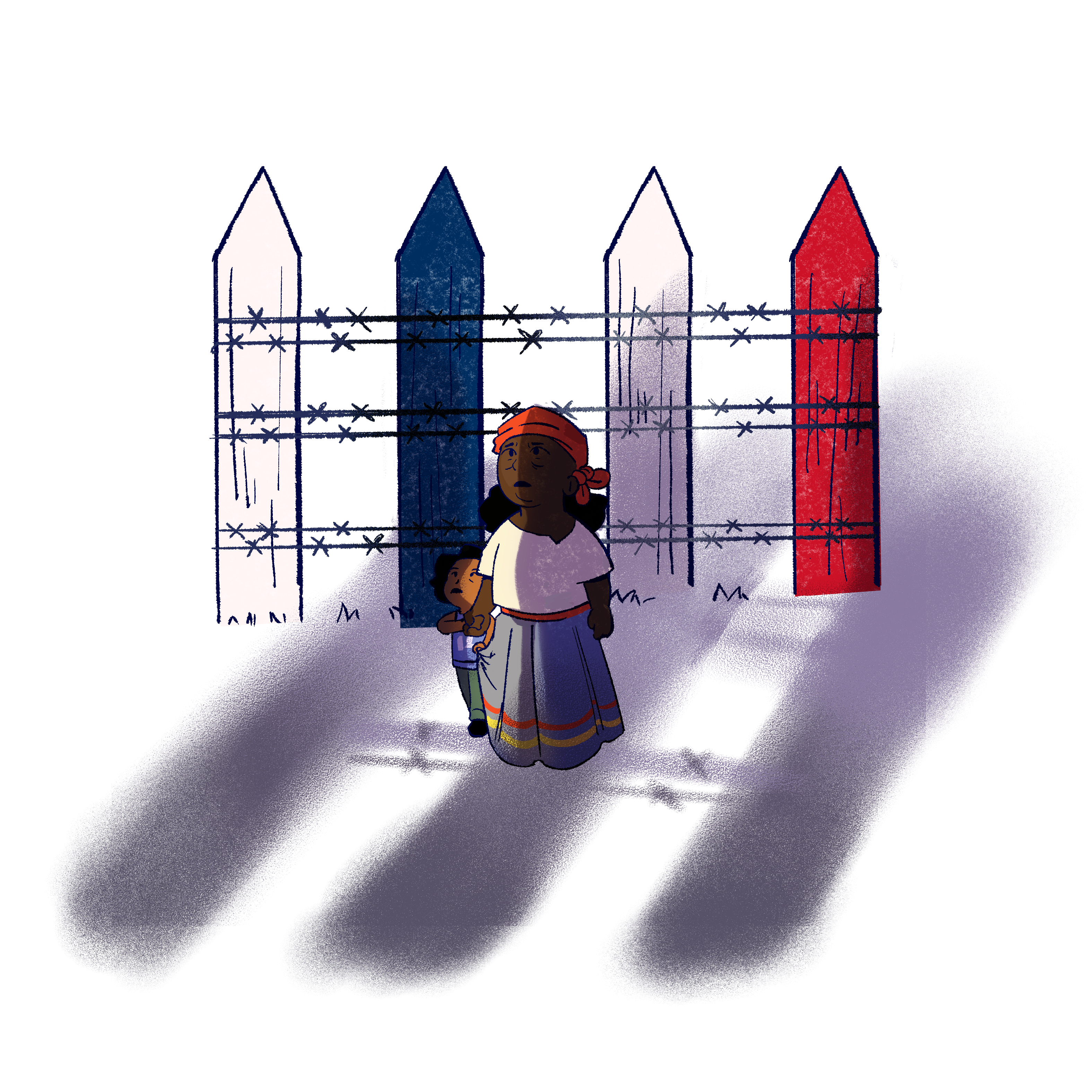
A blue passport can get you far. The leatherbound booklet denotes association with the ‘New World’ and grants access to an unprecedentedly high degree of global mobility and embassy protection — unless the passport reads “Republique D’Haiti.”
The 2013 retroactive revocation of birthright citizenship in the Dominican Republic and mass deportations of Haitian immigrants have created a nation of people who are citizens in name alone. The Haitian government cannot offer the rights, protections, or basic infrastructure that constitute a state; their people are de facto stateless.
Despite sharing the island of Hispaniola, Haiti and the Dominican Republic’s fraught relationship runs deep. The first demographic division of the island was artificially created by French and Spanish colonists, who took over the West and East sides of the Dajabón River, respectively. The two empires took vastly different approaches to colonization. Spain, occupying the modern-day Dominican Republic, developed a settler-based society, with a white and mixed-race majority. France, on the other hand, only saw Haiti as a site from which to extract profit, establishing an immensely lucrative plantation economy and importing over half a million enslaved Africans — 10 times more than the Spanish did. When Haiti won independence in 1804 after over a decade of slave uprisings, the demographic legacy of French slave ownership was immortalized. Haiti became the first Black republic and the first nation to be governed by former captives.
In 1822, to deter threats of French reinvasion, Haitian troops commanded by General Jean-Pierre Boyer surged across the Dajabón River, subjecting the citizens of the Dominican Republic to a brutal occupation. But Boyer’s gamble did not work. In the midst of the summer of 1825, a squadron of French warships, equipped with some 500 cannons, arrived on Haiti’s shores. They proposed a deal: Haiti was to pay the French state 150 million francs to compensate former colonists for lost land, slaves, and profits. In exchange, France would recognize Haitian independence. Of course, this indemnity was little more than a nation-wide ransom. Failure to pay would lead to devastating French reinvasion.
Independently procuring the money required was unthinkable. Historians predict that the required sum amounts to $560 million in today’s dollars, an impossible amount for a nation freshly and violently unshackled from over a century of plantation slavery. Even the first round of payments amounted to around six times the government’s income that year. Without widespread recognition of their independence abroad, there was only one nation whose banks Haiti could turn to take out loans: France. They paid a crippling high-interest debt to the Parisian bank Crédit Industriel et Commercial. To finance their rapidly deteriorating fiscal state, the Haitian government imposed heavy, unpopular taxes on the Dominican Republic. Occupying forces frequently confiscated food, supplies, and property from Dominican residents at gunpoint.
The indemnity levied upon Haiti by the French is often dubbed the “double debt” due to its crippling and lasting effects on Haitian state capacity — by 1914, about 80 percent of Haiti’s national budget was used to pay foreign debts, leaving no money for infrastructure, education, or healthcare. But there is a third facet to the legacy of this debt: The extraction of Dominican wealth under Haitian occupation shaped a national identity built on anti-Haitian sentiment.
The modern-day Dominican Republic cannot forget the haunts of its neighbors’ violent occupation. Driven by high unemployment at home, Haitians continuously seek work across the river in labor-intensive sectors like sugar, coffee, and cocoa production. After the 2010 earthquake, around two million Haitians flowed into the Dominican Republic, many of them undocumented. Shortly after, the Dominican Republic’s Constitutional Court ruled to strip citizenship from children born to undocumented foreign parents — 86 percent of whom were of Haitian descent.
From late 2024 onward, the Dominican Republic has intensified its immigration crackdown on Haitians. Haiti is still a Black republic in the Dominican imagination, resulting in what human rights organizations criticize as the racial profiling of dark-skinned individuals. 379,553 Haitian nationals were deported in 2025 alone.
For Haitian citizens, the stakes of denationalization in the Dominican Republic are particularly high. Haitian citizenship is not a viable substitute for Dominicans of Haitian descent because the failed Haitian state is presently unable to guarantee even basic protections and services to its citizens. Haiti is considered “High-Alert” in the Fund for Peace’s 2024 Fragile States Index — it is the ninth worst globally and has the lowest possible score in the State Legitimacy indicator. Institutionally, the nation has had no nationally elected officials since January 2023, and its parliament has been inactive since 2019. The resulting vacuum of legitimacy has been “filled” by armed gangs and militias functionally acting as governing authorities, controlling territory and major transport corridors, imposing rules, and offering selective protection.
On the ground, the Haitian state has entirely lost the monopoly on force: UN Security Council estimates say 75 to 85 percent of Port-au-Prince, the capital city, is controlled by gangs, with other reports showing figures as high as 90 percent. The UN Human Rights Office verified that at least 5,600 people were killed in gang violence in 2024 alone. Displacement is ubiquitous, with International Organization for Migration reports showing 1.4 million people internally displaced in the country with no policies to assist them. Basic service delivery is collapsing. Amid expanding violence beyond the capital, UN reporting showed fewer than 25 percent of health facilities near Port-au-Prince were functional.
The state of Haitian institutions is so dire that it is contentious whether Haitians can be described as citizens of any state at all. The United Nations High Commissioner for Refugees (UNHCR) 1954 Convention relating to the “Status of Stateless Persons” defines a stateless person as someone “not considered as a national by any State under the operation of its law,” but the UNHCR’s own 2010 paper on de facto statelessness nuances this term. The paper defines de facto stateless persons as those “lacking an effective nationality” and it cites literature defining de facto statelessness as occurring when governments “withhold the usual benefits of citizenship, such as protection, and assistance.”
Haiti’s state failure makes it unable to deliver the core rights and protections that citizenship is supposed to provide. Thus, the revocation of Dominican citizenship from those of Haitian descent effectively relegates the affected individuals to de facto stateless persons, regardless of their Haitian citizenship.
Despite holding a physical token of citizenship, Haiti’s passport sits near the bottom of the global ranking, with only 13 visa-free destinations and visas required for 139 countries. If citizenship was once a physical representation of belonging, Haitians are now contending with the reality of living in limbo. Characterized by their de facto statelessness, deported Haitians and Dominicans of Haitian descent travel with their blue passports to a liminal home.