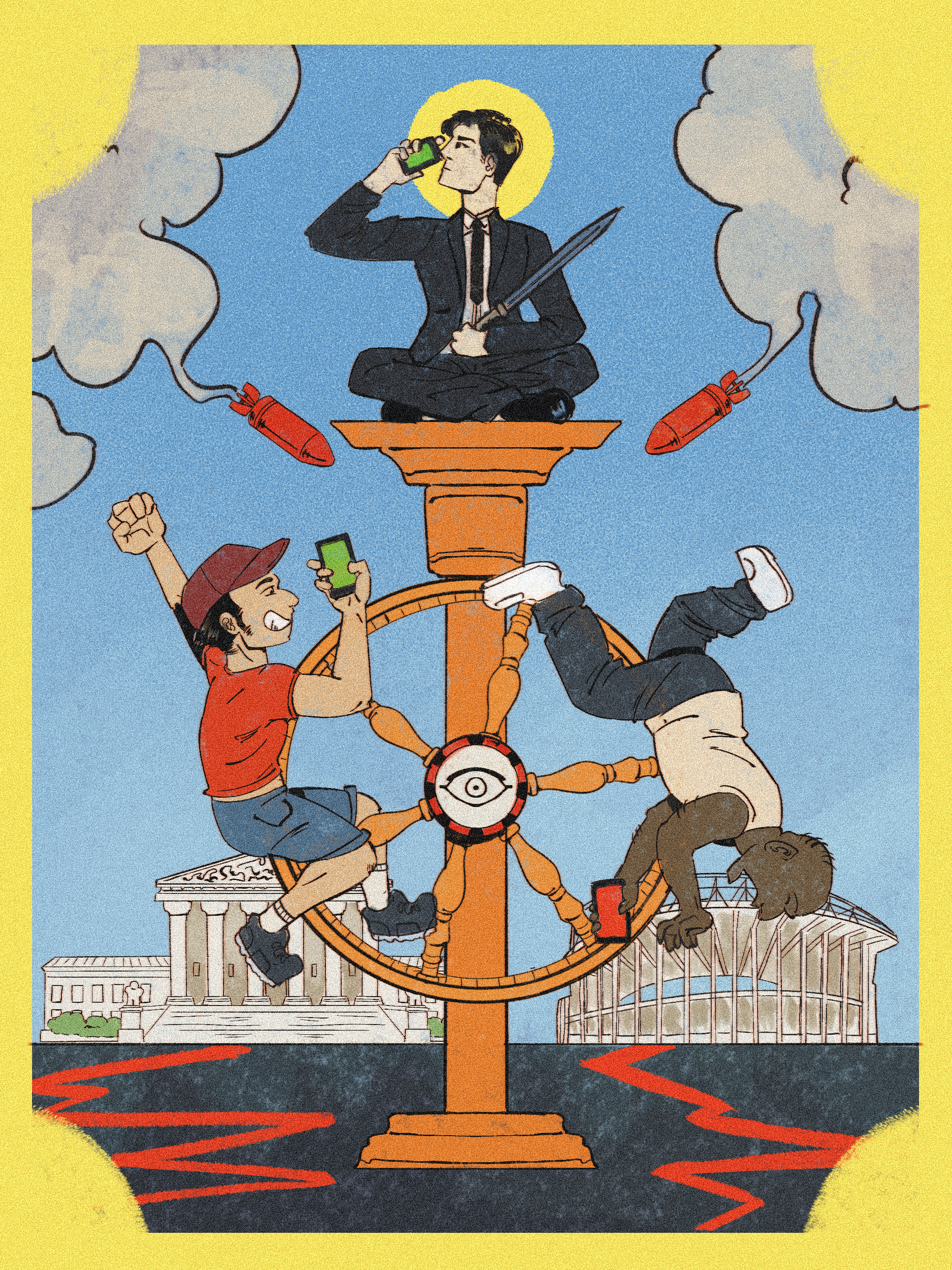
Truth is a fickle matter. It prowls the crevices of bias and roams the pith of dissent. It snakes through equivocation, hiding from politics and eluding online discourse. Even as we increasingly hunger for it, truth languishes in the growing fissures of our information ecosystem.
Thankfully, prediction markets are here to help. By harnessing the wisdom of crowds willing to bet money on their opinions, these platforms are purportedly replacing the subjectivity of journalism with the accuracy of markets, offering “unbiased forecasts for the most important events to society.” On platforms such as Polymarket and Kalshi, users invest in event contracts, short-term derivatives that allow traders to take binary bets on the outcome of real-world events. Traders receive payouts if their bets are correct at the time the contract is settled. Prediction markets present a unique opportunity to make a quick buck (or a few million) and were responsible for $64 billion worth of transactions in 2025. Their trading volumes are expected to grow exponentially, set to exceed $325 billion this year.
But the industry is not without its woes. It seems these platforms are plagued by something of an insider trading problem. Last year, a single trader made over $1 million by betting on Google’s Year in Search rankings, allegedly thanks to nonpublic information. Blockchain analysis on Polymarket has shown that 0.04 percent of traders are raking in 70 percent of profits. More concerningly, suspiciously accurate bets were placed immediately prior to the capture of Nicolas Maduro and US military strikes on Iran. Although allegations of insider trading have not been confirmed, it is still a bad look for prediction markets to be dealing in putatively illegal activity.
Critics pounced on this issue, calling for stricter regulations to prevent such uses of privileged information. While well-intentioned, attempts to constrain and regulate prediction markets have, to date, largely misconstrued their principal aim—an error that precludes substantive regulations on the industry. As decentralized information exchanges that do not pay dividends, prediction markets are fundamentally different from securities markets, which are most often public exchanges through which companies aim to raise capital and provide investors with liquidity. Instead, prediction markets aim to bring truth to light, a goal that is most effectively achieved when traders bet on information that is not publicly available. Shayne Coplan, Polymarket’s CEO, even told CBS that “having an edge to the market is a good thing”—a stark contrast to the ideal of information symmetry that underpins securities markets. But thus far, regulators have attempted to curb “insider trading” on prediction markets with legislation premised on the erroneous assumption that the industry similarly relies on this ideal.
Given that prediction markets’ success is dependent on nonpublic information, it is unclear whether betting on insider knowledge can even be considered insider trading. Regardless, the industry faces a catch-22. Public perceptions of widespread insider trading will inevitably lead market players to believe they will lose money to traders with privileged information. Disillusioned players will stop betting, thereby constraining the industry’s growth. On the other hand, properly regulating prediction markets would similarly impose a growth constraint. Platforms would need to shut down “death markets,” a type of prediction market where individuals place wagers on the date of death, assassination, or killing of specific individuals or the occurrence of specific, high-casualty violent events; prevent people with material nonpublic information from trading; and create enforcement mechanisms to ensure these rules are respected. Such regulations would limit the profits individuals could make on these platforms, driving larger investors away. Either way, regulations would inhibit growth. Whether the rock or the hard place would cause the industry more pain, however, remains uncertain.
Prediction market platforms understand they are in a bind. They also understand that their problems lie mostly in the optics of allowing “insider trading” to run rampant. Kalshi, Coinbase, Robinhood, and Crypto.com, along with a couple of other prediction market platforms, formed the Coalition for Prediction Markets (CPM), which aims “to expand consumer access to safe, transparent, and integrity-driven prediction markets in the United States.” To that end, the coalition is promoting federal regulation—a somewhat counterintuitive strategy given the industry’s desire for growth. But a cursory glance at their regulatory proposals reveals their hand. The CPM is advocating to remain under the jurisdiction of the Commodity Futures Trading Commission (CFTC), which oversees derivative markets and is incidentally the lightest form of regulation available to the industry. A commonly proposed alternative is regulation under state gambling laws, which are far more stringent and would drastically curtail the industry’s growth. Similarly, although prediction platforms operate as fundamentally different markets, one could argue that event contracts based on financial metrics, stock indices, or economic indicators function like security futures and should therefore be subject to Securities and Exchange Commission (SEC) regulations, which are far more exacting than those of the CFTC. The SEC also has a mandate to work with the Department of Justice to prosecute people for insider trading, which prediction markets do not want to risk given their legally questionable premise of disseminating nonpublic information. So, for the CPM, remaining under CFTC jurisdiction would allow the industry to cloak its insider trading problem in a regulatory facade while preserving loopholes through which one could drive a bus.
Regulators, it seems, also recognize the optics problem. In March 2026, Senators Jeff Merkley (D-OR) and Amy Klobuchar (D-MN) introduced the End Prediction Market Corruption Act to Congress, a bill that aims to prevent government officials from using nonpublic information to trade on and profit from event contracts. At a time when the perception of government corruption is particularly high, politicians understand that a bill assuaging the public’s concerns of insider trading and dubious betting behavior would do wonders to increase market players’ confidence in the industry. But the bill only targets the actions of government officials, preserving the foundation of information asymmetry that has driven prediction markets to such rapid growth.
Besides, prediction markets are benefiting from the most pro-industry, pro-tech, pro-crypto administration the country has seen, backseating consumer protection. These aligned incentives will likely result in regulations that preeminently foster industry growth. Look no further than the crypto industry for insight into how regulations on prediction markets could be imposed. Before FTX Trading Ltd. collapsed, it lobbied specifically for CFTC oversight rather than the SEC’s, which a sitting senator admitted made consumer protection legislation nearly impossible to pass. To improve market players’ trust following the collapse of FTX, Congress passed the GENIUS Act in 2025, enacting regulations that superficially protected consumers—and fixed crypto’s optics problem—while largely allowing the industry to continue growing unconstrained. Since Kalshi and Polymarket show remarkable growth potential, each pursuing fundraising rounds of around $20 billion (up from $11 billion and $9 billion in 2025, respectively), this pattern will likely repeat itself.
Treasury Secretary Scott Bessent designates the “three components of the Trump economic agenda” as “tariffs, tax cuts, and deregulation,” a classification that highlights the administration’s preeminent concern with economic growth and profit maximization. As long as these remain the federal government’s economic pillars, it is unlikely meaningful constraints will be imposed on the burgeoning prediction market industry. Rather, any regulations enacted will be perfectly calibrated to restore investor confidence enough to draw more liquidity into the market without meaningfully preventing harm to consumers or fixing the structurally unequal foundation on which the industry is predicated.
But trust, like truth, is a fickle matter. To be sustained, it requires meaningful investment in people’s well-being and attention to their real concerns. And a reluctance to curb the growth of a harmful multibillion-dollar industry does little to bolster either. By attempting to regulate prediction markets as if the optics of putative insider trading are the preeminent issue, regulators ignore the ethical problems that underpin the industry’s very structure. But as long as the federal government places profits over people, it seems prediction markets are here to stay. And with them, a stronger precedent to continue investing in industries that are fundamentally incompatible with supposed democratic ideals of equality.