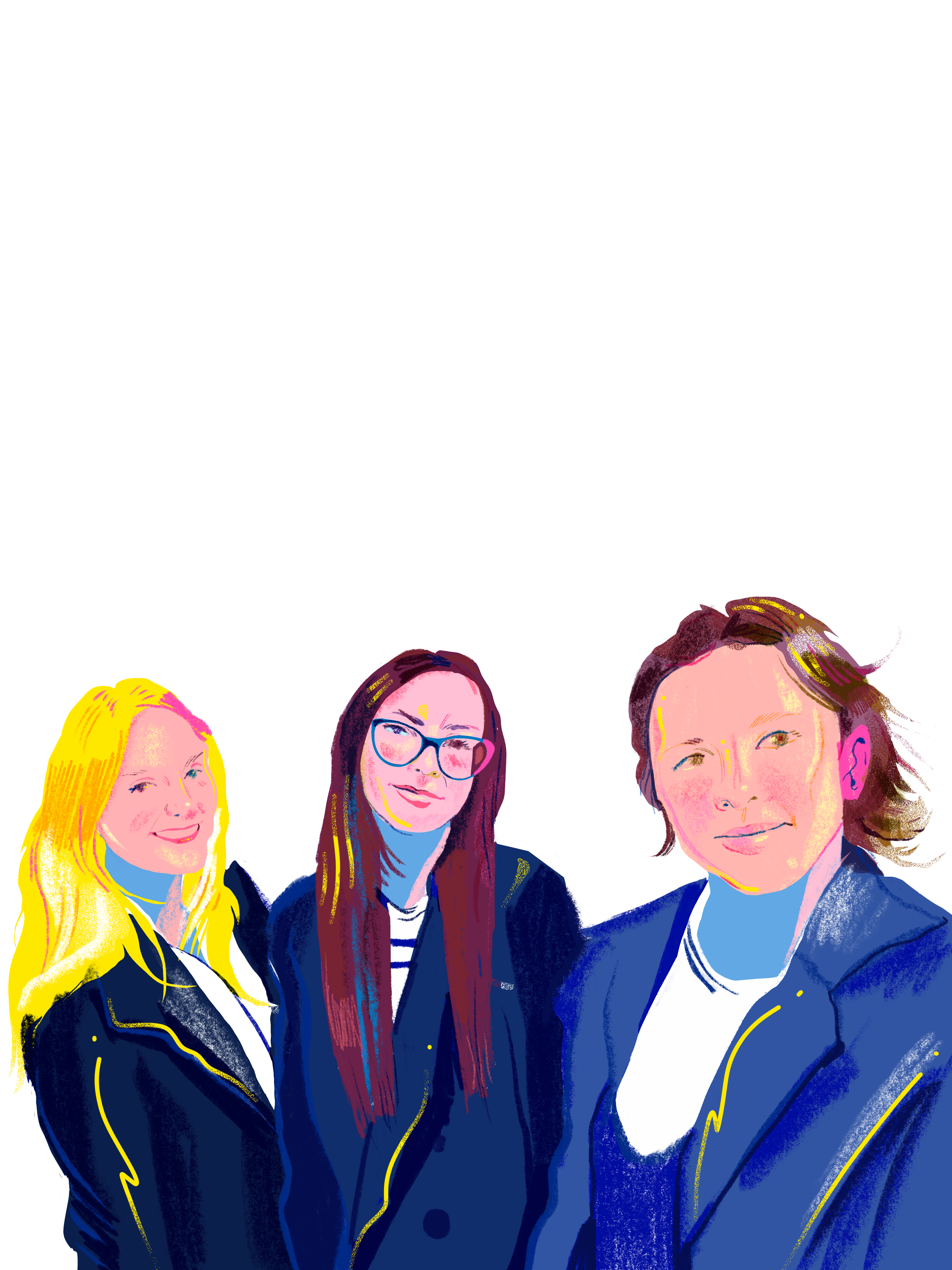
After nearly a decade of conflict, Russia launched a full-scale invasion of Ukraine in February 2022, garnering significant public attention. Now, over four years later, this direct warfare is still ongoing, but the public spotlight has largely faded. Olesia Mykhailyshyn, Viktoriia Portnaia, and Tetiana Kyryliuk are three students from the Kyiv School of Economics participating in an exchange program at Brown University. They are driven by their collective mission to raise awareness about the ongoing situation in Ukraine and share their experiences studying in times of war.
Auden Goldblatt: To start off, can you tell me about yourselves?
Olesia Mykhailyshyn: My name is Olesia. I am extremely grateful for the opportunity that our university provided for us during this extremely difficult period of war.
Viktoriia Portnaia: I’m Viktoriia, and I’m also an exchange student here.
Tetiana Kyryliuk: My name is Tetiana, and I’m a third-year student studying Economics and Big Data.
AG: Can you tell me a little bit about your personal connection to the conflict and what it’s like studying here at this time?
OM: This winter we were here, not in Ukraine. [But the conflict in Ukraine] was extremely harsh for everybody, and the conditions there were just unbearable. Sometimes, you would be sitting at the table doing your regular homework assignments, and you’d hear weak air-defense mechanisms responding to the massive bombings, but life just does not stop. It does not pause. I am not from the part of Ukraine that was massively attacked. I am from the western part, and thankfully, my hometown is not as affected as Kyiv, for instance, where we are staying for the duration of our education.
TK: As major cities continue to be repeatedly attacked, everyone is affected. Even western cities are being affected—though not as much as Kyiv, where attacks happen almost every night. It is something that you have to get used to, which is not okay. Receiving those attacks on a daily basis, you sometimes just do your homework, go to sleep, and then wake up randomly at 3 AM because of an air alert signaling that you have to go to a bomb shelter. Sometimes, you just sleep through it because you have exams the next morning. It is a reality that everyone in Ukraine faces. There were attacks that were not on strategically important infrastructure, such as residential buildings, which are just people’s homes. No one is protected. You never know who will be the next person to have their home attacked. My other personal connection is that my father is serving in the military. One gets to see their relatives who are in the military only a couple of times a year. Of course, you are constantly worried about them, hoping that they will be okay, while also understanding that it is important that they serve your country.
VP: I’m originally from northeastern Ukraine, specifically a town called Shostka, just 60 kilometers away from Russia’s border. I was born there, but when I was five, my parents immigrated to Moscow. I spent my whole life in Moscow and was politically active there. I participated in the democratic movement there and was detained. In 2022, I became a political refugee in Sweden and was not granted asylum, so I had to choose to either return to Russia or Ukraine. My family and I decided to return to Ukraine. I had to start from scratch. My life was extremely impacted by the war. Recently, my father was drafted and is now serving in the Ukrainian military. My aunt has been working as a military doctor since 2020, so she has already served six years at the front lines. Now, I’m studying at the Kyiv School of Economics, and I’m very grateful to this university for helping me rebuild my life.
OM: There is one story that affected our community a lot. It stayed with me for a very long time. The story is about Darya, a student I started my first year with at the Kyiv School of Economics. Her major was Artificial Intelligence, and when she turned 19, she joined the Ukrainian army as a drone engineer. During summer school in Istanbul, I talked about her quite a lot. When I came back just two weeks later, we got the message that she was killed. Our entire community was extremely affected by this news. As a result, people began to think about how they could be more valuable to their country, community, and pursue new skills to help Ukraine. To get these skills, many students even thought of switching to another major.
VP: In honor of her death, the Kyiv School of Economics launched a bachelor’s degree program called Delta Engineering—Delta was her military name—in partnership with Firepoint to build rockets.
AG: At Brown, do you feel that students have been able to empathize with this conflict or understand it?
VP: People do not perceive all of the resources and opportunities that they have here. As for awareness about Ukraine, people here do not have it at all. Some will just ask us where Ukraine is located; they don’t have enough empathy to ask how we or our relatives are. The only person here who has asked me about Ukraine and my relatives was an international student. The military actions taken by the United States in Iran felt just like the beginning of the war in Moscow. I’m very afraid of what’s going on in the United States right now, because it’s very bad that the American people don’t understand how their own country has degraded into something so autocratic.
OM: Everyone needs to increase their awareness, as it will be the first step towards more meaningful engagement and helping others.
AG: Social media is something that’s very important to our generation and for students at Brown. If you’re active on social media, do you think the internet plays a role in raising awareness of what’s going on, or has it been harmful?
VP: Social media is fully controlled by the algorithm it uses. It’s more harmful in terms of political engagement because people do not want to see content they do not like. They do not want to see how people suffer, how civilians are attacked, and how their lives get ruined. People do not like this content, and therefore, the algorithm will not show them this. It will show them beautiful pictures of life, but not of how other people, who are 9,000 kilometers away from the United States, suffer. That is one of the reasons why they cannot understand that there exists a world beyond their bubble, which is a problem. This generation feels that it is enough to just share or like a post that says something dissentful, but they do not take real action to protect democracy.
OM: Social media is a very powerful tool meant to engage everyone from every part of the world, but it doesn’t help Ukraine as much as it could. Most posts are about donations, and the information is spread mainly among Ukrainians. Because of this, people from other parts of the world do not care as much.
AG: How can Brown students, particularly non-international students, engage with this conflict in a way that actually helps Ukrainians?
TK: First of all, we’re really grateful to be here, because this is one of the ways to spread awareness about what’s happening in Ukraine and to share our stories. A message that we’ve been trying to carry is to keep talking about Ukraine and not take anything for granted. Every Ukrainian citizen’s mission is to spread awareness about what’s happening in Ukraine, but for Brown students, I think it is just important to keep reading the news and learning about different perspectives to see what is actually happening. They might think it’s not concerning their life directly, but it really is. The war has been going on for so many years, and its consequences can be seen directly in the shift of political powers and the situation that is happening in the world right now.
OM: People just need to stay aware and curious about Ukraine. They need to keep thinking about what the country is going through right now in order to develop their empathy.
VP: When you see that your country is doing bad things both inside the country and abroad, you have to talk about it. You cannot just pretend that nothing is going on and that you cannot influence it. You can participate in protests and go more than once. You just have to take time out of your daily routine to do it—talk about what’s happening, and question the actions of your government. For this, you have to develop empathy to understand that when other people suffer, you always have to pay attention to it.
TK: Empathy and interest have to be further developed in international politics and relations. We recently had a panel discussion about resilience in times of war, and very few people showed up because everyone is busy with their own lives, and they think that this doesn’t concern them directly, but it does. It is their responsibility to talk about international politics, because they are the ones who can create change in the world and alter our future.
VP: They are not just students. They are citizens.
AG: Is there anything else that you would like to share with the Brown community?
TK: The message we always carry through is to not take anything for granted. We are really lucky to be here during this semester, as the winter back home was really harsh for our people. Temperatures went down to minus 10 degrees Celsius, and people in Ukraine didn’t have heating in their homes because of the attacks on critical infrastructure. When you don’t have electricity to charge your technology, it is really difficult to continue your studies as normal and prepare for exams, but people in Ukraine continue doing it. The message [we want to spread] is to be grateful for what you have, not take anything for granted, and understand that people somewhere else in the world might be going through tough situations. In order to make a difference, people need to raise awareness and take action.
*This interview has been edited for length and clarity