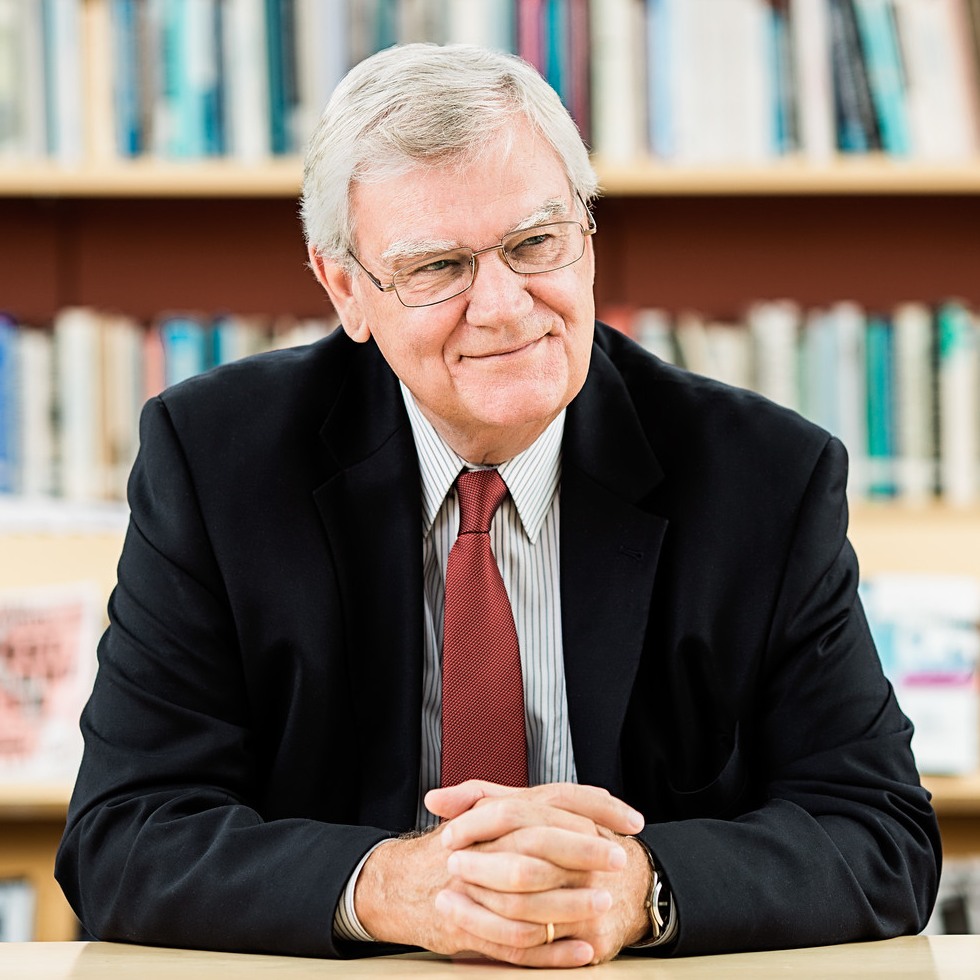
J. Brian Atwood is an American diplomat and educator whose six-decade career reflects a lifetime of work across US foreign policy and international development. He began his public service as a Foreign Service officer in the 1960s, with early postings in West Africa and Europe, before returning to Washington as former Senator Thomas Eagleton’s (D-MO) foreign and defense policy adviser. Atwood later held several senior roles at the State Department, including Assistant Secretary for Congressional Relations during the Carter Administration, where he helped steer diplomatic priorities through a polarized Congress.
From 1985 to 1993, Atwood served as the founding president of the National Democratic Institute, which supports democratic governance around the world. He went on to lead the US Agency for International Development (USAID) from 1993 to 1999, guiding the agency through a period of budget pressure and political scrutiny—the first substantial attack to curtail or eliminate the agency—during which he defended USAID’s mission and institutional independence.
Following his USAID tenure, Atwood became dean of the University of Minnesota’s Humphrey School of Public Affairs, where he expanded the school’s global policy programs. He later chaired the Development Assistance Committee at the Organisation for Economic Co-operation and Development (OECD), helping coordinate donor strategies and modernize approaches to global development cooperation. Over the course of his career, Atwood has contributed to UN reviews of peace operations, written extensively on development and US foreign policy, and received multiple awards for public service, including the Secretary of State’s Distinguished Service Award.
Atwood now teaches diplomacy at Brown University, serves as a Senior Fellow of the Watson Institute, and sits on Watson’s Board of Governors. The Brown Political Review sat down with Professor Atwood as the second interview in a two-part series with experts from Brown examining the consequences of dismantling US foreign assistance institutions.
Matthew Kotcher: So today’s interview is sort of a bookend, because last spring I spoke with and interviewed Brown Professor Dr. Craig Spencer, who’s over at the School of Public Health. We talked about the public health ramifications of the Trump administration’s USAID cuts, its withdrawal from the World Health Organization (WHO), and with you, I was hoping to explore the diplomatic ramifications of this agenda, these decisions. So I was wondering if you could comment on how these decisions affect US influence, credibility, and just our ability to operate abroad.
Brian Atwood: One of the areas that is seemingly easier to reach agreement with friendly nations, in particular, but even nations that are not so friendly, is in the area of development cooperation, and I would include humanitarian relief in that as well. And over the past couple of decades, I’ve been directly involved in some of this, we have reached an agreement within the Development Assistance Committee of the OECD, the Organisation for Economic Co-operation and Development, on goals for the development community. They originally were, basically, in a report that the DAC, the Development Assistance Committee, did [sic] called Development Cooperation in the 21st Century, I think it was called. And that report was then adopted by a summit meeting in Birmingham, England, with the G7. And then about a year later, when the UN was looking to see what could be done at the time of the Millennium changing, they adopted these goals as the Millennium Development Goals.
The implication of that is that we all of a sudden had very specific and tangible goals, eight of them in the early iteration. And what that meant was that people then had to create the tools necessary to measure results within those goals, because the whole world had accepted the goals, including partner countries, developing countries, and people knew that they would be held accountable for achieving those results. One other implication was that we managed to increase the amount of money spent on official development assistance by 50 percent over the period from 2000 to 2015, which is what the Millennium Development Goals covered. There was another summit in Monterrey, Mexico, where President Bush, in that case, basically endorsed the idea of increasing official development assistance and used American leadership to encourage other donors to increase.
However, they also said we need to be a lot more effective in the way we deliver this assistance. And so that set the DAC off in a different direction, in a direction which basically said, “Okay, we need to come up with effectiveness principles.” And those principles were things like local ownership. We want to encourage local ownership. We wanted to encourage transparency so that the partner countries would know what to expect with respect to the development resources that were available. Mutual accountability. I mean, these are principles that were adopted in 2005 in Paris, at an initial meeting that was mostly donors. The next meeting, however, was in Accra, Ghana, and of course, there were a lot of developing countries that came to that meeting. And they pushed the agenda forward, wanting to insist on local ownership, and really were very critical of the donors for not really fulfilling their promises. So we weren’t sure we’d even get an outcome document at that meeting, but it turned out that we did. A lot of people made concessions in the end and achieved something.
The next meeting was the one when I became the chair of the DAC, the Development Assistance Committee, and the next meeting was supposed to be in Busan, Korea. And what I wanted to accomplish more than anything was to get the BRICS (Brazil, China, India, China, South Africa) countries involved. At least get them to accept the effectiveness principles. And so we had a number of initiatives. We had a China DAC study group. I visited China a couple of times. We worked with China in Africa to see how they did their development work. We basically wanted to share information about how the DAC members do it and how China does it, which is slightly different because it was South-South cooperation rather than the kind of peer-reviewed system that the DAC uses. We obviously would have been very happy if the Chinese decided to join the DAC, but that wasn’t going to happen, and it was not expected. But then we had the Arab countries come to London to meet with us, and our chair happened to be an Arab from Egypt. Talat was his name, and he managed to get an invitation to also go to the Arab countries to talk to them about these effectiveness principles.
So it all boiled down to a lot of effort that was made, and we finally were able to achieve a major breakthrough by getting the BRICS countries, including China, Brazil, South Africa, and even Russia, to join on that outcome document and basically adopt the principles of effectiveness. It also created something called the Global Partnership for Effective Development Cooperations, and that was to be co-chaired by a donor nation, by a recipient, meaning a partner country, and by a new provider, meaning the Chinese; in this case, it happened to be Indonesia, the minister from Indonesia. So it was a number of meetings to discuss future forums and what could be most effective. An awful lot got done in that period. And that, I see, was attributable to American leadership. I don’t think it would have happened if it hadn’t been for American leadership. And now, not only have we seen the dismantling of USAID, we’ve seen the Trump administration say that they no longer abide by or support the Millennium Development Goals, which are now called the Sustainable Development Goals. There are now 17 goals as opposed to 8. And they’ve been adopted by every country in the world, except now the United States is basically turning its back on it.
MK: So when Condoleezza Rice visited campus very recently, she offered lots of critiques of USAID, mainly arguing that NGOs had become overly dependent on US funding and that undermined the agency of other countries. So, from your time inside the agency, how fair would you say that critique is and where would you say that it misses the mark?
BA: I think some criticism is warranted. It basically is the system that the Congress has set up.
They have earmarked funds to do things like child survival work, and the earmarked funds are spent well. But they then cut the amount of operational support so that the amount of AID staff available to do this work is at a minimum. So the only thing the USAID can then do is to contract or make grants to NGOs or to for-profit organizations that carry out the work. But the real issue is that you shouldn’t, and so that’s a legitimate criticism, but it isn’t AID’s fault. It’s really the Congress that’s decided to do it this way, and they do it that way for reasons that relate to their own political need. They want to take credit for child survival programs or for population, family planning programs, and environmental programs. They want to say, “I’m the author of that particular provision.” But that doesn’t help us when it comes to local ownership, because when you go into a country, you should be basically developing a strategy based on the needs of that country. And it makes it more difficult to do that.
On the dependency issue, the big issue there is whether or not, when you’re providing humanitarian relief in terms of food, medicine, or whatever else, you are in some way interfering with local production by bringing it in from the outside. And all I can say about that is that AID professionals are very, very attuned to making sure that they don’t interfere with local production. That every single one of these programs is studied to assure that there isn’t a dependency problem that will exist as a result of the aid. So, you know, there are situations where a drought hits and famine becomes a possibility—as I had to deal with in the greater horn of Africa. We had 20 million people at risk, and they were beginning to kill what we call small ruminants—the animals that they use for milk and other things—of course, that means that the situation was getting really dire. So what we did was then bring in a lot of food from the World Food Program, and we had a special delegation that went out to the region and encouraged countries in the broader region who could produce excess amounts of agriculture to basically sell that to the countries that were suffering from the drought. And we also set up communication systems.
It was the early days of the internet, and we managed to get every one of those countries plugged in so they had a network that could communicate, especially on issues related to food availability and food security. So it was… We saved 20 million lives, but no one knew it because, of course, we reverted the crisis. You know, you could say, okay, well, they shouldn’t have done that because it created a dependency. Well, there was not an issue of dependency. We were trying to help them manage future crises. And, in fact, they have managed future crises. We’ve given them information from our FUSE system, the Famine Early Warning System. We give them information from the National Oceanic and Atmospheric Administration (NOAA) that basically tracks these currents in the Pacific that cause weather patterns. So there’s a lot more information available to these countries now so that they can avoid famines in the future.
MK: So, a lot of how we manage future crises at this point is all gone. And Dr. Spencer, in the interview I did with him last year, or last school year, warned about this, just that when we cut disease detection infrastructure abroad, that means we find out about outbreaks and public health threats later. They’re harder to contain. So, how would you say that those kinds of cuts and the consequences of that would show up on the diplomacy side? This could be in crisis response, in negotiations with other countries, and even in how willing governments in all parts of the world are to take the United States’ advice?
BA: Well, we’ve lost a lot of credibility because we have been leaders in this field. I mean, according to this Lancet study, some 92 million lives were saved over the last two decades as a result of all of the interventions that AID has made. 40 percent of USAID’s budget, when it was full budget, went to global health, but that represented 70 percent of all health interventions that were being made around the world. So, you know, we were there. Every disease, whether it’s Marburg’s or Ebola or whatever, USAID was out front trying to stop these diseases from spreading. Infectious diseases obviously can eventually find their way to the United States. So there was some self-interest involved as well. I don’t like the phrase soft power, but when you’re helping countries to the extent that we were, 80 percent of the world’s countries are classified as developing countries, and 47 countries within that 80 percent have extreme poverty. They’re the least developed countries, the LDCs. Those countries are suffering from all sorts of things, including, in many cases, ethnic conflict, infectious diseases that spread beyond their borders, and then migration.
The smartest and most energetic of the people who live in that kind of environment want out. They want to get moving. And so they’re moving to Europe, they’re moving to the southern border of the United States because they don’t have any hope of a better life where they are. Now, the United States, including USAID, puts a lot of money into Central America. But to give you an example, obviously, the immigration issue has been a big one politically, and the southern border has been the focus of a lot of attention in American politics. But we don’t know the number of people who decided to stay home because their kids have been able to get an education. The economy is working to the point where they have jobs. And there are studies that show that the input of USAID in Central America created 40 million jobs. There’s just a real impact. What you do in terms of measuring impact is you look at the number of refugees that have crossed the border or the asylum seekers. You don’t talk about the numbers that stayed home. That’s one of the problems of USAID and all donor agencies. The credit for averting a crisis or the credit for achieving some degree of sustainable development is really not the donors. It’s the partner countries that have to also contribute their own resources and their own expertise. Some of the most brilliant ideas that have come out. Like the Germain Bank, micro-lending programs came from developing countries. In that case, Muhammad Yunus, the Germain Bank.
Fernando de Soto has come up with brilliant ideas about how to basically use private property to create an asset and credit for people who are living in the informal economy. He’s written several books about the informal economy and how damaging that is to a society. So when you’re involved to that extent in helping countries, it’s a little easier to go to them if you have an important vote coming up in the UN or whatever—or to pursue some other interest that isn’t necessarily their interest. It’s just easier to do, and it’s not that that’s the purpose of it: the purpose of it is development. And that helps us too because we avoid all of the problems that underdevelopment creates; it includes migration, it includes infectious disease, it includes conflict that occurs because people are desperate. Across the board, it is basically a contribution to American interests in the sense that we want a world that is a little more peaceful and prosperous to live in.
MK: So as the US steps back from these important roles, other actors are getting involved as we’ve discussed. How do you see great power competition playing out in the world of global health and foreign aid? And what would you say that means for US influence over time?
BA: There’s no question that China is delighted to see us moving out of the system—and they’re filling the gap. One very obvious one is that we started in the year 2000—it was actually negotiated when I was the administrator of AID, the African Growth and Opportunity Act. What that said was that if your country is actually sincere about reforming its economy, and you’re taking steps to make sure that you have a fair tax system, that you’re in yourself investing resources in the workforce of your country, and that your export and import laws are written in a certain way to facilitate export and import. All of the microeconomic systems, banking, for example, are in place. Then, once you’ve achieved that, we will allow you to export goods into the United States with no tariffs whatsoever. Over time, I think something like 32 countries have participated in that. According to the latest study, which was 2024, 74,000 jobs were created in Africa as a result of AGOA. And some $60 billion worth of trade with Africa has occurred as a result of AGOA.
So what happens? The Trump administration doesn’t renew AGOA. Its term was up in September of this year. Not only is there no access to our market for African goods, but they no longer have any foreign assistance either. So there’s a double whammy. And it’s just short-sighted. It isn’t helpful to us, and it’s certainly not helpful to Africa. So, the number of countries that are living at less than $2 a day, which is extreme poverty under the definition of the World Bank, has grown. It’s something like 808 million people are now living in extreme poverty—and that number is growing. So it’s important for the richer countries of the world, if they have any sense about their own interests, to try to deal with that before those problems become so severe that they pour out over our borders.
China is obviously moving in, and their Belt and Road Initiative has had all of the problems of early days of foreign assistance, because they really don’t know how to do it. I mean, they’re basically sending, in some cases, Chinese prisoners to do the work. They’re mostly competent in doing infrastructure work, so they build roads, which is helpful, build stadiums, which is a little less helpful, or they build palaces for leaders. They are not as attuned, although they could be very easily, to the global health issues. They’re now very active in the World Health Organization. They may be learning more about how to deliver this. They’re not as active in the economic field either, because they have a centrally planned economy. It’s not a free market economy, so it’s a little different. They’re not as active, even though they are beginning. Within their own country, climate change, they’re doing very, very well. And they are now exporting a lot of electric cars and other things that are kind of useful.
We managed to get the Chinese to accept the effectiveness principles in Busan in 2011. However, that was a different element in China. That was when the premier, Wen Zibao, took a real interest in their foreign aid program. He announced it to the world. He went on television and let the Chinese people know that they were helping other countries. That was the first time that they’d ever put out a white paper and advertised the fact that they actually had a program of that nature. So then, President Xi has taken a different approach. He’s much more authoritarian than the previous premier, and it’s just a different ballgame. Their Belt and Road Initiative is mainly infrastructure, certainly helping countries, but it’s mainly infrastructure, and they’re running into some of the same problems. Chatham House has done a study of how they have done over the years, over the last five years since their five-year plan has been put in place. They still have a lot of people in China that are vying for these grants and trying to get the contracts to do the work. So they’re delighted to move in where we left. But they’re not really able to do all the things that we have done in the fields of health in particular, education, the environment, and the various sectors, and we can bring a lot of expertise to bear on these issues.
MK: So hypothetically, let’s say that a new administration of either party comes along and wants to reverse course. They want to rebuild foreign aid capacity, re-engage with WHO and other partners on global health. Is that possible still at this point? And if it is still possible, what would you say are the steps that you would recommend towards repairing the damage but also making these institutions more durable in the future?
BA: One of the complications of what the Trump administration has done is that they ran into something that I managed to do when I was administrator, which was to make USAID a statutory agency. It had been created by executive order up until my tenure when I managed to get the Congress to agree that we should be a statutory agency. So they’re having the problem. Now, it is still a statutory agency. It’s still on the books. They’re not doing much. There are about 50 people off in some building somewhere trying to figure out how to dismantle AID.
But AID still exists. Technically, the head of AID now is Russell Vought, the head of the OMB. It’s kind of strange because all he wants to do is get rid of it altogether. So how do you make it more durable? I think the one thing that is really important, even if it’s a part of the State Department, you have to have a firewall against the use of resources that are officially designated as development assistance. That means that these resources are available to do development work, and there’s an entirely different timeframe. You need resources, you need to invest resources that can be spent over five to 10 years or more in some cases, because that’s basically the length of time it takes to get some of these things done.
You cannot have the State Department going in and grabbing that money and using it for short-term political purposes. The political purposes may be perfectly viable, and they need the resources, but you have to have a firewall to protect that money. And then you have to have professionals that know how to run the program. So I would think that if you were to keep it at state, you would probably have to have a deputy secretary or an administrator at the highest level who runs the development side. Obviously, the humanitarian relief side could be a bureau, like the population’s PRM bureau now that does refugees. There’s no reason why that couldn’t become a more operational bureau. Yeah, so there are things that can be done, and a lot of people are trying to protect the intellectual property on all of these sectors, so that when an administration wants to do it, the information will be there, maybe not the people.
MK: So you teach diplomacy to students who came of age during Iraq, Afghanistan, Covid-19, intense political divisions, and turmoil at home. When you make the case for development and global health in the classes you teach, do you lean more on the moral side or the national security side—how we keep Americans safe versus what kind of country we want to be? And which one would you say moves policymakers more?
BA: I would say that a certain percentage of the American people are moved by the humanitarian argument. There are polls on this. If you poll the American people traditionally, and this has been true since I was the administrator in the 90s, 25 percent, when you ask them how much do you think we’re spending on foreign aid, they say 25 percent, maybe more. And when you then inform them that it’s less than 1 percent, then the American people respond, well, we should be doing more. We are a rich country. Why are we doing only 1 percent? That’s the polling information that exists. So the problem then becomes in Washington, which is national security oriented, how do you make the case? Well, Presidents Bush, Obama, Biden, all accepted what they called the three D’s: defense, diplomacy, and development.
Of course, and as I have said many times, the development contribution is in trying to prevent crises from occurring. I don’t call it foreign aid. I call it development cooperation, which is because it’s a two-way street. It’s mutual accountability. So when I accepted this award the other day, I made the point in my remarks that when President Truman first proposed that the American people have a responsibility to help the poor people of the world, in what he called it his point four in his inaugural address in 1949, there were only 2.3 billion people on the face of the earth. There are now 8.2 billion people. Of course, that means that the problems are greater, the chances for something going wrong are greater, the possibilities of conflict, of all of these transnational problems that we’ve been talking about, much greater. Therefore, there is much more of a need for foreign assistance cooperation than ever before. And yet, we’re turning our back on it, and it would seem that the countries that are most appealing to President Trump are countries like Saudi Arabia, where he’s inviting the Crown Prince today to the White House with all the pomp and circumstance that he can put together. It’s always been true that if countries are democratic, they’ll tend to work out their differences much more easily. But that, again, is something that we’ve put in a review now.
MK: So thinking about just all the students at Brown who want to be a part of the solution, who want to work on these issues. The opportunities in this day and age, obviously, are very limited. What would you say your advice is? What should they study? Where should they start? Where would be good to work now?
BA: I think it’s very important that Brown continue to have a diverse student body with students from these countries that are suffering so that you get a better perspective as to why they feel the way they do. I feel that you’re getting a little bit of that in our class, because you’ve got some really good students from countries that are developing, if you will. So that’s one thing. I started my career as an exchange student. When I was 16 years old, I went to Luxembourg, one of the smallest countries in Europe. It just taught me that when you’re speaking on behalf of the United States, you speak with a soft voice, you listen carefully, and you learn.
I think it’s a good time to prepare yourself for work in the international arena, whether it’s in diplomacy or in development. And that may mean getting a degree in Development Practice. There’s a master’s degree program that we have at the Humphrey School in Development Practice and a number of other places. Because I think it’s coming back. There’s no question. There’s only three years left in this administration, but a new administration has got to confront the need in the world. It’s in American interest to confront that need because we may be on the verge of another pandemic at some point. People don’t realize that if you really look behind all of these programs, they come back to help Americans. They protect Americans from infectious disease.
They provide opportunities for American agriculture. It’s a story that unfortunately, I guess, never got to the whatever floor it was that Trump had in the Trump Tower. But it’s a story that needs to be told and needs to be told a lot more effectively than it has been in the past. But it’s a difficult one to tell, because you can’t argue if a crisis doesn’t happen, that it’s because of something AID did. The press isn’t going to pay a lot of attention to it because it’s not a crisis.
MK: Now have a lightning round. Short questions, short answers. First, what’s the biggest misconception Americans have about USAID?
BA: That it’s 25 percent of the American budget.
MK: What is the most underrated diplomatic tool that isn’t a weapon or a treaty?
BA: Development cooperation.
MK: What is a country where US development assistance quietly changed more than people realize?
BA: Mexico.
MK: What’s a book, podcast, or movie on diplomacy or development you wish every Brown student would read?
BA: Robert Kaplan has written a book called The Good American about a person that I’ve worked with very closely. And it’s just an excellent book about what can be done in the world if you do it the right way.
MK: You just mentioned this, but are you more optimistic or pessimistic about the world’s readiness for the next pandemic—and why, in one line?
BA: I’m pessimistic because the WHO has been undercut by the American government, leaving and not providing the resources for it.
MK: Do we need a big ballroom to replace the state dinner backyard tents? Yes or no?
BA: No.
MK: If you could send one message in a single sentence to a skeptical member of Congress about why USAID matters, what would it be?
BA: American values.
*This interview has been edited for length and clarity.