
Computers—and therefore, the world— run on chips. The production of said chips is limited to just a few countries (primarily because of the immense fixed costs and supply chain clusters), namely South Korea, China, and Taiwan, creating a geopolitical disadvantage for the United States. In 2022, seeking to combat this issue, the Congress passed Creating Helpful Incentives to Produce Semiconductors (CHIPS) and Science Act with the aim of relocating critical supply chains to the United States. Specifically, CHIPS sought to reinvest in counties and states that have been struck by mass unemployment and automation. The artificial intelligence (AI) boom has catalyzed a hyper-demand for more processing units and more computers, requiring billions in investments into infrastructure.
For labor unions, this era presents a paradox: a boom in manufacturing that can provide immediate, high-wage employment for key trade sectors, while also contributing to the long-term threat of job displacement across the industries they represent.
The CHIPS Act authorized subsidies and tax incentives for approximately $280 billion in new funding, with over $70 billion dedicated towards the semiconductor industry. The current geopolitical split of semiconductor supply is quite new: in 1990, the United States supplied almost 40 percent of global chips, dropping to 12 percent in the early 2020s with zero domestic capacity for the most advanced “leading-edge” chips. CHIPS will appropriate $39 billion in direct subsidies for fabrication and assembly, testing, and packaging of chips on US soil, complemented by $11 billion for advanced semiconductor research and development (R&D). Additionally, private tech companies have committed $400 billion to additional investments and government subsidies.
Tech giants such as Intel, Micron, Samsung, and 14 others are focusing their investments across the country, particularly in Idaho, New York, Ohio, Oregon, Texas, and Arizona. It is estimated that 15,000 direct semiconductor jobs and 30,000 to 46,000 total jobs are projected to be created in the short term, with more anticipated in the longer term. Measuring the economic impact of CHIPS is hard, as it is a dynamic chain of local and national infrastructure developments.
Though the CHIPS Act was a Biden-Harris era piece of legislation, the Trump administration has thus far left CHIPS alone. Trump has openly spoken against Taiwan’s dominance in the semiconductor global supply chain and its proximity to China, making CHIPS a bipartisan strategic tool, and the Trump administration is currently attempting to rebargain the terms while keeping the Act largely intact.
The states targeted by the CHIPS Act are primarily the states disadvantaged by manufacturing moving overseas. Between 2000 and 2018, manufacturing’s share of total US employment fell by about a third, concentrating the burden on factory‑dependent local economies. New York lost nearly 45 percent of its manufacturing workforce between 2000 and 2024; Pennsylvania, Ohio, Michigan, and Wisconsin lost around 800,000 manufacturing jobs between 1990 and 2007. The CHIPS Act could potentially become a remedy for the 40‑year employment shock these states have been experiencing since the 1980s.
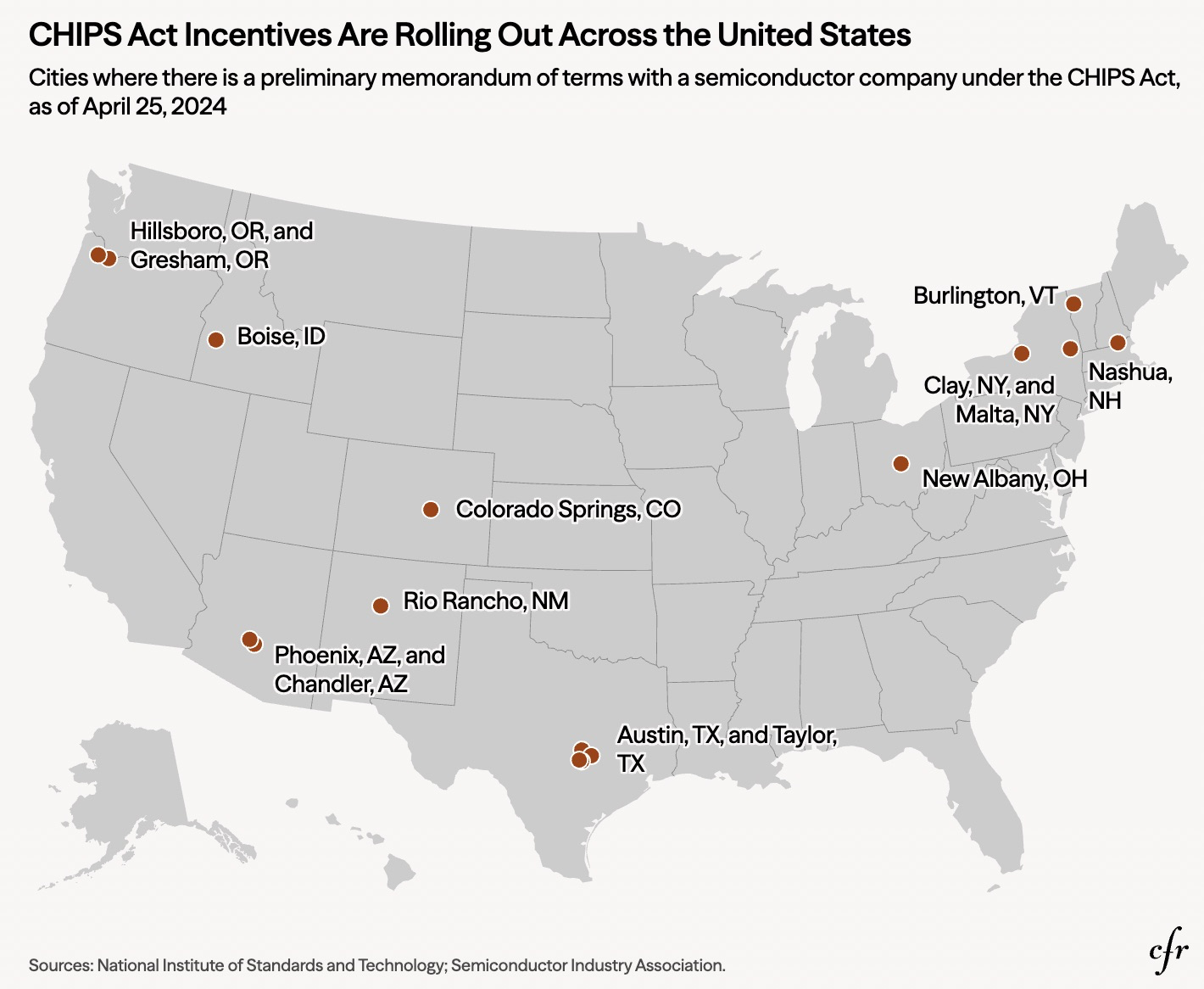
From the Council on Foreign Relations, “What Is the CHIPS Act?” from April 29, 2024.
The CHIPS Act is a once-in-a-lifetime investment in American technology and industrial policy. Why is it then that coalitions are protesting and organizing against the implementation of the act?
There is an immediate pushback against the rising infrastructure costs that the chips’ manufacturing brings to the local communities. In states like Pennsylvania, grassroots activism is growing over concerns that data center energy consumption will drive up residential electricity bills and strain water resources used for cooling of the data centers—another key piece of AI infrastructure. Some reports suggest that up to a $3 trillion investment is needed by 2030 to adapt to AI’s energy demands. More efficient chip design and data center infrastructure might be a solution for the total number, but the urgent need for chips to keep pace with AI development leaves no time for those improvements to be introduced. The harm of the chips production race is thus being taken on by the local energy and water grid consumers.
In New Brunswick, New Jersey, residents successfully halted construction of a proposed data center, explicitly linking it to 20 percent energy rate hikes. Activist groups are also organizing fiercely across New York, Michigan, and Arizona. Though trade unions have not yet taken a stance on data centers, their construction is a part of the ongoing negotiation between AI development and short-term human welfare.
However, there is a larger employment tension at hand: the employment benefits of the manufacturing and data centers might be overstated, while the danger of long-term job displacement brought upon by AI is increasingly worrying.
Trade unions are excited about the possibility of rising employment, especially in key states targeted by CHIPS. The International Brotherhood of Electrical Workers (IBEW), with around 887,000 members, and Laborers’ International Union of North America (LiUNA), with around 500,000 members, have spoken up in support of the CHIPS Act, celebrating the good jobs created by manufacturing. For IBEW, Intel’s new $100 billion semiconductor complex in New Albany, Ohio, is expected to hire local union workers, making it the largest project labor agreement in their history. It is projected that the plant will bring 7,000 construction jobs—including up to 3,000 electrician positions—for at least a decade. These facilities will require highly specialized and skilled workers, but knowing exactly which jobs are needed allows trade unions to prepare recertification programs for their workers.
In contrast, the American Federation of Labor and Congress of Industrial Organizations (AFL-CIO), which represents roughly 15 million workers, is focused on the “worker-centered AI” approach. Their stance is that technology should only be implemented in the workplace if collective bargaining is used to establish enforceable guardrails and a high level of transparency from tech companies and employers. Both the Communications Workers of America, who have spoken out against AI, and IBEW are under the AFL-CIO umbrella, making it hard to create a cohesive policy for or against AI while representing such a diverse union base. The CHIPS Act enacts clear worker protections through mechanisms like the Davis-Bacon Act, which ensures that workers are paid at least the locally prevailing wages, leveling the playing field for union contractors. There is no way to predict and plan for the long-term damage of AI—yet labor policy to address the current impacts of this technology are required now.
The long-term goal of the infrastructure created by the CHIPS Act is to deploy tools of automation that could potentially displace millions of workers in the service and knowledge sectors, with 71 percent of Americans fearing permanent job loss from AI. The immediate benefits of the CHIPS Act are concentrated in traditionally unionized sectors, while the long-term risks of AI displacement, however, are likely to fall most heavily on white-collar occupations, like office, legal, and business workers. This asymmetry creates a difficult strategic moment: The workers building the infrastructure of AI may not be the same workers vulnerable to its long-term economic consequences.
The construction boom is finite (a ten-year investment in Ohio) but the displacement enabled by AI is potentially permanent. Currently, labor unions like the AFL-CIO are responding to these fears by trying to shape the technology through collective and preemptive bargaining, while also defining worker-centered AI principles and producing research on how AI is changing the workplace. Unions like AFL-CIO are powerful players and can shape both conversations and policies by demanding stronger labor rights, binding guardrails on workplace AI, and institutionalizing workers’ voices in AI R&D and procurement.
The tension between the politics of AI infrastructure will not be resolved through national industrial policy alone. The political responses must become place-specific to cater to the local anxieties and opportunities brought about by AI. Large federations such as the AFL-CIO cannot treat the CHIPS Act as simply a national industrial policy victory or a technological threat. They should amplify and create space for local chapters to shape the local policy and response to the different implications of AI. While not new, the CHIPS Act versus the AI impact on long-term job displacement once again brings to the surface deep tensions within traditionally nonunion and union working sectors.
Finally, this shift can become an opportunity for a new push towards unionization of workers who previously shied away from organizing. The unions now have a strong chance to show leadership by building broad coalitions and promoting policies centered on workers, rather than relying on unilateral action.