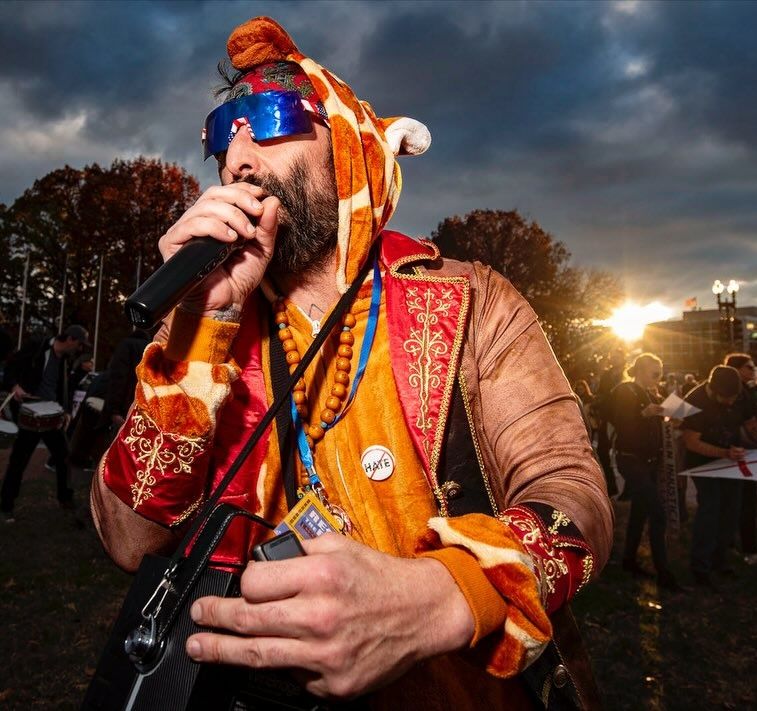
Rob Potylo is a Massachusetts-born musical comedian and producer best known for his fictional alter ego, Robby Roadsteamer. After years in New England’s underground comedy, music, and radio scenes, Potylo recently gained national attention for performing parody songs at political hotspots across the country. In doing so, he seeks to show that comedy and absurdity can be tools of de-escalation—and ways to revive the spirit of counterculture activism.
Ciara Leonard: You’ve been described as “part comedian, part rock god, part political chaos agent.” I would love to know how you came to embody this combination—could you tell me a little about yourself and your background?
Rob Potylo: I grew up in New England, and as an alternative counter or creative type, it’s really hard to find a living around here. I kept trying to find my way in the comedy scene, the music scene, the radio scene, and even put a TV show on television up in New England. That resilience of not wanting to give up on being a creative type led to a really peculiar skill set that when it came time to my activism career. Whether it be a comedian, musician, or radio show character, I just kept bouncing from one thing to another.
CL: More specifically, where did the character Robby Roadsteamer come from? What’s his origin story?
RP: When I was trying to figure out what I could do creatively as an adult, I realized I already had the skill set. I’d been performing for years but usually as an exaggerated version of myself. I then decided to lean into this bigger, wilder, wrestling-style alter ego—Robby Roadsteamer.
My dad fought in Vietnam. He was intimidating and scary, but he also had this really dark sense of humor. I think a lot of the character comes from that—taking all that inherited rage and turning it into something fun.
CL: When did the character become political? Was being politically involved and protesting always the plan?
RP: Politically, this is new. I spent decades doing albums, shows, comedy bits as Robby Roadsteamer—but never brought him into the political realm until two years ago. Before that, I’d gone to protests, rallies, and performance-art actions. I had all the ingredients, but the political climate just felt like it reached a certain ugliness where it suddenly made sense to bring Robby into it.
And because he’s such an unexpected fit, I’m able to infiltrate MAGA spaces really easily. It’s almost like he’s a pied piper into what they love: He taps into a kind of underlying negativity those crowds already respond to. I’m honestly grateful the character has such an effective outlet now because I don’t enjoy bringing that energy into a normal comedy club. Robby is abrasive by design and only really makes sense in a setting like a MAGA rally.
I was in Washington recently for a Remove the Regime rally at the Lincoln Memorial, and that was the perfect environment. People were laughing and just embracing the absurdity. That’s what I’m doing—matching their extremity with humor, flipping their own tactics back on them. MAGA folks love watching “the woke” get triggered, so I use a kind of judo: I reverse their energy into absurdity instead of anger. They usually crack when that happens.
CL: Can you expand on this strategy of fighting MAGA not by arguing with them but by making them absurd?
RP: I’m part of a few different organizations around the country, and a lot of people are totally focused on trying to out-debate MAGA—like if they can just win the argument, everything will click. But with Trump’s version of MAGA, so many of the figureheads don’t really argue in good faith. They jump straight to name-calling or gaslighting. It becomes so over-the-top that trying to meet them with logic doesn’t work. The only technique that does work is to reflect that absurdity back at them.
That’s what I’m doing with whatever version of Robby I bring out at an event. It’s very much in the spirit of 1960s counterculture like the Merry Pranksters and Haight-Ashbury, using humor and performance to face a dark regime. None of this is new; the universe keeps running the same stories, just with new technology. In the mid-60s, people were living under this dejected political climate—the Kennedy assassination, tens of thousands dying in Vietnam. And still you had hippies putting daisies into rifle barrels. They used absurdity and joy as resistance.
I think the real pure form wherever I go with the character is about getting counterculture excited about being part of the movement and not feeling like they’re leftist radicals ready to blow up everything. I love going to the [Democratic National Committee] DNC or to independent activist scenes in places like Portland, Los Angeles, or Illinois. There are grassroots cultures springing up everywhere in response to whatever “civil war” narrative is being pushed from above. I remember going to Los Angeles last June when the media was calling it a war zone. But the Latino community was out in the streets celebrating—mariachi bands, flags, families everywhere. It completely broke the storyline. During the George Floyd protests too, everything was described as a war zone, and then these creative protest movements would show up and pop the bubble.
Absurdity is such an awesome way to de-escalate, to romanticize the scene and get communities feeling like they’re on the good side of trouble again, as John Lewis would put it.
CL: There’s a risk that humor and joy in these tense political environments can be misread as not taking issues seriously, especially online. How do you navigate that fine line?
RP: It’s hard because when we talk about “the internet community,” we’re talking about the same online culture that helped put Donald Trump in power. So if our barometer for how we measure ourselves as humans is on social media, I’d hope some of those people could log off and actually show up at a protest. Being there in person, you can see the real power of de-escalation.
Anyone who decides to be on the front lines protesting shows that this country is still worth living for on both sides of the coin. Whether it be soldiers, police, right, left, up, or down, we’re still all in this together.
I don’t think anybody that chooses to be on the front line out there trying to de-escalate with comedy, humor, or compassion could be labeled as not caring. That in itself is absurdity.
CL: When you face serious challenges, whether negative encounters with counter-protesters or law enforcement, what keeps you motivated to continue?
RP: I just feel in love with the movement, the country, and the energies. A lot of times I find a home at these places I go to around the country. This year alone, in Portland, Oregon, Broadville, Illinois, and DC a dozen times, I’ve found a pulse in all these different pockets of counterculture.
It’s people coming together, people finding their stories, people falling in love with each other or a community again. It’s the weirdos, the outcasts, the people with backbone and courage—our veterans, our punks, our trans community—who come out. There’s a spirituality to art. And there’s a spirituality to activism that when it’s really locked in, you find your people.
You find them in a way you don’t in the warm comfort of a chat room or a social feed where dreams just get fed into an algorithm. I still believe in taking those dreams out into real life. Take some chances. Fight against the rumors that it’s all just the “radical left,” or whatever people say. Go find some community out there. If history tells us anything, it’s that tense moments like these are a prime time to rediscover counterculture. It’s out there. Your story is out there.
If the DNC can get hip to the idea that we can bring progress and hope back, then maybe that will bring real change. Maybe we stop some of the dumb things we’ve seen happen this year. But the only way is getting the 15 million people who didn’t vote last time to vote this time.
We need night culture. We need to inspire. We need them to fall in love with the country again, in spite of the fact that it’s dire and dark. I feel like a large part of that usually gets answered by counterculture’s amazing community and art. We need all of that more than ever. So come out and have a good time. If you don’t want to come to a protest, it’s actually a festival. So just come to the festival.
CL: What do you hope people understand about this form of activism that they often miss?
RP: I just think people get too caught up in the major media outlets that are telling them not to participate because there’s supposedly some kind of radical war or unrest happening. And a big part of what a lot of these organizations have been trying to do lately is actually the opposite—romanticizing the scene so people can fall in love with the movement again.
I’ve been to a lot of No Kings rallies and Remove the Regime protests, and one thing I keep seeing is people realizing, in real time, that it’s not going to be some violent, chaotic front. It’s actually a good time. I’ve seen so much color in the crowd—people in costumes, veterans, immigrants, LGBT folks, people who feel marginalized—just all coming together under this great canopy of hope again.
CL: You go to protests across the country. How do you stay informed and aware of everything happening?
RP: Once you become part of it at that very first protest, everything changes. When you go, you meet like-minded people and organizations fighting on the front lines, whether they’re trans folks, veterans, Dreamers, artists, people who are homeless, people from all walks of life who care about the country. And from that, you start building a real social network. That network tells you where the next events are.
The more you put into it, the more you become part of the collective consciousness or the hive mind. You meet the people who know what’s coming, and then you decide if you want to do it. And every time you go, you gain more skills. The second protest won’t feel as uncomfortable as the first. By the third, you might actually find yourself in love with it.
And then what happens? The protests become your family and the family at the dinner table doesn’t even make as much sense anymore. I go around this country, and I see that everywhere. I see the spirit of people still fighting on the front lines for good counterculture, spirit, and progress. They’re giving out food, setting up tents, doing activism, making art and giving it away for free, marching, and supporting each other.
CL: Your mentor is Vermin Love Supreme, a Massachusetts political satirist who’s been on the scene for nearly 40 years. How did this connection come about, and what’s been his impact on you and your work? Even interacting with other people on the scene like the Portland Frog, how does that feed your own work?
RP: I was doing the character Robby on the comedy side in shows, and I was struggling. I was depressed. I told you, I did television, a kind of mockumentary on an affiliate of CBS. The whole storyline was that I lived in a hippie commune. And I was really inspired by Bob Dylan at that point. It was around 2012.
I wanted to do comedy songs at protests. And holy cow, who shows up to the shoot for one of these episodes but Vermin Supreme? I had started seeing him glitter-bomb political candidates—Randall Terry in New Hampshire and on C-SPAN for the lesser-known candidates’ debate. To me, it felt like seeing Pete Seeger or Woody Guthrie as Bob Dylan. Here was a man standing on a political front, bringing the spirit of Haight-Ashbury, the Rainbow Family, and this loving, communal, comedic energy to protests.
He ended up bringing me to the DNC in Charlotte, to Trump’s inauguration, and we toured the country. I helped produce a lot of his videos and did some documentary work. The mentorship felt very organic—as creative, almost like being a protégé. I was in my own creative discipline and got to be around this gentleman who went into the political ranks and brought this gift of creativity, comedy, and absurdity. He set up the infrastructure of making a marriage between activism and art that I use myself.
Seeing this synthesis from folks like Vermin Supreme but also the Merry Pranksters and the Portland Frog is amazing. There’s an art form, a language. Outside of my own partaking in that creative work, it really makes me feel warm to see all these amazing creative types from all walks of life doing their part, like the Good Liars and Jon Stewart. They have taken up this torch of counterculture art that builds community and is inspiring. I’m very thankful. I don’t think anything I do is accidental.
There are some really amazing artists out there who have been hiding under the guise of a mascot outfit, or a boot on their head, or whatnot, and who seem to have the ability to bring calm to the chaos that our leaders should be doing—but they’re too rich or too tired. We’re in dark times; we’ve been in dark times before, but it’s not a protest. It’s a festival. Come find your people.
CL: To wrap up, do you have any words of wisdom or urges for young people right now?
RP: For young people who are of a creative ilk, I think there’s an amazing opportunity to impact the psyche of a nation. I think folks, more than ever, need comedy out there. I lament sometimes, because I feel like I’m trying to be a Woody Guthrie or something—I perform as Robby in an animal onesie. I know I don’t have the best voice and character—but I can only imagine the amazing youth out there, with a vocal range like Freddie Mercury, going out and singing a poignant song about ICE or immigration, capturing the hearts and spirits of a country with their performances.
I think there’s a lot of room for people out there. If you’re a musician, comedian, or performer and you’re frustrated, why not bring your frustration to a protest front? Even if you don’t find a song or a routine there, you might find your people.
I’d say take some chances. There’s romance in life if you take chances.
*This interview has been edited for length and clarity.