The BPR High School Program invites student writers to research, draft, and edit a college-level opinion article over the course of a semester. Annie O’Connor is a junior at St. George’s School.
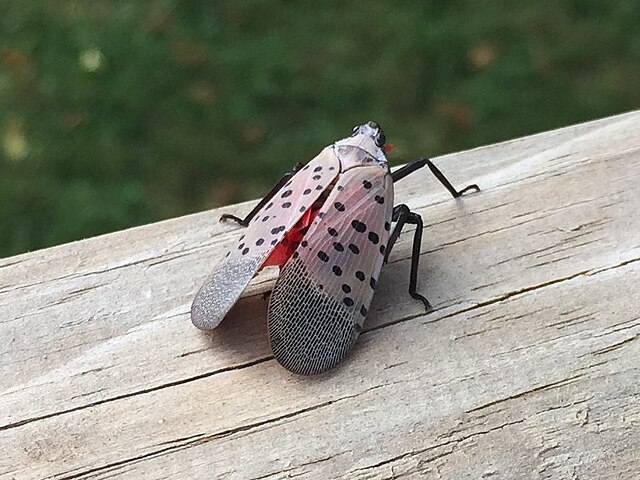
“Fifteen kills today!” My mom proclaimed after stomping on another winged pest. This summer, my mom and I took up an uncharacteristic hobby: killing flies. Coming from the kind of household to carry a spider outside, or let a ladybug make itself at home, squashing bugs wasn’t our initial idea of a bonding activity. However, these were not just any flies. They were the North East’s hottest new invasive species: the spotted lantern fly. Although I knew it was ultimately for the greater good, each time I killed one of the pests, it felt a bit wrong and violent. While the aggressive messaging around killing lantern flies may seem antithetical to typical green efforts, this level of passion is just what the environmental movement needs.
The exotic red-and-black speckled insects are foreigners in the United States. Originally from various parts of Asia, lantern flies were first identified in Pennsylvania in 2014. Since then, their population has grown exponentially across 19 states, wreaking havoc upon native species. The pests feed on over 70 different plants, leaving behind a sugary liquid that promotes mold growth and further destruction.
This summer, the bugs’ population and destruction reached new heights. Alongside that rise, however, was a rise in discussion surrounding the bugs. Campaigns and social media posts advertising with the slogan “See it? Squish it!” put spotted lantern flies on the map, introducing a new type of violence in protecting nature.
Eco-friendly efforts are often associated with a soft image: green hues, paper straws, the Earth sitting in the palm of a hand. Events like Earth Day are represented similarly, promoting harmony with the natural world without a specific call to action. National Geographic, one of the most famous environmental organizations, writes that the mission of Earth Day is to “raise awareness of the need to protect Earth’s natural resources for future generations.” The issue lies in the vague messaging of “raising awareness” and “protecting resources.” These efforts come across as passive, rather than deeply urgent. Earth Day typically lacks the urgency needed for the environmental crisis we face; although people may post photos of nature on Instagram, they rarely take immediate or significant action to protect the Earth they love. Appreciation and awareness alone are insufficient to protect resources. While traditional efforts are not devoid of passion, they lack the necessary intensity and specificity we need today.

The climate crisis is urgent. We are far past the point of previous efforts of “spreading awareness” and reposting Instagram infographics. Invasive species are currently threatening and destroying native plants and habitats worldwide. Yet, invasive species are only one issue of countless problems impacting our planet. The World Health Organization describes climate change as a “health crisis”, one that is “already killing us.”. The Earth is rapidly degrading, taking down entire communities with it. Thus, the passive nature of many previous environmental efforts has become destructive in itself. We cannot continue to believe that passively recycling or turning off the lights when leaving a room will make a significant enough difference. That does not mean, however, that taking small actions does not count. It is taking the necessary action. Society needs to take on climate change aggressively, stomping out the issues that kill our planet and our people. It takes humanity as a whole to make a difference, whether that be large-scale shifts to renewable energy or simply stomping on a bug that’s hurting native wildlife.
Despite often taking the form of superficial activism, social media does not have to be passive. In fact, it is transforming the activism scene as a whole. Through various platforms, activists can now instantly spread information and share messages worldwide. In the late stages of climate change, rapid global dissemination of information is key. The urgency with which we address climate change should mirror the urgency of the issue itself. Professor Ray Brescia claims that the success of activist movements depends on their ability to embrace the communication technologies at their disposal. We must reevaluate how we use social media as tools to take speedy, direct action rather than share passive awareness. Platforms like TikTok have played an instrumental role in communicating and spreading the lantern fly movement. Videos talking about the flies have received hundreds of thousands to millions of likes, leading to stomping across the country. What sets the lantern fly campaign on social media apart is that it is awareness linked to a specific action. The lantern fly mission exemplifies the right way to use social media to create change.
The lantern fly mission’s violent, specific, and urgent goals stand in stark contrast to most forms of soft environmentalism. It should serve as a role model for other environmental efforts. The popular slogan “See it? Stomp it!” sums this up perfectly. It has a clear goal: stomping to protect a specific resource — our native species. More so, stomping on bugs, while maybe gruesome, is fun. Gamifying an environmental mission, like my mom and I have, can encourage people to care about invasive species in ways they might not have before.
With the combination of trendiness, straightforward goals, and a recognizable look, it’s no surprise that lantern flies have become the most well-known invasive species. Although many other invasive plants and animals pose even greater threats than the lantern flies, they remain unknown to the general public. Species like the box tree moth, Japanese barberry, and mustard grass have been slowly overtaking native species across the United States. However, you do not see people ripping out weeds or stomping on moths on a daily basis, because few other species have received the notoriety of the lantern fly. This speaks to the success of this new form of active environmentalism in spreading awareness while getting people to be proactive.
That is not to say that stomping is the most effective measure for eradicating the lantern flies. In fact, a Fordham study states that “thirty-five percent… at relevant life stages,” meaning as eggs or young flies, “would need to be killed to start lowering the population growth.” Lantern flies reproduce and invade environments at rates too rapid to be stopped. Essentially, the stomp-on-sight method doesn’t really do much to fight the bugs. However, the stomping and awareness campaigns have been successful at getting people to care and take action for our planet, something we can learn to emulate in other campaigns.
By the end of the summer, our fly count had lost its novelty. But each tally on my kill count reminded me that caring for our environment should not be gentle. While maybe stomping will not single-handedly put an end to the spotted lantern fly invasion, it awakened something bigger: a shared sense of urgency. It’s time for society to turn awareness into action. The future of environmentalism should not be green. It should be bold, direct, and aggressive.