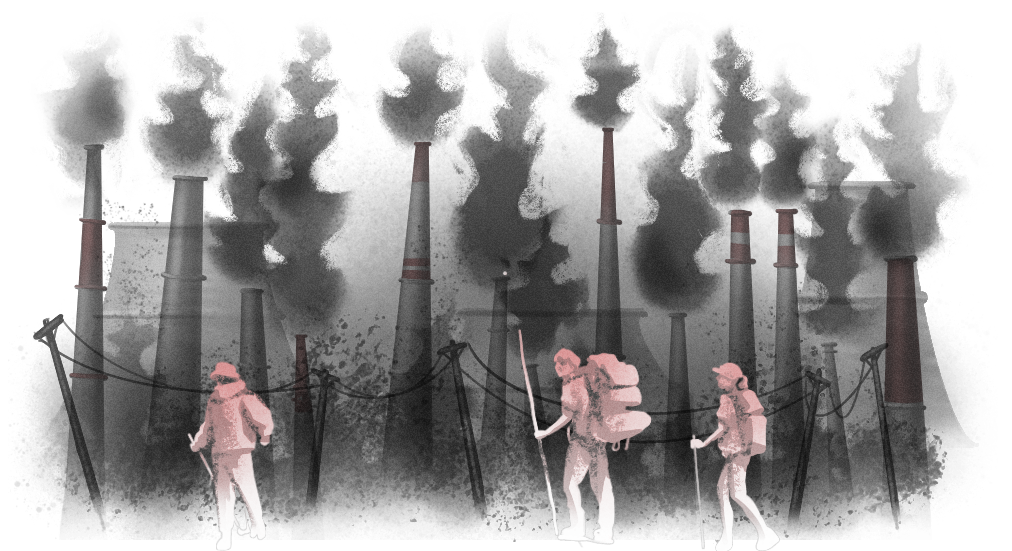
Many Americans take clean air for granted, but it is the product of detailed federal regulations that weigh the economic costs of reducing pollution against the benefits of cleaner air to human health. Recently, however, the Environmental Protection Agency (EPA) announced that it will no longer consider lives saved or health benefits in its cost-benefit analysis of pollution regulations. Although this change is meant to apply to a specific rule governing the emission of pollutants from gas-fired plants, experts suggest that its rationale may also govern the EPA’s clean air rules. While President Donald Trump’s administration claims the EPA will still consider health effects, experts in environmental law note that this “reassurance fails” because “refusing to monetize large and important benefits is not a neutral choice.” Rather, it is a way to “diminish” how much they are weighed and tilt the cost-benefit analysis in favor of companies and their economic benefits.
This policy shift reflects the Trump administration’s pro-industry bias and tendency to favor short-term economic gains over longer-term benefits. It is on par with the ill-advised thinking that governed the Department of Government Efficiency (DOGE), which took a red pen to programs throughout the government without considering whether their benefits outweighed their costs. Given the slapdash process, it was not surprising that many line items cut by DOGE ultimately had to be reinstated.
The administration’s proposed approach to the EPA suffers from the same blindspot. In the agency’s current view, the benefits of reducing smog and soot are simply too “uncertain” to quantify and should thus no longer be part of its cost-benefit calculus. But only considering a regulation’s cost to industry without similarly quantifying the real harms to human lives and health is senseless unless the goal is to ensure that industry wins. In other words, this policy amounts to devaluing human lives in favor of extra profit, trading short-term economic benefit for enormous human costs in the long run.
This is particularly alarming in the context of curbing pollution, where research on its benefits to human health is voluminous, making them among the easiest to quantify. The benefits of environmental regulations on emissions are evident in cities across the country, from Los Angeles to Fairfield County. By contrast, in some areas of India, where pollution regulation enforcement is lackluster, citizens have to stay inside on some days due to the toxicity of the air.
The EPA’s failure to quantify the real benefits of pollution regulations is ironic and tragic. The conservative administration of former president Ronald Reagan first mandated the cost-benefit analysis that included health benefits. Opponents of quantification, meanwhile, mostly came from the left, arguing that such valuations were too low and insufficiently captured people’s well-being, instead merely accounting for the economic value that they contributed to society. These left-leaning critics believed that underestimating the value of lives and health as part of the cost-benefit analysis had the effect of squashing too many valuable regulations because the economic costs to companies were easier to measure. Nevertheless, the quantification of health and lives has been standard practice for many years. As such, battles have been over how, not whether, human health and lives should be quantified. For example, the EPA has assigned a value of $11.7 million to a ‘statistical life,’ thus assigning a monetary benefit to reducing the risk of death for a large group of people. There has been a consistent debate between public interest groups and industries about whether to raise or lower the value. For instance, in 2018, the American Petroleum Institute pushed the EPA to use a lower value of human life for older people because they do not earn as much in their older years. What the current administration is doing is one of the worst possible options — failing to recognize even the most well-established economic benefits of pollution regulation to human health and safety, and instead prioritizing costs to industry.
The Trump administration’s decision will put countless lives in danger, and the health consequences will ripple for generations. More than two million children are predicted to be exposed to dangerous toxins that increase their likelihood of life-long health issues. Poorer communities and communities of color are also disproportionately likely to be affected by these decisions.
This policy shift sets a dangerous legal precedent as the Trump administration is likely to place a similar thumb on the scale in other contexts where regulations are designed to protect human health and lives, including environmental protections, occupational health and safety rules, and food and drug regulations. Legal experts have pointed out that this policy shift may be vulnerable to a judicial challenge because federal agencies, including the EPA, are required to engage in balanced decision making and may not neglect significant costs or benefits when evaluating regulations. Moreover, some experts have pointed to a Supreme Court precedent that suggests the current approach is legally flawed. In an opinion by former Justice Scalia, one of the Court’s most conservative members, the Court made clear that a full consideration of costs must include “harms that regulation might do to human health or the environment.” By refusing to consider both the costs and the benefits of health regulations, the EPA is weakening the foundations of environmental law.
The EPA’s policy shift represents a fundamental redefinition of what an environmental protection agency should be doing. The administration is abandoning the legal framework of environmental policy that enables courts to hold industries generating pollution accountable, and their methodology is skewed to do precisely what it should not: prioritize short-term economic benefits over the long-term health of society. Prioritizing immediate economic gains at the expense of the future seems to be part of a general shift in viewpoints at the EPA and within the Trump administration. While this may appease corporate campaign donors and wealthy allies of the administration, it is detrimental to the long-term health and safety of the American people. Ultimately, these costs will be crushing.