In the 1930s, the Soviet Union engineered the Holodomor in Ukraine, starving a population residing in some of the most fertile land in Europe. Unrealistic grain quotas were imposed on Ukraine to power the rapid industrialization Stalin sought, draining Ukraine dry. Not even a decade later, Nazi planners plotted to colonize the region in order to feed the “master race” at the expense of the Slavs, whom they viewed as subhuman. This gave rise to the lesser-known “Hunger Plan,” which further starved the Ukrainian people. In both cases, Ukraine was seen as key to fueling the engines of extremist regimes.
Today, Ukraine is one of the world’s largest grain exporters and a major supplier in international food aid programs. In his mission to destabilize Western institutions and consolidate regional power, Russian President Vladimir Putin has leveraged Ukraine’s status as the breadbasket of Europe to weaken and divide the continent. By disrupting Ukrainian agricultural production, Putin has sent outsized humanitarian and economic ripple effects felt across Europe and the world, undermining regional support for Ukraine, and worse, stoking pro-Russian sentiment — all in support of his goal to restore the power Russia once held before the fall of the Soviet Union.
The immense disruptions to Ukrainian agriculture since Russia’s invasion in 2022 are well-documented. Ukraine’s arable land has dropped by 14 percent, losing 3.5 million hectares to Russia. Of the remaining arable land in Ukrainian territory, a further 1.6 million hectares remain uncultivated due to military threat. This amounts to an annual loss of more than 15 million tons in agricultural products — enough to feed 70 million people for an entire year. Furthermore, the Ukrainian land Russia continues to poorly harvest will only become increasingly damaged and strained, heralding a lasting setback to Ukraine’s agriculture that will persist beyond liberation.
Russia’s export blockades have only exacerbated the effects of this agricultural disruption. During the early months of the war, Putin restricted nearly all Ukrainian exports through its main export route, the Black Sea, with a series of naval blockades, mined waters, and missile strikes. The sheer amount of grain lost to these disruptions pushed the United Nations, Turkey, and Russia to negotiate the Black Sea Grain Initiative in 2022, which re-opened three major Ukrainian ports. Part of this deal included minimizing sanctions on Russian food and fertilizer. However, Russia was left unsatisfied with the remaining sanctions and pushed for further concessions, ultimately ending the deal in 2023 when its demands were left unanswered. Ukraine was forced to establish its own maritime export corridor through ports such as Odesa, Chornomorsk, and Pivdennyi, although employing these routes remains risky and strategically vulnerable.
To support Ukraine’s economy and combat world food insecurity, the European Commission, in collaboration with Moldova and Ukraine, constructed “Solidarity Lanes”: rail, river, and road routes carrying Ukrainian grain to the rest of Europe to circumvent Russian blockades, often enabled by temporary suspensions of tariffs on Ukrainian agricultural goods.
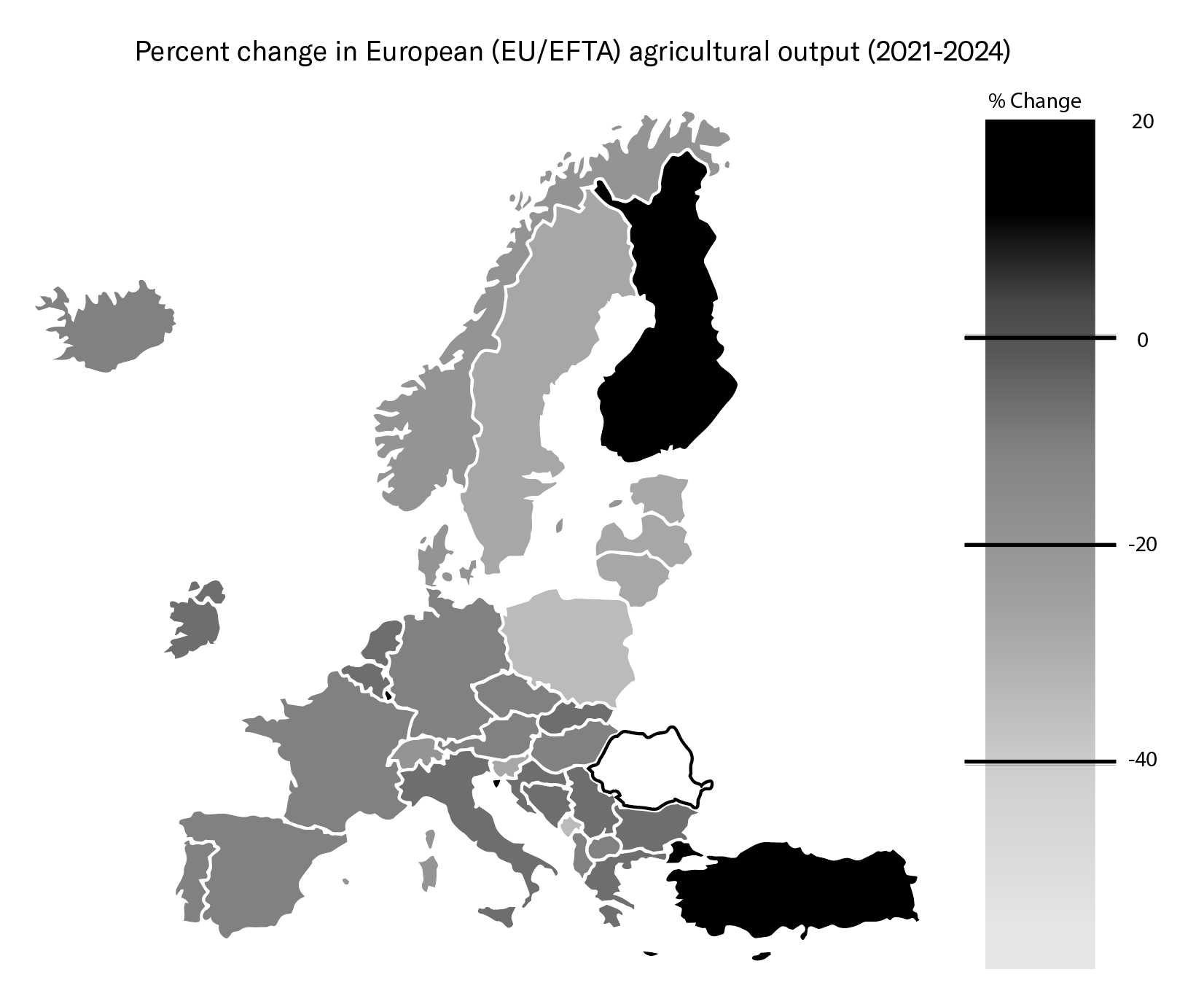
However, it quickly became evident that the “frontline five” — Poland, Slovakia, Hungary, Romania, and Bulgaria — whom the European Commission relied on to facilitate this trade, lacked the resources necessary to handle the transportation of such a large amount of grain. The resulting accumulation of grain in the frontline five pushed down the price of locally produced grain, causing huge income losses for farmers in these countries and triggering mass farmer protests.
As a result, Slovakia, Bulgaria, Hungary, and Poland adopted bans against the importation of Ukrainian grain, directly opposing the Solidarity Lanes. “[I]nstead of export corridors, our countries are becoming warehouses,” said Yavor Gechev, then-agriculture minister of Bulgaria.
Such resistance directly fractures the unified front in support of Ukraine that the European Union aims to project. A spokesperson for the EU deemed such unilateral actions unacceptable, stating that “[i]n such challenging times, it is crucial to coordinate and align all decisions within the EU.” A partial compromise was reached, in which the European Union adopted a temporary ban on the domestic sales of Ukrainian wheat, maize, rapeseed, and sunflower seed within the frontline five, as long as transportation to other countries was facilitated. Yet, the frontline five did not keel so easily. The nations’ agriculture ministers signed onto a position declaring their countries’ intention to extend the ban to the end of 2023, despite the European Commission’s decision to end the ban in September.
The widening fractures in European solidarity — especially on the part of countries previously part of the Soviet sphere that have since moved toward the West — are music to Moscow’s ears. Putin’s goal has always been clear: He seeks to restore what he views as the old Russian Empire and regain the power Russia had before the fall of the Soviet Union. He fears the eastward expansion of the EU and NATO not just for security reasons, but also because it constitutes a threat to his imperialist ambitions. Once a country has joined the EU and is subject to its rule of law or has joined NATO and is protected by its military pact, Russia’s chances of regaining that territory are severely diminished. These policies partly explain why Putin reacts so intensely when post-communist countries suggest a westward alignment.
Yet belonging to the EU and NATO does not insulate countries from Russian antagonism. Repeated European opposition toward EU policies that aim to support Ukraine has set a precedent of dissent, challenging European Union authority on Russia-Ukraine policy issues. As such, Putin’s war on Ukrainian agriculture has therefore successfully fractured both European solidarity with Ukraine and the Union’s identity as a unified coalition.
Hungary and Slovakia, both affected by inflows of Ukrainian grain, have negotiated exemptions from Russian oil sanctions, and Hungary has refused to militarily aid Ukraine. More than 18 percent of Slovaks even want Russia to win the war. Hungary’s Prime Minister Viktor Orbán has been working on plans to create a Ukraine-skeptic political alliance, possibly impeding the EU’s ability to militarily and financially aid Ukraine.
While the European Union fractures, Putin has increased Russian influence in other parts of the world by filling the gaping loss of Ukrainian grain, although millions of tons of the Kremlin’s exported grain are pilfered from Ukraine. Russia is currently among the top grain exporters in the world, particularly supplying grain to countries such as Turkey, Iran, and Egypt. Limiting Ukraine’s export capabilities and stealing its supply has become a major source of revenue for Russia, who has been suffering economically from sanctions and tariffs on its goods.
Russia’s deliberate attack on Ukrainian agriculture has rippled across the world, triggering farmer protests across Europe and rising global food insecurity. As people suffer, support for Ukraine wanes alongside anti-Russian sentiments, and many countries previously under Soviet influence have ventured to deliberately resist the European Union rule of law, fracturing the very foundation of the system Putin so ardently opposes. Ultimately, the war on Ukrainian farmers has resulted in the shattering of the West’s unified front toward the war in Ukraine and the attraction of post-Soviet countries back toward the East.