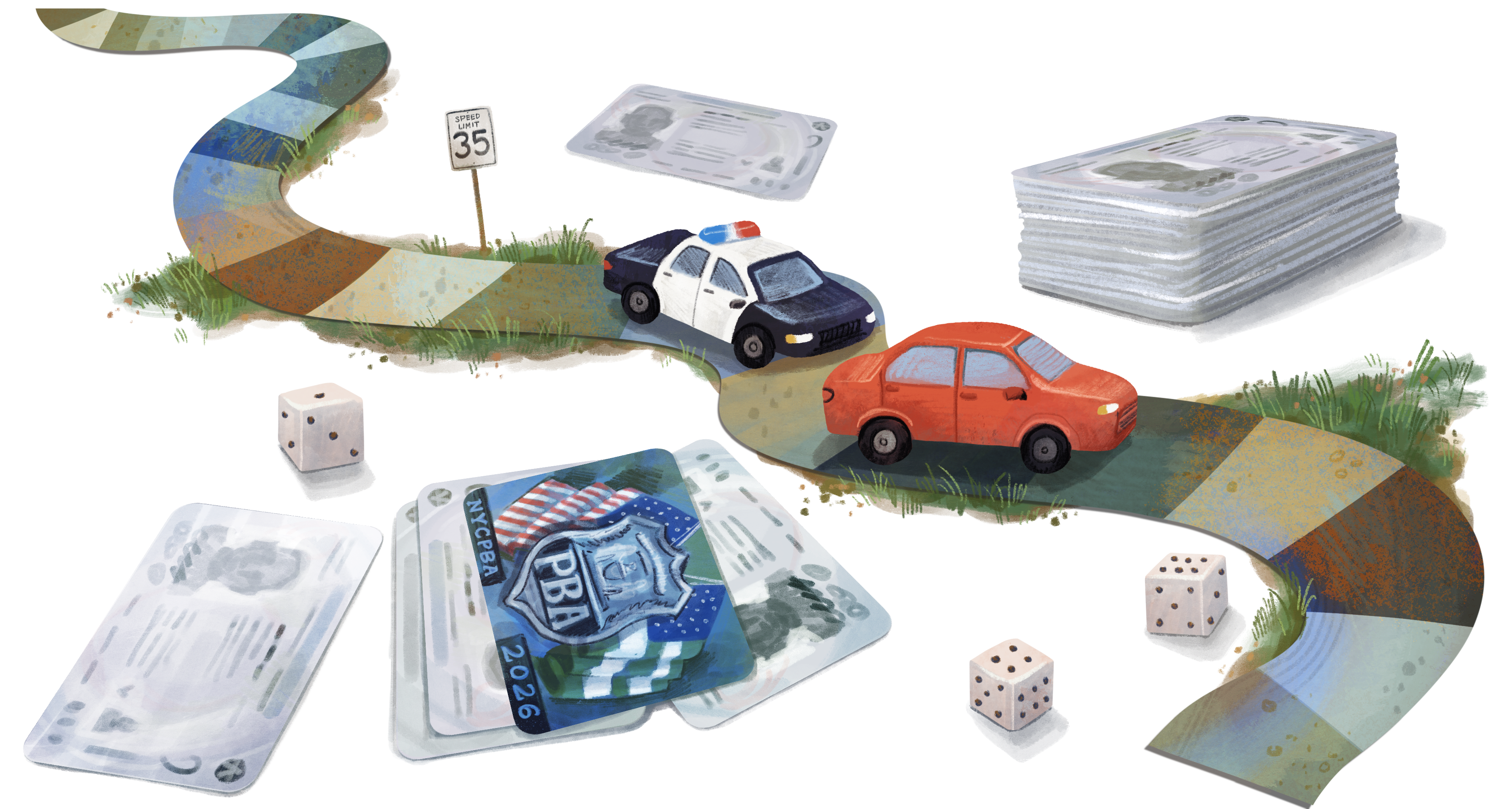
Picture this: You are freshly 16 years old, zooming down the New Jersey Turnpike with music blasting at 2 AM, hitting 103 miles per hour like it is nothing. The feeling is nipped by the glare of flashing blue lights. Panic does not set in, however, because you reach into your wallet and pull out a golden ticket. A potential felony has just ameliorated into a minor offense—all thanks to a small plastic card.
Courtesy cards—also called PBA cards due to their origins in the New York City Police Benevolent Association (PBA), a police union—are doled out informally by police officers across New Jersey, New York, and Connecticut. These cards line the pockets of hundreds and thousands of tri-state drivers, most of whom are close friends or family members of police officers. Those without direct connections can acquire cards through fierce eBay bidding wars or large donations to a local police union. Bestowed or bought, courtesy cards symbolize the unspoken code of preferential treatment owed to members of the informal police network. This “blue wall of silence” fosters a dangerously corrupt environment that encourages officers to prioritize loyalty above the law.
But just how effective are these cards? Existing analyses, though limited, suggest that the cards are incredibly effective at allowing citizens to evade a ticket, even when the offense is severe. The first and only formal analysis of these cards took place in 2024, when the New Jersey Office of the State Comptroller (NJ OSC) examined bodycam footage of 501 motor vehicle stops where no ticket was issued. Among these stops, more than 25 percent of drivers presented a courtesy card and received preferential treatment. Though police officers often claim that the cards are mainly used for minor traffic infractions—like a busted tail light or speeding—NJ OSC found that officers let citizens off for much more dangerous offenses, such as driving over 100 miles per hour or while severely inebriated.
Despite their ubiquitous nature, there is no definitive statistic on how many cards are in circulation. In 2018, the New York Police Department (NYPD) announced they were reducing the number of cards allotted per officer from 30 to 20 due to the cards being sold on eBay. In response, one retired officer remarked, “The cops I spoke to were…very disappointed they couldn’t hand them out as Christmas gifts.” Using the NYPD’s card reduction announcement as an estimate, a VICE journalist calculated that roughly 480,000 courtesy cards would have been issued to the 24,000 officers in the New York City area in 2020—not including the thousands more issued to retired members. When asked for a more informed estimate, another retired officer remarked, “I can tell you now from inside experience: They don’t have a clue how many cards are printed because they’re not serialized. They don’t inventory the cards. They just give them out.” As one of the largest and most well-funded police unions in the United States, the PBA is certainly capable of tracking the number of cards in circulation, yet they have chosen to leave them largely unaccounted for. Failing to account for the number of cards in circulation is more than just a form of insurance against liability—it also reflects the casual nature of the practice. Officers themselves have come to view the cards as trivial tokens in a sea of city crime rather than as material proof of a two-tiered system.
By extending an allegiance of preferential treatment to officers’ friends and family, courtesy cards morph the police union’s legal bond into a familial one. In a recent op-ed, David Miner, a detective lieutenant in Groton, Connecticut, warns that when police departments describe themselves as a “law enforcement family,” officers begin to “equate belonging with silence or mistake accountability for betrayal.” Miner’s concerns are not unfounded. When NYPD officer Josue Kavanaugh was given a daily summons quota that compelled him to issue tickets to courtesy cardholders, the PBA representative and fellow officers in the department reportedly harassed him—threatening to give out his personal information to the motorists he had ticketed, throwing fire crackers at him in the precinct locker room, and refusing to grant him his yearly allotted number of PBA cards. Underlying this bullying was an implicit belief that he had broken their informal code of allegiance: that loyalty to the department ‘family’ is always supposed to come before accountability to the law.
Unsurprisingly, this informal oath of allegiance makes external investigation incredibly difficult. Journalists and legislators who attempt to research courtesy cards are met with a black hole of information. When one reporter tried to interview police officers about the cards several years ago, the only quote he got was simply: “Nobody wants to go on the record about this.” When VICE reporters interviewed several cardholders about how they used the courtesy cards, all wished to remain anonymous. Secrecy on both the part of the officer and the cardholder reveal the stigma associated with speaking out about the cards.
This lack of transparency is not unique to courtesy cards. Scholars have coined the “blue wall of silence” as a key source of departmental corruption wherein “police engage in a pervasive pattern of deception and withholding of the truth in ritual cover-up for their brethren.” The wall functions through aligned silence and paints external investigators of officer conduct as interlopers who have “little appreciation for or understanding of the danger, adversity, and peril that consume the working lives of the police.” Ultimately, this antagonistic locker room mentality prevents progressive changes to police culture, sustaining the divide between the ideals of policing and its corrupt reality.
Despite their pledge to stand “at the front lines of advocacy, protection and progress,” the internal importance of courtesy cards to the New York City Police Benevolent Association reveals that in-group loyalty remains their utmost priority. As long as refusal to respond to external mechanisms of accountability—whether through government investigation, public pushback, or journalism—is encouraged, progress remains an empty promise. An equitable justice system necessitates holding police officers and unions accountable, but so long as internal loyalty is materially enforced and silence is institutionally mandated, justice cannot be realized. Flashing blue lights in the rearview mirror are meant to serve as a deterrent reminder of America’s extensive carceral system—but for some, they are only a minor inconvenience.