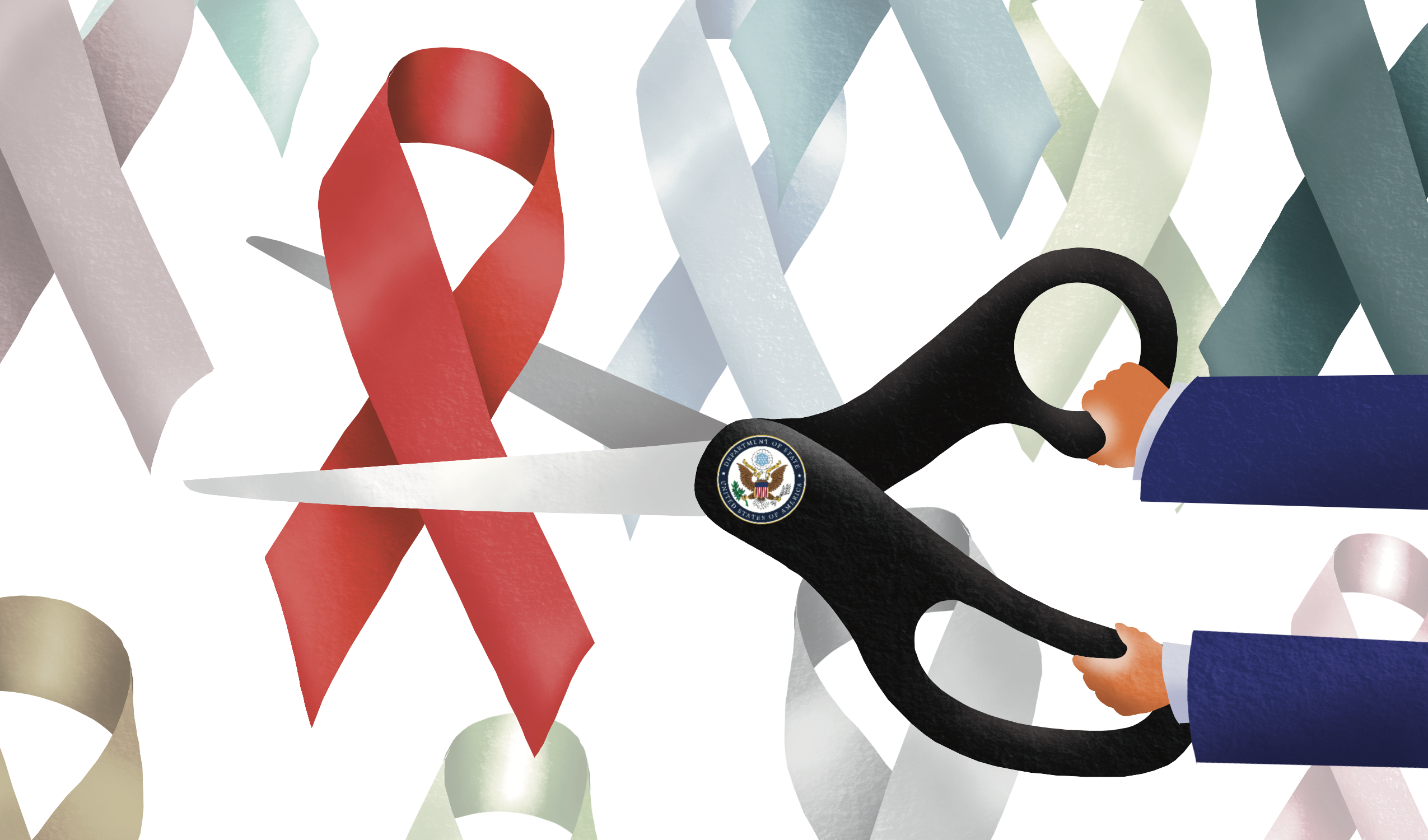
A “criminal organization” led by a bunch of “radical lunatics” is not how the world’s largest foreign aid organization, United States Agency for International Development (USAID), is typically described. Yet, these were the very phrases President Donald Trump and billionaire Elon Musk used in their bid to feed USAID “into the wood chipper.”
As the global community grapples with the fallout of this executive decision, it is important to realize that it is not only the poorest and most vulnerable who should be concerned: the average American should be, too.
In an attempt to shut down USAID, the Trump administration sent out notices deciding to terminate 90 percent of the organization’s foreign aid contracts. This goes against a federal judge’s order to release all congressionally approved foreign aid, an issue that a divided US Supreme Court continues to grapple with. This decision reflects much more than simply a $60 billion budget cut—it is a blow to US national security and global influence. While projects like $1.5 million for LGBTQ+ groups in Serbia and $6 million for tourism in Egypt have been brought out as examples of “wasteful spending,” it is important to note that, in 2023, USAID’s approximately $43 billion budget accounts for a mere 0.7 percent of federal spending, yet it delivers some of the highest returns in countering authoritarianism and securing the liberal world order as we know it.
Take the exiled Tibetan community—since China’s invasion that started in 1949, over 80,000 Tibetan refugees have rebuilt their lives across the globe. I grew up in one of the communities where, in the foothills of the Himalayas, the USAID-backed National Democratic Institute helped form the Central Tibetan Administration (CTA). This fledgling government provides education, housing, healthcare, and cultural preservation to our community. Beyond these tangible roles, it is also raising a whole generation of Tibetans who, despite physical displacement from our homeland, are intrinsically tied to the fight for their freedom and human rights. Now, a $23 million congressional grant aimed at sustaining this resilience hangs in limbo, threatening not only a vulnerable community but also a key counterweight to China’s expanding authoritarianism.
As decades of work prove, foreign aid is not a feel-good expenditure: it is a crucial aspect of American national security. Yet, these initiatives attract outsized attention, making foreign aid a target of strongmen and technocrats.
Policy analyst Yamini Aiyar attributes the Department of Government Efficiency’s (DOGE) crackdown on “government wastage” on various federal projects to the Silicon Valley’s cult-like movement called Dark Enlightenment, which sees “freedom and democracy [as being] inherently at odds.” DOGE—led by Elon Musk as the senior advisor to the president and staffed with young engineers linked to Musk’s own company—is tasked with carrying out spending cuts and modernizing federal technology to maximize efficiency. DOGE has allowed a new group of tech elites to cut through ranks in the government and insert themselves in its furthest corners as long-serving federal employees have been fired, agencies have been shut down, and spending cuts have been determined by Grok (Elon Musk’s AI Chatbot). Now, Musk even has the ability to send mass emails to all federal employees. Historian Janis Mimura issues warnings of this emergence of techno-fascism, comparing this very real phenomenon to the small group of industrialists and bureaucrats who, through their monopolistic exercise of power, drove Japan to World War II.
If bureaucratic inefficiency is really being used as a distraction to challenge the democratic edifice of the state, it is no wonder that it is not just technocrats in the United States but also authoritarian leaders in Russia, Hungary, and El Salvador—who have long clashed with democracy initiatives—welcome the attempts at dismantling USAID.
Nevertheless, history proves that strong democracies are America’s best allies. Especially in an age dominated by hybrid, information-centered tactics, investing in non-military preventative measures is crucial. From Russia’s 2014 invasion of Crimea to the Azerbaijan-Artsakh conflict, weak democratic institutions have exposed these societies’ pre-existing vulnerabilities and exemplify that, without trust in democratic governance, societies fragment, opening doors to violent extremism and foreign manipulation.
Worldwide, we are witnessing a rapid decline in public trust in state institutions, which dropped in the United States from 73 percent in the 1950s to just 24 percent in 2021. In an era where disinformation and polarization are key weapons, it is imperative to bolster civilian trust by reinvigorating our democracies.
Additionally, as highlighted by a letter written by 141 generals and admirals opposing cuts to the international affairs budget in 2019, democracy initiatives often prevent conflicts before they even start. “For every $1 spent on conflict prevention, we save $16 in response costs and avoid sending our troops into harm’s way,” the generals and admirals stated in the letter.
Arguably, the role of foreign aid is tragically understated in national security discussions where defense and diplomacy often take center stage. Nevertheless, development is the most effective tool in fragile states where poverty, food insecurity, and famine frequently coincide with armed conflict and human rights abuses. In West Africa’s Sahel region, weak governance has allowed violent non-state armed groups to expand unchecked. Similarly, in the Middle East, political and economic instability exacerbated by a huge lack of foreign aid has contributed to the Israel-Palestine conflict spilling into neighboring nations.
Returning to the case of Tibet, cutting foreign aid would weaken one of the strongest voices against China’s repression, allowing Beijing to further its human rights violations without impunity and rework the international order after its own model.
Kenneth Roth, director of Human Rights Watch, has warned how the world community has struggled to “adopt a strong common voice” against China’s human rights violations that fundamentally threaten the world order we take for granted. With China using its economic clout and advanced surveillance technology to silence discussions of its crimes, it is more important than ever to support one of the strongest voices against their repression. Without the work of Tibetan advocacy groups and the CTA’s programs, China would face even less resistance to its mass detention of Uyghurs, its intrusive DNA collection schemes, colonial boarding schools, and the erasure of ethnic minority identities.
Since former President John F. Kennedy created the organization amid the Cold War, USAID has been a key tool in the US soft power toolbox, favorably shaping global perceptions of America while advancing economic and security interests. Samantha Power, the Biden administration’s administrator for the aid organization, says she hoped that the Trump administration “would recognize that U.S.A.I.D. had become the ground game in U.S. foreign policy,” especially in light of China’s bold expansion of its global investments and the pandemic’s exemplification of the transcontinental nature of many human security threats.
With the country in a time when the “America First” rhetoric is dominating domestic politics, it is essential to recognize that the efforts to defund USAID undermine decades of strategic investments, creating a power vacuum that our adversaries are more than eager to fill.
Foreign aid is not a philanthropic handout. It forms the pillars that uphold the global order, without which the United States and its liberal allies risk being engulfed by a tide of expanding authoritarian regimes.