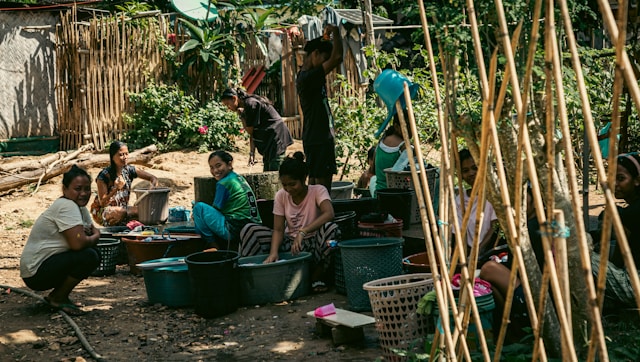
Community-driven conservation initiatives approach environmental conservation through local participation, decentralized management, and the integration of community and Indigenous knowledge into conservation practices. These models have gained increasing prominence, particularly across the Global South, where the international community and governments promote them as more equitable and effective alternatives to top-down conservation. In the Philippines, these programs—such as community-based forest management and marine protected areas—often claim to protect fragile ecosystems while simultaneously promoting sustainability and empowering local communities. Yet in practice, conservation governance frequently depends on the unpaid or unrecognized labor of women, particularly in rural communities where ecological care is already embedded in everyday domestic responsibilities. The main question in nature conservation is not simply whether local communities should participate in conservation work, but how environmental labor will be distributed within the community. Contemporary conservation governance in the Philippines relies heavily on women’s gendered care work while failing to address the structural drivers of ecological degradation.
In many rural Philippine households, women are responsible for subsistence farming, food preparation, and household resource management. Women manage these crucial agricultural tasks to feed their families. Because these domesticated activities are closely tied to environmental conditions, women often experience environmental degradation at the forefront, both as a threat to their environment but also to their own livelihoods. As a result, these women become the primary responders to ecological degradation. Conservation programs formalize these roles by designating women environmental human rights defenders (WEHRDs) and assigning them responsibilities, such as monitoring forest boundaries and reporting illegal activities to local authorities or partner organizations. These women are charged with patrolling forests to protect them from large-scale operations of environmental degradation—including illegal logging and mining operations—that threaten Indigenous territories and local communities. Environmental organizations within the Philippines endorse WEHRDs because they employ a human rights-centric framework and uplift marginalized communities. The Philippines’ largest and longest-standing conservation organization, the Haribon Foundation, recently established the Women Go project, which aims to increase the level of influence of rural women in protected area governance. They recognize that women-led forest management is an effective solution, since community well-being is already managed and protected by the women of the communities.
This dynamic is reinforced through the moralization of environmental work. Women’s participation in conservation is frequently framed through narratives of “motherhood” or “feminine altruism,” positioning ecological defense as an extension of caregiving. Female environmental defenders are often encouraged or expected to justify their activism in terms of protecting their children’s future or safeguarding the household’s well-being. Rather than being recognized as political actors making strategic interventions to protect the environment, WEHRDs are cast as “natural” caretakers of both family and the natural world. This framing draws on the long-standing gendered association of women with nurturing roles. Formal conservation programs have institutionalized this logic, embedding it into governance structures in ways that serve to further entrench gendered divisions of labor.
Women’s ecological responsibilities extend their “double burden” outside of the home to the local environment. The double burden refers to when women take on both unpaid domestic labor and additional, income-generating responsibilities in the public sphere. Environmental stewardship becomes layered onto women’s existing responsibilities for social reproduction and subsistence livelihoods, exacerbating this burden. A woman who already manages household food production and childcare may now also be expected to attend conservation meetings, monitor coastal protected areas, or participate in ecological restoration projects—a new and increasing reality for many rural women. Conservation initiatives may publicly celebrate women as environmental stewards, but they also worsen the gendered division of labor within households with the added responsibilities of conservatory work.
The risks associated with this gendered redistribution of responsibility extend beyond labor. WEHRDs increasingly face targeted threats and harassment because of their opposition to corporate- and state-backed projects. In 2023, 17 of the 196 environmental defenders who were killed or forcibly disappeared were from the Philippines—the highest death toll in all of Asia. Among these deaths, Indigenous groups and women are disproportionately targeted. This discrepancy is not incidental; it is directly linked to the feminization of environmental responsibility. As women take on visible roles in defending land and resources, they become both symbolically and materially vulnerable. Attacks frequently occur in domestic spaces or target family members, such as assassinations taking place at homes in front of children and grandchildren. These tactics weaponize women’s maternal roles by terrorizing domestic spaces and community, violating the sanctity of the home. Sexual violence has also become commonplace during military and police raids on protests or communities, preying on cultural narratives of feminine shame. The costs of environmental protection include both intensified labor and heightened vulnerability. Just as domestic violence operates within and reinforces unequal household power structures, violence against WEHRDs reinforces broader political and economic hierarchies by disciplining those who challenge them. The result is a deeply uneven distribution of both responsibility and risk: Women are expected to sustain households, communities, and ecosystems, while also bearing the disproportionate burden and consequences of defending them.
Crucially, this expanded burden exists alongside the absence of accountability for corporate and state actors driving environmental degradation. Large-scale mining, logging, and agribusiness operations—often backed by state policies—continue to extract resources at a scale that far exceeds the impact of local subsistence practices. Yet, conservation efforts disproportionately target local communities as sites of intervention, emphasizing community stewardship rather than confronting the structural sources of environmental harm. Women in particular are mobilized to mitigate the effects of environmental damage they are not responsible for, effectively absorbing the social and ecological costs of corporate extraction and deepening the double burden. Just as in the home, where women clean up messes they do not make, they are also tasked with repairing ecological damage they did not cause. By shifting responsibility for environmental protection onto women’s labor, these programs effectively redistribute both the work and consequences of ecological degradation downward, allowing corporate and state actors to evade accountability while intensifying gendered inequalities.
Recognizing these dynamics does not mean dismissing community-based conservation or the important contributions women make to environmental stewardship. Many women actively use these spaces to advocate for community rights, resource access, and environmental justice. However, genuine inclusion requires more than just participation in labor-intensive conservation programs. It requires a fundamental restructuring of environmental conservation: one that not only recognizes and compensates women’s labor, but also protects them from the risks that increasingly accompany it. As women take on more visible roles in defending land and resources, they are exposed to heightened threats and violence—revealing that conservation is not simply an extension of care work but a politically fraught and dangerous form of labor. Without confronting both the unequal distribution of labor and the disproportionate exposure to risk, conservation programs risk functioning less as a solution to the environmental crisis, and more as a system that reallocates its burdens—transforming women’s everyday care work into a hidden foundation of environmental governance while leaving the structural drivers of ecological degradation largely untouched.