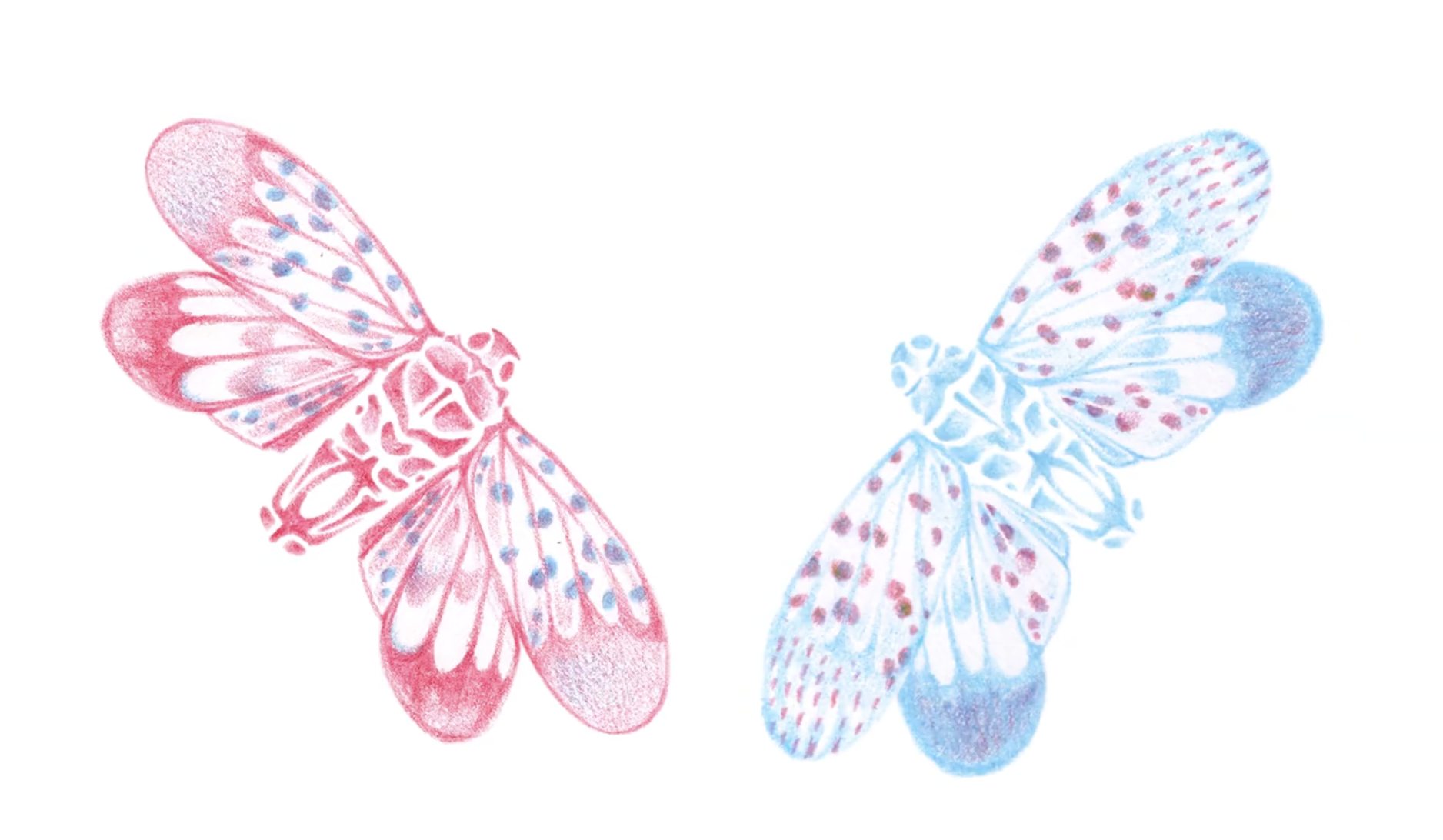
On the sides of brick buildings, across grapevines and maples, and even on car windshields, the spotted lanternfly can be seen all over Brown’s campus and New England. Its wings are delicate, decorated with little black dots and a flash of red hidden beneath its wings. At first encounter, it can be startlingly beautiful. Yet its “relatively high” threat level to agricultural production, particularly grapevines and fruit crops that sustain regional economies, has incited widespread alarm. Rhode Island officials call for residents to squash the bugs upon sighting, while local newspapers like the Providence Journal deem the bug “invasive and destructive.”
But while lanternflies sip sap and can weaken grapevines and fruit trees, entomology researchers have found that most hardwood trees tolerate them without significant damage. The lanternfly’s impact on native ecosystems is limited, even in Rhode Island. Part of why they are such a threat to vineyards is not because the little creatures are villains of nature, but because those monocultures are economically valuable yet ecologically fragile, offering an easy feast for the lanternfly. The hysteria with which the public has decried the lanternfly reflects a larger conflation of ecological and economic value, revealing the fragility of conserving “nativeness” in a world where ecosystems—and the meanings we assign them—are constantly in flux.
The line between ‘nonnative’ and ‘invasive’ species is far blurrier than public messaging suggests. American ecologist Julie Lockwood notes that nonnative species are typically defined as those introduced by humans beyond their natural range, while invasive species are the subset that cause harm—ecological or economic—after arrival. But even that distinction depends on human judgment and shifting priorities. When British ecologist Charles Elton, often regarded as the founder of invasion biology, first defined the concept in his 1958 book The Ecology of Invasions by Animals and Plants, he described invasive species as those that, through human introduction, disrupt or damage native ecosystems.
Four decades later, the 1999 US Executive Order on Invasive Species (13112) redefined invasiveness through a markedly different lens: Any species whose introduction causes economic harm, and only secondarily environmental or human health harm, would now qualify as invasive. The language in the executive order did not emerge in a vacuum. This policy reflected a broader shift toward aligning conservation with economic priorities, particularly those of agriculture, forestry, and trade. In a sense, it formalized a logic long implicit in environmental governance, that the threshold for action is crossed not when an ecosystem is disrupted but when a human enterprise is threatened.
The executive order thus marked a turning point. What had begun as a biological concept rooted in ecological balance became, by the turn of the century, a policy category shaped by human-caused market vulnerability. The redefinition signaled a conscious reframing of ‘invasiveness’ from a question of ecological fit to one of economic risk.
When harm is defined through profit, species that generate value are welcomed, while those that disrupt markets are condemned. The shift from ecological to economic reasoning reshaped not only how governments regulate species but also how the public began to perceive them.
Consider the European honeybee (Apis mellifera). Far from native to North America, honeybees were introduced by European settlers in the 17th century and have since outcompeted many native pollinators. Yet campaigns to “save the bees” rarely meaningfully distinguish between native and nonnative species. Honeybees are spared the label ‘invasive’ because they deliver an unmistakable service, pollination for agriculture and honey for commerce. Their productivity makes them untouchable, even as native bee populations decline. This double standard reveals the deep alignment between conservation and capitalism. We tolerate ecological imbalance when it sustains an economy, but mobilize eradication when profit is at risk. The backlash to lanternflies mirrors this phenomenon. Public messaging centers those profit-driven sectors, as it should when livelihoods are on the line. But the rhetoric of “harm to the ecosystem” often describes harm to profitable services, not an impartial verdict rendered by nature or conservation science. The very word ‘invasive’ now functions less as a biological diagnosis than as a measure of economic inconvenience. If our definitions of invasiveness are built on economic priorities, our definitions of nativeness are built on an even greater illusion, that nature ever stood still. Many nonnative species become established but remain noninvasive, integrating into local ecosystems without causing measurable disruption. Some even fill ecological roles once occupied by extinct or declining species; dispersing seeds, filtering water, or stabilizing soils. Ecologists describe this process as ecological fitting, when new arrivals “slot into” existing networks without shared evolutionary histories, creating continuity in function rather than collapse.
Across millenia, species have always moved, adapted, and reshaped habitats alongside changing climates and human activity. The idea of a fixed “native range” is, at best, a human snapshot, one moment in a much longer story of flux. Ecologists Jennifer Crees and Samuel Turvey remind us that what we call “native” depends entirely on the baseline we choose; pre-1492, preindustrial agriculture, or postglacial retreat. Each cutoff produces a different list of “original” inhabitants. Over centuries and millennia, species’ ranges slide north and uphill, rivers change course, winds carry seed and spore across oceans. Mobility, not permanence, is the norm.
To recreate a still image of the past in such moving systems requires constant intervention: spraying, reseeding, fencing, replanting. These acts of control can start to resemble the very invasions they aim to undo. It results in a paradoxical phenomenon, where in trying to preserve ‘wilderness,’ we produce landscapes that are less self-sustaining and more like museums of ecological nostalgia.
Climate change has emphasized this paradox. As temperatures rise and rainfall patterns shift, species are once again on the move, tracking the conditions they need to survive. Ecologists call these preferred zones “climate niches.” They designate the temperature, moisture, and light conditions within which a species can live and reproduce. When warming alters those niches, many species must migrate or face extinction. Some cross barriers that once seemed impassable.
If human industry helped dissolve those barriers by warming the atmosphere and seas, what then is the “natural” range? To label every climate-driven arrival as an invader is to punish adaptation itself. The concept of nativeness, once used to guide protection, has begun to obscure the realities of ecological change. What we need instead are conservation goals that acknowledge that ecosystems are always in flux. New arrivals can form mutually beneficial relationships, providing food, shelter, or pollination to native organisms. Ecosystems are, in other words, living negotiations that humans have deeply skewed.