Over the past five years, American politics has celebrated a new archetype: the Gen Z candidate. They are fluent in both digital culture and political language and are often presented as the generation poised to rescue democracy from inertia. Yet beneath the rhetoric of renewal lies a more complicated reality. What does it actually take to run for congressional office as a young person in the United States?
The contrasting campaign strategies and electoral outcomes of Deja Foxx and Maxwell Frost, two of Gen Z’s most visible figures, suggest that youth is not a fixed political identity but a medium through which different theories of political power and change are expressed. While Foxx ran on her youth and lived experience as a catalyst for change, Frost channeled his youth into establishing place-based legitimacy within his district, giving both the Democratic establishment and voters concrete reasons to trust his progressive vision. That difference – between the politics of moral imagination and the politics of institutional trust – defines the Gen Z candidate’s dilemma. Gen Z differs from Millennials not only in digital nativeness, but also in entering politics amid historic lows in institutional trust. These conditions reward visibility and punish patience. But even though visibility is easier to acquire than ever, it alone does not provide the foundation necessary to build a successful political movement.
Foxx’s 2025 special election campaign for Arizona’s 7th Congressional District was both improbable and emblematic. Two years out of Columbia University and 25 years old, she challenged Adelita Grijalva, the 55-year-old daughter of the late incumbent Raúl Grijalva, in a race shaped by dynastic inheritance and generational aspiration. A former Planned Parenthood activist and an influencer-strategist for Kamala Harris’s 2020 and 2024 presidential campaigns, Foxx rooted the moral center of her candidacy in her lived experiences of relying on Section 8 housing, Supplemental Nutrition Assistance Program (SNAP) benefits, and Medicaid. Through these experiences, she argued that perspective, not tenure, should lend candidates legitimacy.
Foxx’s campaign, however, existed at the intersection of two difficult terrains. She was a young woman of color running in a special election in a district where her national recognition could easily be recast as outsider ambition, and digital fluency could come off as distance from the constituency she hoped to represent. Her ties to the national Democratic establishment (despite her campaign’s attempts to frame her as an outsider, she was a speaker at the 2024 DNC) certainly did not help, especially in a period of record disapproval for the Party. As The Washington Post observed, Foxx’s “digital footprint often exceeded her presence on the ground,” a red flag in a special election with low turnout.
These problems are most evident in two key details of Foxx’s campaign. The first is that only 16 percent of her itemized individual contributions came from Arizona; the largest share came from California, and much of the remainder from New York. While Foxx had grassroots support (roughly 75 percent of receipts were donations under $200), that support was largely from outside her potential constituency. The second is that two progressive stalwarts, Alexandria Ocasio-Cortez (AOC) and Bernie Sanders, endorsed Foxx’s opponent. Foxx has repeatedly (and perhaps unfairly) been compared to AOC, and she has called Ocasio-Cortez one of the leaders who “best represent[s] the values of the [Democratic] party.” So, AOC’s endorsement of Grijalva, despite their generational differences, suggests a genuine disconnect between Foxx and the progressive leaders she hoped to emulate. Grijalva, a former teacher, school-board president, and county supervisor in her constituency, not only came off as having a larger personal stake in her community than Foxx but also brought a record of actually implementing progressive policy on the ground (most notably helping establish free preschool for middle and and low-income families), which better aligns with the background of politicians like Sanders and Ocasio-Cortez. Sanders reaffirmed this when endorsing Grijalva: “Let me be clear: Adelita Grijalva is the progressive candidate in the race for AZ-07.” This resulted in a 39-point loss to Grijalva—a thorough rejection of Foxx’s campaign.
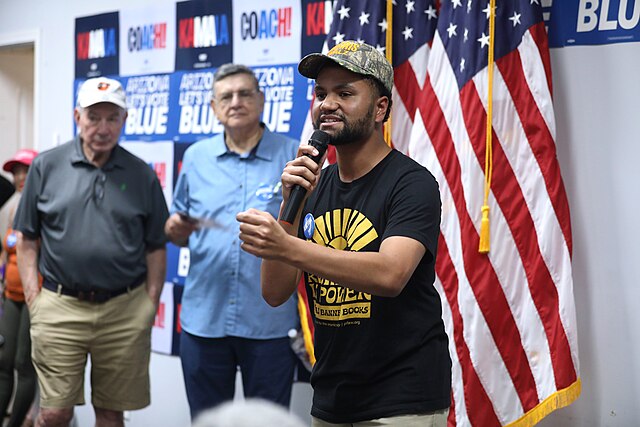
Frost, by contrast, was rooted in the organizer tradition, not the influencer one. Before his election in Florida’s 10th District, he spent years building March for Our Lives chapters as the group’s national organizing director, was an organizer for the American Civil Liberties Union (ACLU), and served on the advance team for Bernie Sanders’s 2020 presidential campaign. Frost’s campaign was steeped in policy specificity: gun reform meant banning assault weapons, closing all-sale background-check gaps, and funding community violence-intervention plus federal research; housing & transportation meant national tenant protections (rent-stabilization, right to counsel), ending exclusionary zoning and tying federal dollars to Lynx/SunRail and bus/rail upgrades; climate policy meant a Green New Deal/THRIVE Act frame plus a Civilian Climate Corps to build resilient, union-track infrastructure. His campaign was built on union and faith-based networks, community organizations, and long-standing policy partnerships. It treated youth as an organizing capacity rather than an identity: Where Foxx’s platform sought to expand access to power, Frost’s sought to operationalize it.
The two campaigns cannot be compared in a vacuum; geography, demographics, and timing are all confounding variables. But their divergence illuminates the central tension which Gen Z candidates face. Foxx’s campaign centered on expanding the moral space of politics within institutions; Frost’s centered on carving out institutional space for a progressive agenda from an organizer’s world.
These messages are underwritten by the contrasting spheres of politics that the two candidates come from. Foxx’s experience was in messaging and media, Frost’s was in organizing. If Foxx comes from the Kamala Harris school of politics (as evidenced by her time on her 2020 campaign), Frost comes from the Bernie Sanders school (as evidenced by his time on his 2020 campaign). Foxx ran on what to replace, Frost on how to replace it.
These distinctions reflect two competing models of how youth plays into contemporary politics. Foxx used youth as an epistemic advantage–claiming that those closest to the social and technological transformations of the present possess insights that the political establishment cannot. Frost sees youth as an organizing capacity–the ability to mobilize energy and narrative toward durable structures. Foxx’s campaign illuminated the cost of being expected to personify generational change while also exceeding it. Frost’s success underscored the continuing power of traditional institutions to confer legitimacy even on insurgent figures. Neither story fully resolves the question of what ‘youth politics’ really means. Still, together, they reveal the distinct tensions between visibility and locality, identity and infrastructure, and narrative and governance.
It’s tempting to cast Maxwell Frost’s model as the future and Deja Foxx’s as the past. In this race, at least, the results weren’t ambiguous. The system still rewards place-based legitimacy, field capacity, and endorsement networks, while penalizing candidates who can’t translate national name recognition into ward-level turnout. Foxx was a nationally embedded political figure—she had the DNC stage, the progressive media, and the creator infrastructure—but that visibility failed to substitute for precinct captains, canvass universes, and local validators in a low-trust, low-turnout special election. Frost, by contrast, spent years inside unions, faith groups, and neighborhood organizations—he spoke the institutional language of vote goals, coalition maintenance, and deliverables.
If youth politics means more than branding, it has to begin with organizing. Social reach can amplify a message but clearly, it cannot replace a good ground game. For now, the model that wins is the one that treats the digital as an accelerant to doors, not their replacement. The next wave of Gen Z candidates will have to decide not only what they hope to replace but how they intend to replace it—starting with precincts, not posts.