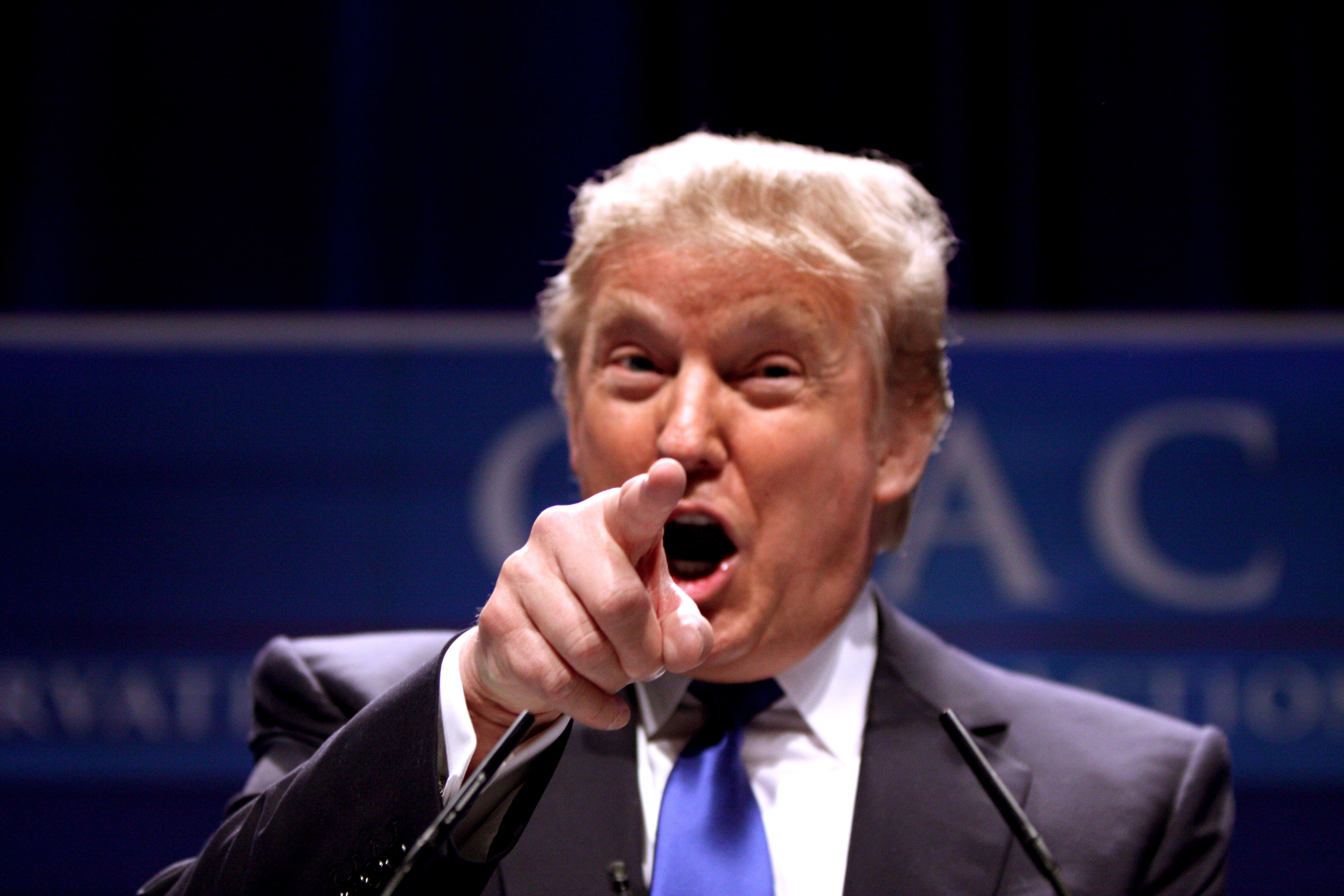
In the first 10 months of President Donald Trump’s second term, one phrase has popped up with unusual consistency in his frequent Truth Social posts: “Thank you for your attention to this matter!”
Everything about it—the tone, the phrasing, the punctuation—is at odds with our president’s typical informal rhetorical style: AI-slop about sending the US Immigration and Customs Enforcement (ICE) into Chicago, photoshopped images of Rosie O’Donnell, and childish nicknames for his political opponents. As president, he knows he has our undivided attention. Why is he thanking us?
The question of why our president is using such an odd phrase may seem unimportant; however, abrupt and unusual changes in tone and style are particularly useful for identifying the underlying implications of speech. The linguist Paul Grice theorizes that deviations from typical verbal mannerisms are a means to convey important, unspoken information.
Let’s look at Trump’s case: In the past decade, Trump has consistently used informal language in almost every setting. He is well-known for creating nicknames and rambling at rallies. The phrasing of his new verbal tic is wildly inconsistent with his typical rhetorical style. It is both highly formal and polite—the type of phrase you would expect to hear after an announcement at the train station and not from the mouth of Donald Trump.
The Gricean explanation for this verbal variation: President Trump wants to be taken seriously.
Trump first thanked us for our attention immediately after the 2024 election, a timing that suggests our president is anticipating the end of his political career. Given that Trump has historically cared deeply about opinion polling, this new catchphrase could reflect a last-ditch effort to modify his perceived image among his constituents before his final term ends. Trump was willing to walk back unpopular policies—such as repealing the Affordable Care Act (ACA) and family separation at the Southern border—after they failed to gain popular support during his first term. Now, perhaps he is walking back the informal, childish language he often employs in a similar attempt to improve his public persona.
Our Dealmaker-in-Chief may also be recognizing that he is not particularly well-liked nor respected by his peers. For instance, when Russian President Vladimir Putin flew out to Alaska in August 2025, Trump did everything in his power to present himself as a serious, legitimate head of state: He rolled out a literal red carpet and had the Air Force perform a flyover. Then Putin flew home early.
Days later, when Putin met with Chinese President Xi Jinping and North Korean leader Kim Jong-un to celebrate the anniversary of victory in World War II, nobody flew home early. Trump never received an invite; instead, he watched from afar, frantically posting on his social media.
This is not an isolated incident. Trump has consistently been mocked by European leaders, taken advantage of by authoritarians, had his tariffs flouted, and had trade cut off. Just as recently as this October, cameramen caught footage of the French President Emmanuel Macron poking fun at our president with other world leaders. On the world stage, Trump is not seen as a serious man, and this gets to him—he is constantly worried about being laughed at by his peers. His new tone could be an attempt at communicating to fellow world leaders that he deserves their respect, not their ridicule.
To say that one phrase can signify something profound about our president’s insecurities and inner desires may seem like a stretch. But Trump cares deeply about language. He has a knack for nicknames, and, in his first year in office, he renamed the Department of Defense and the Gulf of Mexico. He does not use language arbitrarily. The question is what exactly he intends to accomplish with his new phrase.
If Trump is concerned about his image and legacy, his change in behavior is a positive development in the fight against his authoritarian impulses. If Trump cares about how he is perceived and wants to be remembered as a proper, legitimate leader, then that leaves an opening for his constituents to shape the policies coming out of his White House. A man who is desperate to leave a positive legacy is a man who will cave to public pressure. So, if the phrase is directed towards the authors of our history textbooks, Trump’s susceptibility to public opinion could be a tool in resisting his quasi-authoritarian power grabs.
Yet this need for public adoration is not in and of itself a complete bulwark against fascist tendencies. A president who is determined to only be showered in praise may turn to authoritarian tools to silence dissenters rather than heed the calls of the public. Take Putin’s crusades against his critics or the state-controlled media in North Korea, for example. Rather than adapt his policy positions to better align with public opinion, Trump could simply silence the public altogether (a tactic that he has been toying with by urging the firing of Jimmy Kimmel, among others).
If this phrase indicates that our president craves the respect of his peers on the international stage, his authoritarian tendencies might only worsen. Trump has seen that the title of “President” does not inherently draw respect and admiration. In his first term, he was ridiculed by European leaders and mocked by the foreign press. This term, Trump has seen his threats to the Brazilian Supreme Court ignored, his tariffs and trade deadlines flouted, and allies abandon him for safer partners. His summit in Alaska was a disaster. His respect-seeking strategies have all largely failed.
So, it is not a stretch to imagine that Trump will turn to the people whom he respects as an example. Who does Trump see as a strong, respected, and powerful leader? The answer: The Kims, the Putins, and the Erdogans of the world. Trump sees these men as powerful because they have control: Control over their country, their citizens, and their media. They exercise power publicly and extravagantly. Other world leaders fear them and the impact they could have on their countries. As a real estate businessman raised in New York, Trump knows the power that fear and control can have. He knows that being seen as a titan in your field brings you immense respect. Who else would he model himself after but the authoritarian strongmen who do just that? He will try to become what he sees as a good leader; that version of a leader is, quite simply, authoritarian.
The most terrifying possibility is that both readings of Trump’s verbal tic point to the same conclusion: A man obsessed with being taken seriously and surrounded by authoritarians who are taken seriously will inevitably reach for authoritarian tools. When your role models are Putin, Kim, and Erdogan, “serious leadership” and “authoritarian control” become synonymous.
As his constituents, the ball is in our court. Trump is not simply giving us his gratitude with this phrase, nor is he asking for our attention. He is commanding our respect. It is on us, as Americans, to decide whether to grant it to him, and on what terms we do so. Our choices may very well decide whether we slip further into authoritarianism or emerge from this presidency as a functioning democracy.
Thank you for your attention to this matter.