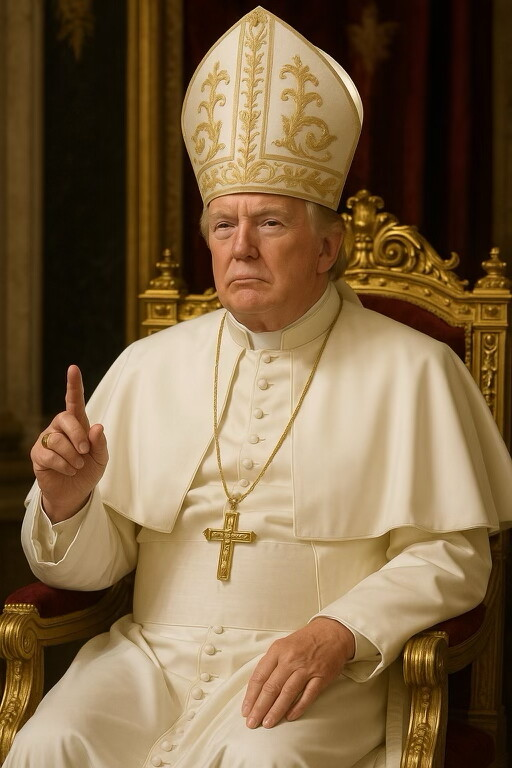
“I’d like to be Pope,” said the President of the United States of America, Donald Trump. Days later, he posted an AI-generated image of himself scowling while clothed in full papal regalia and insignia. Kristi Noem, Special Envoy for the Shield of the America, described shooting her puppy with pride in a memoir intended to advance her political career. A nineteen-year-old by the pseudonym “Big Balls” who controls multiple Russian domains was hired at the Department of Government Efficiency (DOGE) as an “expert” and currently has access to sensitive government data. When politics already feels like a joke, what is left to make fun of? In the United States, where politics increasingly converges to clownery, satire has lost its poignancy.
Satire uses humorous exaggeration to denounce flaws within a system, often through the use of vulgarity and shock. It can be a powerful tool in the hands of the disenfranchised against the ruling class, undermining and disarming their hegemonic legitimacy. In the years prior to the French Revolution, for example, political cartoons decried the excesses of the monarchy by portraining Queen Marie Antoinette as a sexually promiscuous, debaucherous woman, dubbed Austrichienne (a portemanteau between the French words for “Austrian lady” and “bitch”). Another cartoon from the time, Les Deux Ne Font Qu’un (“The Two Are But One”) displayed the king and queen as two sides of a two-headed creature: the king was combined with the body of a pig and the horns of a cuckold, alluding to the queen’s alleged infidelity, whose own decadent headdress disparaging her inordinate spending. These cartoons flipped social norms on its head, replacing reverence for the ruling class with unabashed scorn. A cartoon titled “A faut esperer q’eu se jeu la finira bentot” (“Here’s hoping this game’s over soon”) showed a noble and a clergyman riding on the back of the commoner. These images held immense power as they exposed the absurdities of the status quo and fueled angry masses toward revolution. Unlike Voltaire and Diderot’s literary jabs, satirical cartoons required low levels of literacy, easily summarizing and conveying political messaging to the public. The critiques of power and the humiliating images spread like wildfire—there was little the elites could do to stop them.
In today’s attention economy, satire has lost its punch. To be effective in criticizing the flaws of a political system, satire must be able to shock viewers into recognizing taboo ideas. Now, it is difficult for provocative content to elicit a response. Our phones have become constant sources of disjointed, senseless messages designed to provide emotional overstimulation.
A few minutes spent scrolling on the subreddit r/nottheonion—a forum dedicated to sharing real headlines so ridiculous that they could be featured on the satirical publication The Onion—demonstrates that politics has entered a realm of theatricality and absurdity beyond belief. It seems as though politicians are also competing for clicks via increasingly absurd actions. Between “RFK Jr. says he used to snort cocaine off toilet seats” and “White House alters arrest photo of ICE protester, says ‘the memes will continue’” it is understandable if the average spectator to this production becomes desensitized. When absurd headlines are normalized, effective satire is harder to create. There is little room left for surprise.
Moreover, generative AI creates endless streams of content changing our tastes to favor constant unintelligible overstimulation rather than poignant criticism. Algorithms have fundamentally changed the ways in which people produce and consume content: Their unpredictability incentivizes creators to produce mass amounts of lower quality content through AI. Why spend hours carefully hand-drawing a caricature of JD Vance when an AI-generated image created in seconds could perform just as well, if not better? As a result, popular content has shifted towards meaningless jokes and memes—otherwise known as “AI slop” and “brain rot.” This content shapes our taste in humor: Our brains no longer look for storytelling that requires critical thinking. In response to these changing tastes, headlines on The Onion have gone from sharp to wholly absurd: “Human Arm Hanging Limply Out Of Food Delivery Robot.” Instead of transgressing established norms and sensibilities to challenge an unjust system, this satire in the attention economy pursues comedic shock value through disorientation. Satire has lost one of its two key ingredients: the ability to transgress social norms. We live in a world where politics are exaggerated to the point where it is difficult to distinguish between real headlines, misinformation, and jokes.
The other key ingredient to satire is politicization, which too has been lost. Research shows that viewers of late-night television and political comedy may not be processing the message politically. Rather, they process it strictly as comedic entertainment: They discount the joke’s message. Satire cannot cause the political outrage so inherent to its design if people are tossing it alongside Friends and Family Feud in their intellectual stimulation. Satire therefore no longer hinges on political opinion: unflattering AI-generated images of JD Vance make the right laugh as much as the left, with little more justification than “They’re just funny.”
Decline in Saturday Night Live viewership and popularity is not inherently alarming—it could be perceived as a simple evolution of the times. After all, during the French revolution, the literate population read books painstakingly printed on wooden presses, whereas many today can simply take their phone out of their back pocket and click the Kindle app. Yet, it is not a secret that literacy has widely expanded. Why is the same not true of satire? The comparison to the expansion of literacy is misleading: books have not fundamentally changed in nature, while satire has lost its defining property.
What started as poignant exaggerations of the political status quo are now real headlines. Meanwhile, salient jokes against specific institutions, figures, and behaviors have been displaced by overwhelming streams of nonsensical AI-generated images. When satire dies, ordinary Americans lose a powerful political tool. When the Americans for whom laughing to Saturday Night Live was a decades-long tradition turn off the TV and open social media, critical thinking skills atrophy. Popular resistance is disarmed. Disconnected and out-of-touch elites win.